Why does the mature female *D. crocata* reaching up to 15 mm offer an advantage when confronting prey?
Answer
The bulk provides leverage and reach necessary to subdue armored prey
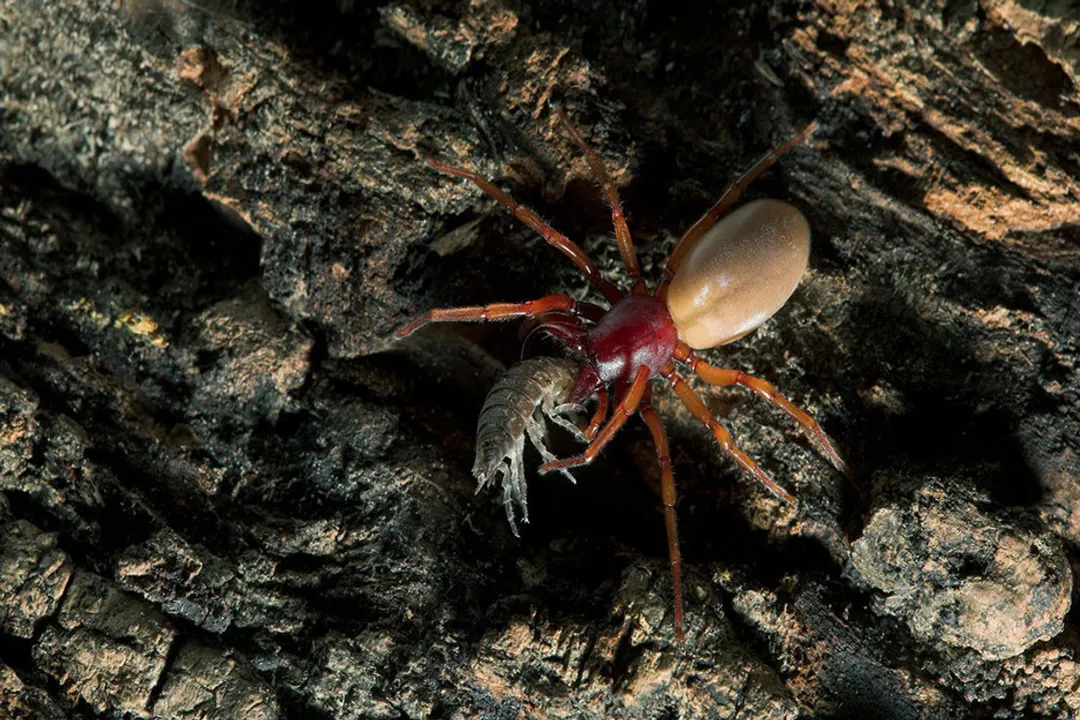
The relatively substantial size achieved by mature females, up to 15 mm in body length, is advantageous in their specialized predatory role. Subduing a pill bug, which can instantly roll into an impenetrable defensive sphere, requires significant physical power and maneuverability. A larger spider possesses the necessary leverage and reach to effectively navigate the prey's defensive posture, ensuring it can maneuver into a position to deliver a decisive bite. This size characteristic likely developed under selective pressure favoring individuals capable of reliably overcoming the physical defense mechanisms of their armored food source.
Related Questions
What is the defining feature of *Dysdera crocata*'s chelicerae orientation for consuming isopods?To which ancient lineage group does the Dysderidae family belong within the Araneomorphae suborder?What is the primary function of the silk produced by *D. crocata*?What are the primary prey items that drove the evolutionary specialization of the woodlouse spider?What factor strongly dictates the required microclimate where *D. crocata* populations thrive?How does the coloration of *D. crocata* relate to its nocturnal hunting and hiding strategy?Which sense is *not* considered the primary input for hunting by the woodlouse spider?How did *D. crocata* achieve its circumglobal distribution in temperate regions outside its native area?Why does the mature female *D. crocata* reaching up to 15 mm offer an advantage when confronting prey?What is the key evolutionary contrast between *D. crocata*'s feeding strategy and that of generalist spiders?