To which ancient lineage group does the Dysderidae family belong within the Araneomorphae suborder?
Answer
The Haplogynae group
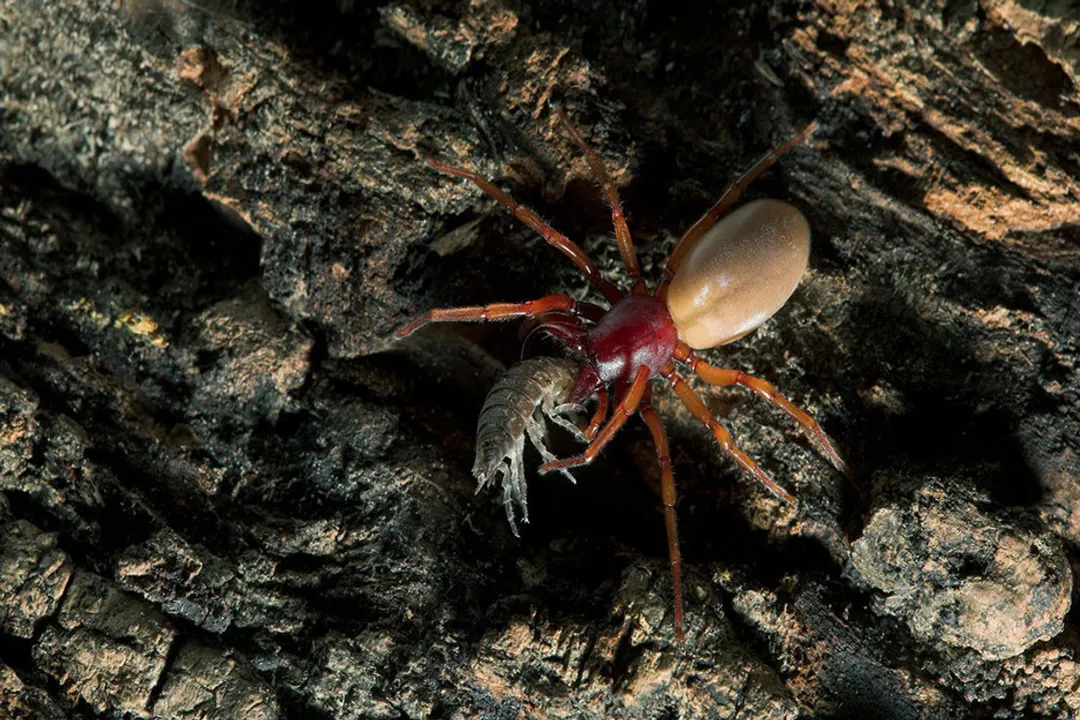
The family Dysderidae, to which *D. crocata* belongs, is positioned within the Haplogynae group inside the suborder Araneomorphae. This placement signifies that the lineage is considered older and more basal compared to the Entelegynae, a group containing many more recently diversified spider families, such as the common orb-weavers (Araneidae). Being part of the Haplogynae suggests that the specialized traits of the woodlouse spider, like its powerful jaws, are deep-seated evolutionary features retained over a significant span of spider history, rather than recent developments.
Related Questions
What is the defining feature of *Dysdera crocata*'s chelicerae orientation for consuming isopods?To which ancient lineage group does the Dysderidae family belong within the Araneomorphae suborder?What is the primary function of the silk produced by *D. crocata*?What are the primary prey items that drove the evolutionary specialization of the woodlouse spider?What factor strongly dictates the required microclimate where *D. crocata* populations thrive?How does the coloration of *D. crocata* relate to its nocturnal hunting and hiding strategy?Which sense is *not* considered the primary input for hunting by the woodlouse spider?How did *D. crocata* achieve its circumglobal distribution in temperate regions outside its native area?Why does the mature female *D. crocata* reaching up to 15 mm offer an advantage when confronting prey?What is the key evolutionary contrast between *D. crocata*'s feeding strategy and that of generalist spiders?