What factor strongly dictates the required microclimate where *D. crocata* populations thrive?
Answer
The high humidity required by its isopod food source
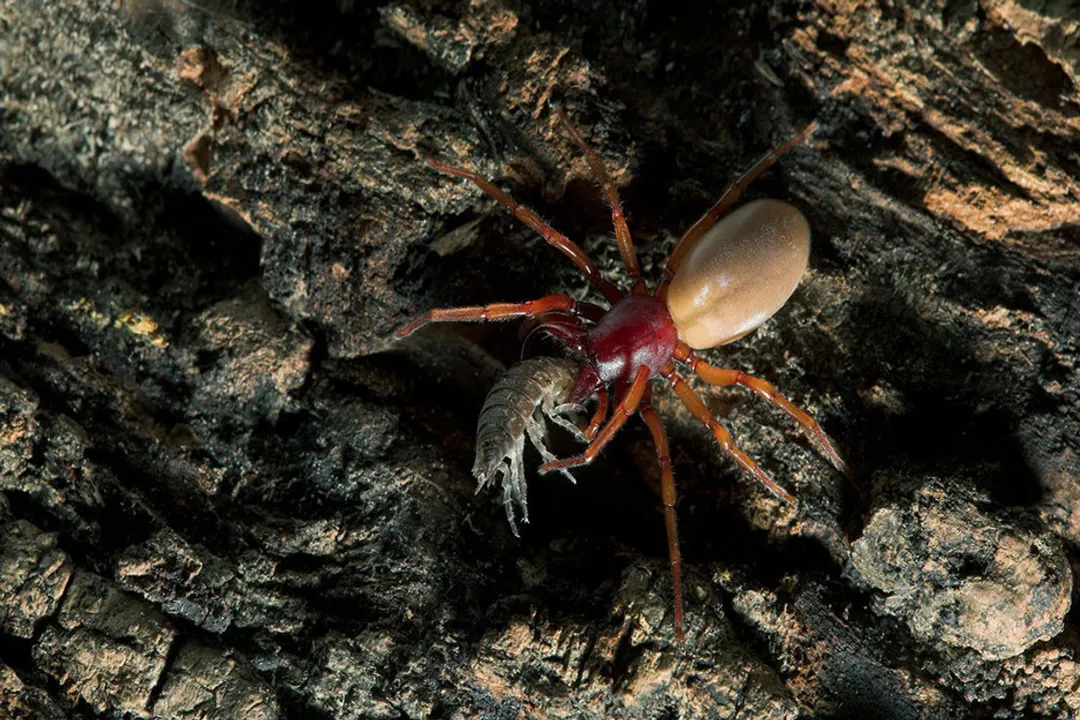
The behavioral ecology and habitat selection of the woodlouse spider are entirely dictated by the environmental requirements of its specialized prey, the woodlouse. Since isopods are terrestrial crustaceans that require high humidity to breathe and move effectively, they are found in damp, dark locations like under logs or leaf litter. Consequently, *D. crocata* must also inhabit these same high-moisture microhabitats to remain close to its food supply. This tight ecological coupling means the predator's physiological need to avoid desiccation is managed indirectly by strictly following the moisture needs of its specific, armored prey.
Related Questions
What is the defining feature of *Dysdera crocata*'s chelicerae orientation for consuming isopods?To which ancient lineage group does the Dysderidae family belong within the Araneomorphae suborder?What is the primary function of the silk produced by *D. crocata*?What are the primary prey items that drove the evolutionary specialization of the woodlouse spider?What factor strongly dictates the required microclimate where *D. crocata* populations thrive?How does the coloration of *D. crocata* relate to its nocturnal hunting and hiding strategy?Which sense is *not* considered the primary input for hunting by the woodlouse spider?How did *D. crocata* achieve its circumglobal distribution in temperate regions outside its native area?Why does the mature female *D. crocata* reaching up to 15 mm offer an advantage when confronting prey?What is the key evolutionary contrast between *D. crocata*'s feeding strategy and that of generalist spiders?