How does the coloration of *D. crocata* relate to its nocturnal hunting and hiding strategy?
Answer
Uniform reddish-brown or orange provides camouflage in soil and litter
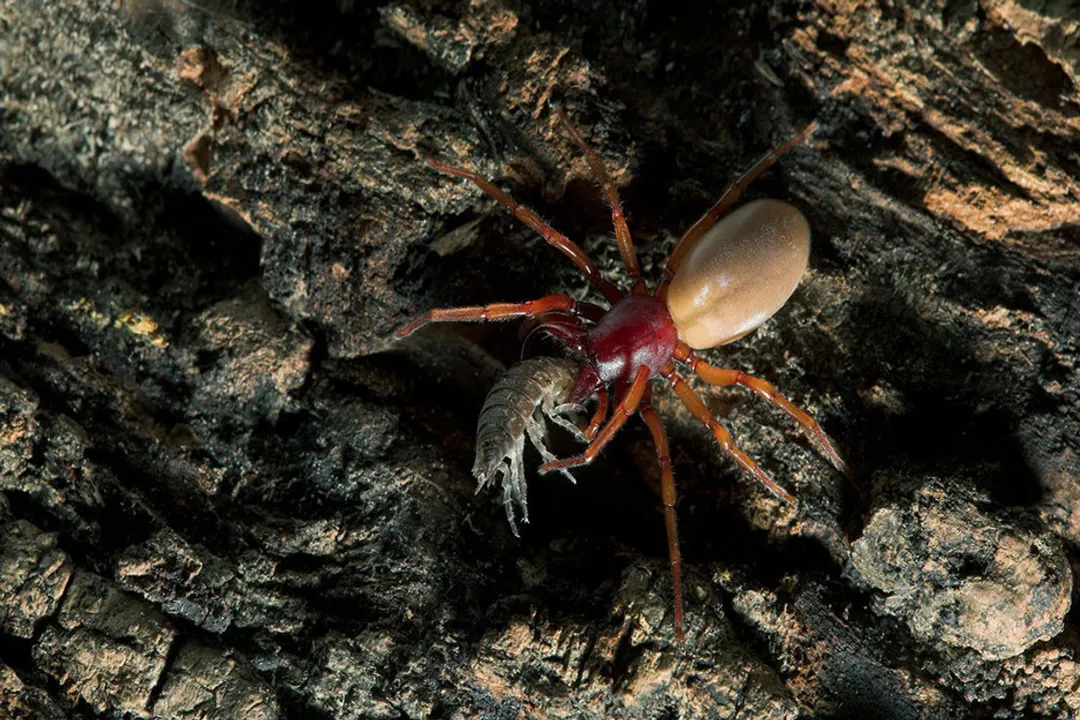
*Dysdera crocata* typically displays a uniform coloration, ranging from reddish-brown to orange, which is a crucial adaptation for its lifestyle. Since this spider is overwhelmingly nocturnal and hides in dark environments such as leaf litter or soil-rich areas during the day, this muted, consistent coloration provides effective camouflage against these substrates. This adaptation is less about complex visual signaling or attracting mates visually, and more about evading detection by diurnal predators, like birds, while resting or moving between hiding spots.
Related Questions
What is the defining feature of *Dysdera crocata*'s chelicerae orientation for consuming isopods?To which ancient lineage group does the Dysderidae family belong within the Araneomorphae suborder?What is the primary function of the silk produced by *D. crocata*?What are the primary prey items that drove the evolutionary specialization of the woodlouse spider?What factor strongly dictates the required microclimate where *D. crocata* populations thrive?How does the coloration of *D. crocata* relate to its nocturnal hunting and hiding strategy?Which sense is *not* considered the primary input for hunting by the woodlouse spider?How did *D. crocata* achieve its circumglobal distribution in temperate regions outside its native area?Why does the mature female *D. crocata* reaching up to 15 mm offer an advantage when confronting prey?What is the key evolutionary contrast between *D. crocata*'s feeding strategy and that of generalist spiders?