Woodlouse Spider Evolution
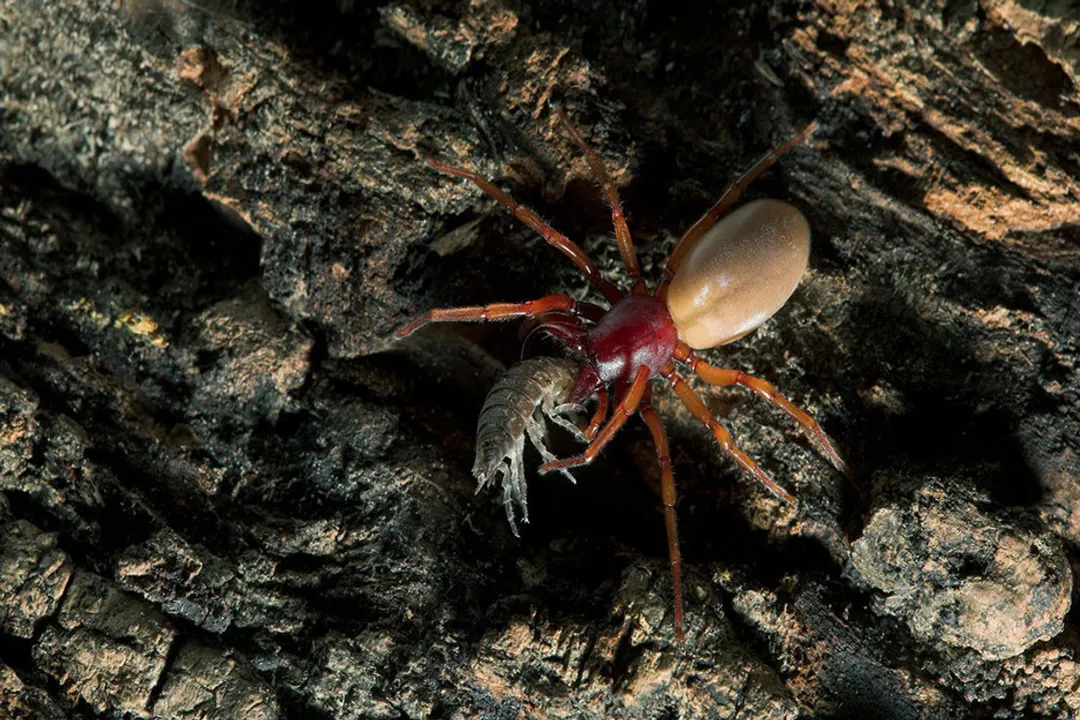
The woodlouse spider, scientifically known as Dysdera crocata, is a creature immediately recognizable by its striking, almost unnerving, appearance, featuring a reddish-orange cephalothorax and abdomen, and disproportionately large chelicerae. [1][5] While many people recoil upon seeing one, perhaps mistaking it for a dangerous intruder, understanding its unique biology provides a window into a highly successful, albeit specialized, evolutionary path within the vast world of spiders. [3] It is not a cobweb weaver of the common sort; rather, it is a hunter whose entire morphology and behavior seem honed for a very specific purpose: consuming pill bugs and sowbugs. [1][2] This specialization is a testament to evolutionary pressures shaping form to fit function over time. [7]
The spider's presence across various continents suggests a history involving successful global dispersal, perhaps aided by human activity, establishing it firmly within numerous ecosystems. [8][5] However, its story in any given location is one of adaptation to dark, moist environments, reflecting an ancient lineage prioritizing concealment and nocturnal predation over bright, complex web construction. [10]
# Taxonomic Placement
To appreciate the evolutionary trajectory of D. crocata, one must first place it within the broader spider family tree. Spiders belong to the order Araneae, and the woodlouse spider falls under the family Dysderidae. [1][9] This places it within the suborder Araneomorphae, which contains the majority of modern spiders. [1] However, within Araneomorphae, the Dysderidae are often considered to be part of the Haplogynae group, which represents an older, more basal lineage compared to the Entelegynae, where familiar families like orb-weavers (Araneidae) reside. [9]
This placement is significant. A relative position closer to the base of the major spider radiation suggests that the Dysderidae lineage branched off earlier in spider evolutionary history. [9] This means their specialized traits—like the powerful jaws—are not recent novelties but rather deep-seated features retained and refined over millions of years of evolutionary separation from other common spider groups. [7] The evolution of the Dysderidae, therefore, represents a persistent, successful adaptation of an ancient spider stock to specific ecological roles, rather than a rapid diversification into many forms like some newer families. [9]
# Specialized Hunting
The defining feature of the woodlouse spider's evolutionary success is its diet. As its common name suggests, its primary prey consists of terrestrial isopods—the familiar woodlice, pill bugs, or sowbugs. [1][2] These prey items are notoriously difficult targets for many predators because they possess tough, segmented exoskeletons, providing substantial physical defense. [2] Many spiders would struggle to penetrate this armor.
The woodlouse spider, however, has evolved what can only be described as the perfect tool for the job: massive, elongated chelicerae (fangs) that are oriented parallel to the body axis. [1] These fangs are significantly larger relative to the spider's body size than those of many other spiders, giving them a formidable grip and piercing power. [2] This extreme morphological specialization for a narrow prey base is a classic example of evolutionary adaptation to a specific resource. [7] While many spiders evolved to cast wide nets or use complex venom cocktails against diverse insects, D. crocata put its evolutionary "effort" into overcoming the defenses of one specific, abundant group found in damp environments. [2]
If we were to chart the evolutionary pressures, the presence of tough isopod populations in humid microhabitats likely selected for individuals with slightly stronger or longer fangs. Over deep time, this created a positive feedback loop: better fangs led to more successful hunting of the heavily armored isopods, leading to reproductive success for those individuals, thus driving the trait further into the population. [6] This contrasts sharply with generalist spiders whose traits must remain flexible enough to handle flies, beetles, and moths alike. [9]
# Physical Traits
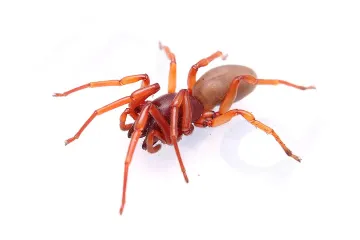
Beyond the fangs, the spider's coloration is also linked to its lifestyle, which is dictated by its evolutionary history. D. crocata is typically a uniform reddish-brown or orange, lacking the complex patterns found on many web-building species. [1][5] This coloration offers effective camouflage in the dark, leaf-littered, or soil-rich environments where they hunt and hide. [5][10] Their activity is overwhelmingly nocturnal, meaning their coloration is less about attracting mates visually and more about evading detection from diurnal predators like birds, or even larger nocturnal predators. [1]
Their eyes are simple, usually arranged in a compact group, indicating that vision is not their primary sense for hunting—a common trait among spiders that rely on vibration or touch for prey detection. [1] Their silk is used for lining retreats or creating egg sacs, not for catching prey in the air. [1] This difference in silk use versus orb-weavers highlights a divergence in lifestyle that occurred early in their evolutionary separation from those groups.
Consider the comparative size. A mature female can reach up to 15 mm in body length, substantial for a ground-dwelling spider. [1] This larger size might be an advantage in wrestling armored prey, a required attribute selected for by the inherent danger involved in subduing a pill bug that can roll into an impenetrable ball. [2] For instance, when encountering a very large woodlouse, a smaller spider might be unable to secure a reliable bite location, whereas the bulkier D. crocata has the leverage and reach to maneuver around the defensive posture. [3]
# Global Range
The present-day distribution of the woodlouse spider is circumglobal in temperate regions, with a native range believed to be in Europe and the Mediterranean region. [8][1] Its presence in places like North America, Australia, and New Zealand is the result of introduction, most likely via shipping or trade where woodlice (often hitchhikers themselves) were transported in cargo or soil. [5][8] This ability to survive transport and establish a viable population in a new environment speaks to its hardiness—an evolutionary trait that ensures survival even outside its native, ideal habitat. [1]
In many introduced areas, the woodlouse spider has thrived without native competitors or specialized predators, allowing its population to grow and become a common fixture in gardens and basements. [2] Its success in colonization mirrors that of many invasive species, but because its niche is relatively narrow (isopods), it hasn't typically displaced the generalist native spider fauna to the same extent as a generalist invader might. Its evolutionary packaging makes it an excellent traveler but a poor generalist once it arrives.
| Trait Category | Woodlouse Spider (D. crocata) | Generalist Orb-Weaver (e.g., Araneus) | Evolutionary Implication |
|---|---|---|---|
| Hunting Method | Active nocturnal hunter, ambush | Passive aerial web capture | Divergence in hunting strategy and silk evolution [1] |
| Primary Prey | Isopods (Armored) | Flying insects (Soft-bodied) | Specialization vs. Generalization in feeding niche [7] |
| Chelicerae Size | Very large, parallel, powerful | Medium, angled, designed for quick injection | Morphological specialization for prey defense [2] |
| Coloration | Uniform reddish-orange | Often patterned/cryptic against foliage | Adaptation to substrate (leaf litter/soil) vs. vegetation |
The persistence of this distinct lineage for hunting woodlice suggests that the ecological niche provided by isopods has been consistently rich enough across geological time to prevent the selective pressure for diversification away from this specialized diet in this particular family. [9]

# Behavioral Ecology
The behavior of D. forcata is intrinsically linked to its evolutionary adaptations. They are predominantly found in damp, dark locations, such as under stones, logs, leaf litter, or inside human dwellings like basements or garages. [1][5] This habitat choice is directly related to the preferred environment of their main food source, the woodlouse, which requires high humidity to breathe and move effectively. [2] A spider that evolved to hunt prey dependent on high moisture content must, in turn, evolve physiological or behavioral mechanisms to prevent its own desiccation—a critical boundary condition for terrestrial arthropods. [10]
Furthermore, the silk they produce is used primarily for creating a protective tube-like retreat rather than an aerial trap. [1] This behavior fits perfectly with an active nocturnal hunter that needs a safe, dark place to rest during the day, protected from sunlight and diurnal predators. It's an evolutionary trade-off: sacrificing the energy investment in building a complex, ephemeral web for the security of a permanent, well-defended home base close to foraging grounds. [5]
When disturbed during the day, a D. crocata will typically flee into the nearest dark crevice, rather than displaying an aggressive posture unless directly handled or cornered. [3] This reluctance to engage in confrontation unless absolutely necessary suggests that, despite their intimidating fangs, energy conservation and avoiding unnecessary risk when not actively hunting are paramount to their survival strategy. An injury sustained fighting a prey item could be fatal if it prevents future hunting, reinforcing selection against overly risky engagement styles when safety is an option. [2]
In considering local conditions where they are abundant, one might notice that the density of D. crocata seems to peak where soil moisture retention is high—think under old paving slabs or thick moss patches near a foundation wall. This observational link between high humidity zones and spider presence is a direct, visible manifestation of co-evolution with their isopod prey, demonstrating that the microclimate requirements of the predator are dictated entirely by the microclimate requirements of its specialized food source. [5] This tight coupling prevents them from successfully colonizing very dry, exposed areas, regardless of whether woodlice are present there.
Ultimately, the woodlouse spider’s story is not one of explosive, recent evolutionary change, but one of deep-seated, persistent specialization. Its large jaws, nocturnal habits, and specific habitat preferences all point back to a successful ancestral lineage that found and mastered the niche of armored subterranean prey. The continued success of Dysdera crocata worldwide confirms that, in evolution, sometimes being extremely good at one thing is far better than being mediocre at many.
The scientific community continues to map the precise relationships within the Dysderidae, using molecular data to refine the evolutionary tree and better understand when and how these unique predatory features arose relative to other spider families. [9][7] These studies provide the fine detail to the broad picture sketched out by morphology and behavior, confirming that the woodlouse hunter represents a remarkably well-adapted branch on the vast tree of life.[6]
Related Questions
#Citations
Woodlouse spider - Wikipedia
Woodlouse Hunter Spider - Penn State Extension
Woodlouse Spider - Veseris
From an evolutionary point of view, why has the woodlouse got ...
Woodlouse Spider (Dysdera crocata) - Woodland Trust
Evolutionary insights into the eco-phenotypic diversification of ...
Integrative taxonomy and evolutionary history of a newly revealed ...
Woodlouse Spider (Dysdera crocata) - iNaturalist
Integrative taxonomic revision of the woodlouse-hunter spider genus ...
365 Urban Species. #098: Woodlouse Spider - LiveJournal