Which sense is *not* considered the primary input for hunting by the woodlouse spider?
Answer
Vision
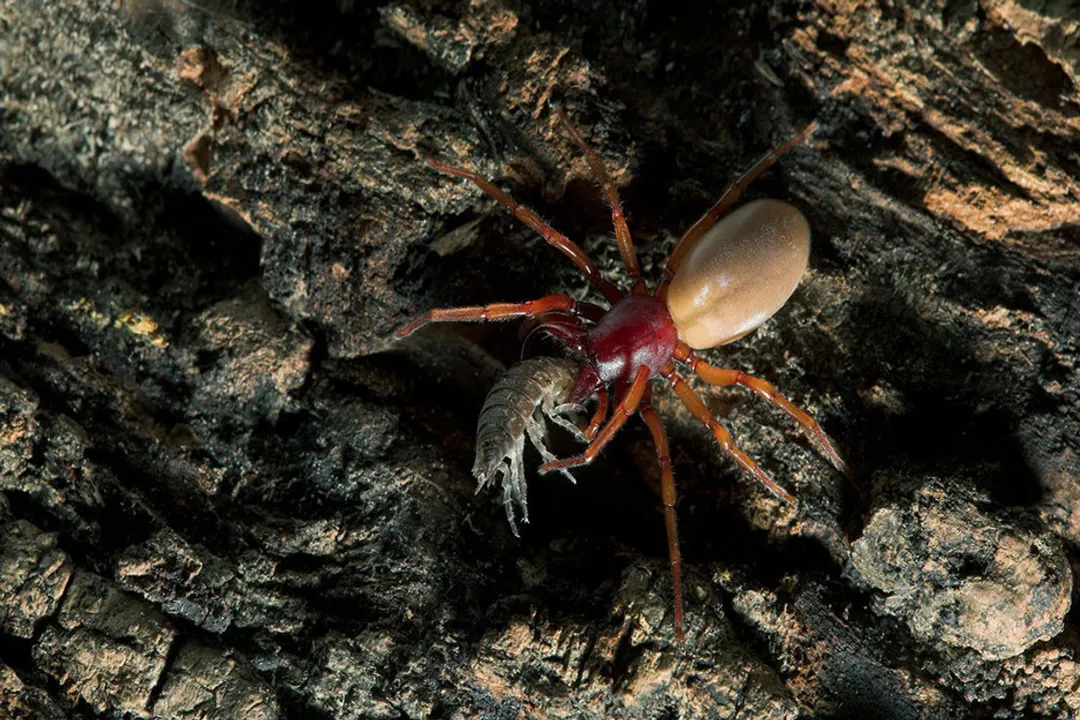
The eyes of the woodlouse spider are described as simple and typically arranged in a compact group. This morphology indicates that vision is not the spider's principal sense relied upon for locating and capturing prey. Instead, like many ground-dwelling, nocturnal hunters, *D. crocata* relies more heavily on cues derived from touch (vibration or substrate movement) to detect the presence and movement of the heavily armored isopods in dark conditions. This sensory profile confirms its divergence from highly visual hunters.
Related Questions
What is the defining feature of *Dysdera crocata*'s chelicerae orientation for consuming isopods?To which ancient lineage group does the Dysderidae family belong within the Araneomorphae suborder?What is the primary function of the silk produced by *D. crocata*?What are the primary prey items that drove the evolutionary specialization of the woodlouse spider?What factor strongly dictates the required microclimate where *D. crocata* populations thrive?How does the coloration of *D. crocata* relate to its nocturnal hunting and hiding strategy?Which sense is *not* considered the primary input for hunting by the woodlouse spider?How did *D. crocata* achieve its circumglobal distribution in temperate regions outside its native area?Why does the mature female *D. crocata* reaching up to 15 mm offer an advantage when confronting prey?What is the key evolutionary contrast between *D. crocata*'s feeding strategy and that of generalist spiders?