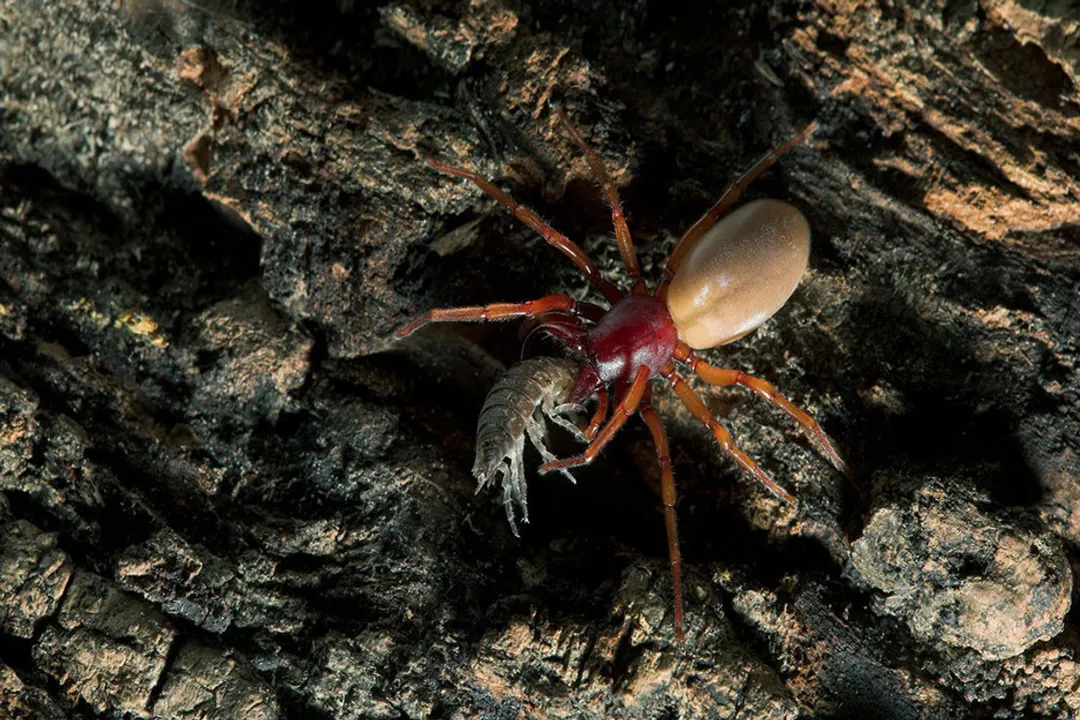
What is the key evolutionary contrast between *D. crocata*'s feeding strategy and that of generalist spiders?
*D. crocata* focused evolutionary effort on overcoming one specific resource defense, unlike generalists needing flexible traits
The woodlouse spider exemplifies evolutionary adaptation to a specific resource by concentrating its morphological development—specifically the chelicerae—on defeating the tough armor of isopods. This contrasts with generalist spiders whose evolutionary pressures favor flexibility; they must maintain traits capable of handling diverse prey like flies, beetles, and moths. The specialized spider creates a positive feedback loop favoring better fangs for isopod hunting, while the generalist must maintain traits that remain moderately effective across a wide spectrum of prey types, sacrificing extreme specialization for broad utility.