What are the primary prey items that drove the evolutionary specialization of the woodlouse spider?
Answer
Terrestrial isopods (pill bugs or sowbugs)
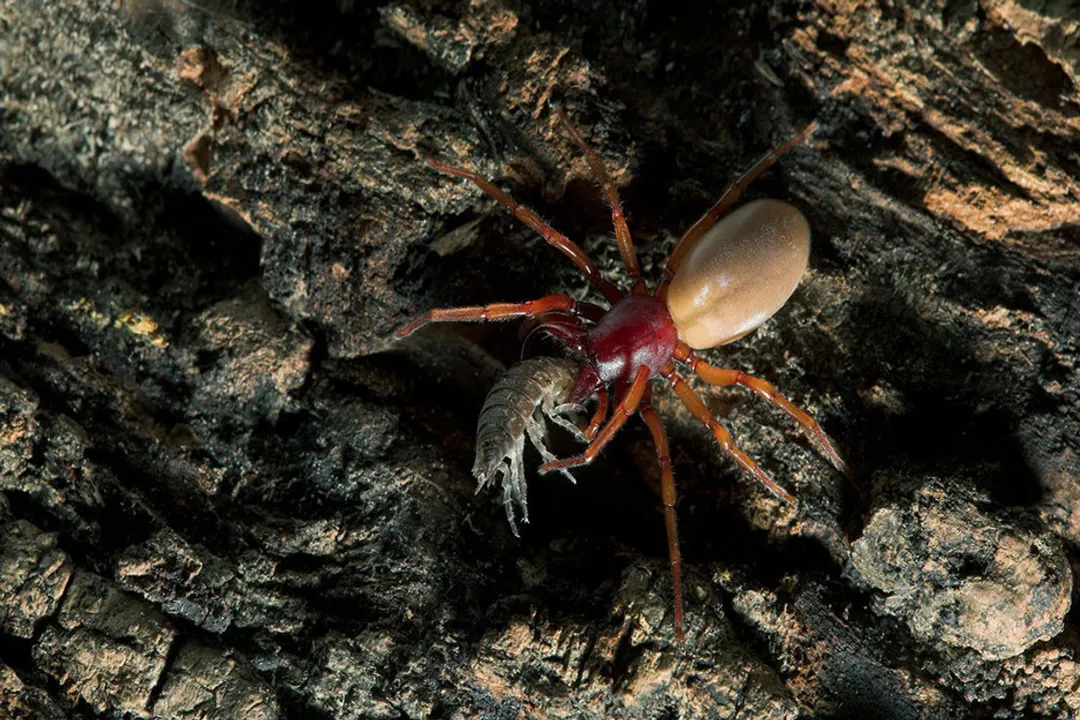
The defining evolutionary success of *Dysdera crocata* is intrinsically linked to its diet, which centers almost exclusively on terrestrial isopods, commonly known as woodlice, pill bugs, or sowbugs. These prey items are difficult for many predators to handle because they possess tough, segmented exoskeletons that function as substantial physical armor. The spider's entire morphology, particularly its massive chelicerae, evolved specifically to overcome this defense, representing a classic case of evolutionary adaptation focusing on exploiting a specific, highly protected resource abundant in damp environments.
Related Questions
What is the defining feature of *Dysdera crocata*'s chelicerae orientation for consuming isopods?To which ancient lineage group does the Dysderidae family belong within the Araneomorphae suborder?What is the primary function of the silk produced by *D. crocata*?What are the primary prey items that drove the evolutionary specialization of the woodlouse spider?What factor strongly dictates the required microclimate where *D. crocata* populations thrive?How does the coloration of *D. crocata* relate to its nocturnal hunting and hiding strategy?Which sense is *not* considered the primary input for hunting by the woodlouse spider?How did *D. crocata* achieve its circumglobal distribution in temperate regions outside its native area?Why does the mature female *D. crocata* reaching up to 15 mm offer an advantage when confronting prey?What is the key evolutionary contrast between *D. crocata*'s feeding strategy and that of generalist spiders?