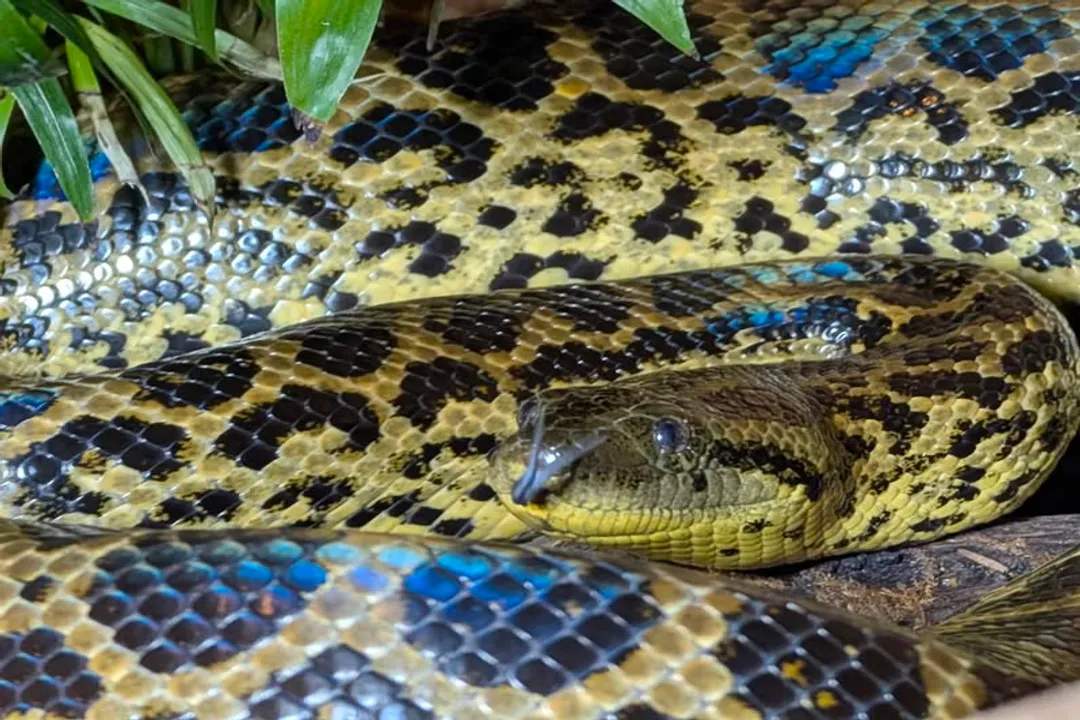
Where are the eyes and nostrils of *E. notaeus* positioned for an aquatic lifestyle?
Answer
On the top of the head
A classic and vital morphological adaptation shared by anacondas and other aquatic snakes involves the placement of key sensory organs. For *E. notaeus*, both the eyes and the nostrils are positioned on the dorsal surface, or the top, of the head. This specialized arrangement allows the snake to maintain almost complete submersion beneath the water's surface—providing concealment and buoyancy control—while still being able to breathe air and effectively observe its surroundings for both prey location and threat detection. This feature underscores the intense selective pressure favoring a highly aquatic existence over terrestrial movement.
Related Questions
Approximately how long ago did the Eunectes genus split from pythons and other boas?What is the characteristic base coloration of the yellow anaconda, *Eunectes notaeus*?Which massive South American wetland system is the primary habitat for *Eunectes notaeus*?Where are the eyes and nostrils of *E. notaeus* positioned for an aquatic lifestyle?Compared to *Eunectes murinus*, what is generally true about the maximum size of *E. notaeus*?What specific locomotion pattern do newborn yellow anacondas exhibit when escaping immediate threats?How recent is the divergence among the four recognized species within the *Eunectes* genus?The presence of *E. notaeus* is strongly tied to the drainage basins of which two major South American rivers?Despite local pressures, what is the current global conservation listing for *Eunectes notaeus*?What characteristic defines the biomechanics of the S-start escape motion in neonates?