Yellow Anaconda Evolution
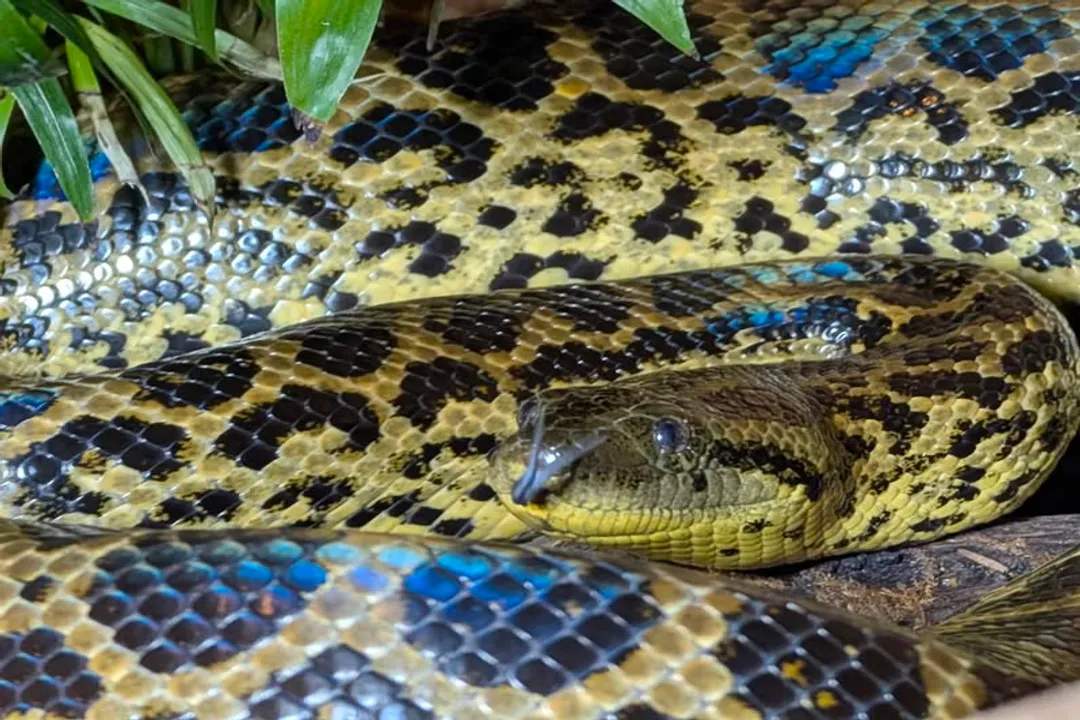
The yellow anaconda, Eunectes notaeus, is a compelling subject within the world of giant constrictors, often overshadowed by its larger, greener cousin, yet possessing a fascinating evolutionary narrative rooted deeply in South American waterways. [1][7][9] This species is recognized by its lighter coloration compared to the common green anaconda, typically featuring a bright yellow to yellowish-brown base color adorned with dark, rounded blotches running down its back. [1][9] While sharing the genus Eunectes with the green anaconda and the recently described Eunectes beniensis and Eunectes deschauenseei, the evolutionary path of the yellow anaconda offers a distinct glimpse into how specialized environments drive species divergence within a lineage of apex predators. [3] Understanding its place requires looking back across geological timescales to see when this group first separated from other boas and pythons, and then examining the much more recent splits that defined the four modern species we see today. [3]
# Ancient Split

The lineage that gave rise to the anacondas represents a significant chapter in serpentine history. Researchers have estimated that the split between the Eunectes genus and other major snake groups, such as pythons and other boas, occurred approximately 12 million years ago (MYA). [3] This deep evolutionary separation established the fundamental body plan and ecological niche that anacondas would go on to exploit: that of a massive, aquatic ambush predator relying on constriction. [3] This ancient divergence suggests that the ancestors of the yellow anaconda were already evolving specialized traits for a semi-aquatic existence long before the specific geography of the modern Pantanal or the Paraguay River basin fully crystallized. [2][3]
# Recent Diversification

While the initial separation from other snakes happened millions of years in the past, the fine-tuning that resulted in the distinct species we recognize today—including E. notaeus—is comparatively recent. [3] The four recognized species within the Eunectes genus diverged from one another more recently, potentially within the last few million years. [3] This tight grouping of closely related, yet geographically or ecologically distinct, giant snakes provides an excellent natural laboratory for studying speciation driven by habitat differentiation. [3] The yellow anaconda primarily occupies the floodplains and swamps of the central and southern parts of South America, specifically the drainage basins of the Paraguay and Paraná rivers, spanning areas like Bolivia, Brazil, Paraguay, and northern Argentina. [1][2][8] This specific geographic isolation likely played a key role in solidifying the traits that differentiate it from its relatives, such as the green anaconda (E. murinus), which is generally found further north. [1]
# Aquatic Forms

The physical structure of the yellow anaconda reflects intense selective pressure for an aquatic lifestyle. [2] Like all anacondas, E. notaeus is non-venomous and relies on powerful constriction after an ambush attack. [9] Their coloration, while lighter yellow than the darker green species, still offers excellent camouflage among the submerged vegetation, muddy bottoms, and shaded waters of the Pantanal wetlands. [1][2] Furthermore, their eyes and nostrils are positioned on the top of the head, a classic adaptation in aquatic snakes that allows them to remain almost entirely submerged while still being able to breathe and observe their surroundings. [2] This morphological specialization for water life is a shared hallmark of the genus, molded over millennia of adaptation to environments where terrestrial movement is secondary to swimming and submerged waiting. [2][9]
A point of interest when comparing the yellow anaconda to its famous cousin, the green anaconda, is size disparity. [1] While both are giants, E. notaeus is generally smaller, often reaching lengths of up to 13 to 15 feet, whereas E. murinus is capable of exceeding 20 feet. [1][9] This difference in maximum size suggests that the evolutionary pressures in the specific ecological niches occupied by E. notaeus—perhaps smaller prey bases or different vegetation densities in the Paraguay basin versus the Amazon—favor a slightly less massive build for successful hunting and maneuvering. [1] This difference hints at differing selective regimes acting on growth rates and ultimate body mass between the species since their divergence. [3]
# Escape Motion
The survival strategies of anacondas, particularly the young, reveal intricate evolutionary pressures related to threat detection and immediate response in their environment. Newborn yellow anacondas exhibit a highly specialized mode of locomotion when escaping immediate threats, often described as an "S-start" motion. [5] This is distinct from the typical serpentine motion used for general swimming or crawling. [5][10] Researchers modeling this motion found that the S-start involves a rapid, non-reciprocal bending of the body upon initial contact with the substrate or water, allowing for an explosive, rapid escape that is mechanically unique. [5]
This particular burst of speed is likely vital for neonates who are much more vulnerable to predation than adults. [5] The efficiency of this escape mechanism, which involves maximizing the initial acceleration using body posture, suggests strong selection pressure for rapid evasive action immediately following a perceived threat. [5] The biomechanics involved in this rapid directional change provide a snapshot of evolutionary fine-tuning—a life-or-death mechanism honed over generations within a dynamic, predator-filled aquatic setting. [10] Comparative studies on locomotion across the Eunectes genus, which look at how movement differs between aquatic and terrestrial phases, help flesh out how these snakes have adapted their movement repertoire to master their complex wetland habitats. [10]
# Habitat Range
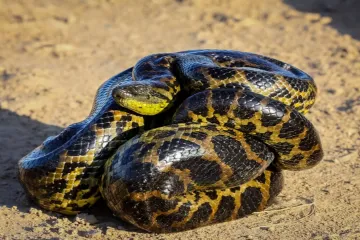
The current distribution of the yellow anaconda is tightly bound to specific hydrological systems in South America, systems that have likely shaped its evolutionary trajectory. [1][2] The species thrives in the vast, seasonally flooded grasslands of the Pantanal, which covers parts of Brazil, Bolivia, and Paraguay. [1][2] Its presence is strongly tied to the tributaries and wetlands of the Paraguay River system. [1][8] This environment experiences dramatic shifts between flood and drought, meaning the snake must be adept at both fully aquatic life and surviving periods of reduced water availability, perhaps by burrowing or seeking deeper pools. [2]
Considering the geographical separation, it is interesting to note that while habitat loss is a recognized threat, E. notaeus is currently listed as Least Concern on a global scale, although local populations face pressure. [1] The evolutionary success of this species seems intrinsically linked to the successful exploitation of these massive, interconnected wetland systems, which historically provided ample prey and cover. [2] The resilience of the species is partially dependent on the stability of these huge tracts of wild, fluctuating water landscapes. [1]
To better appreciate how the physical form supports the lifestyle, one might consider the musculature required for the S-start versus sustained swimming. While the sources detail the mechanical efficiency of the initial burst, [5] the underlying physiology must support both powerful, slow-moving ambush constriction and explosive, short-distance escape maneuvers. This dual requirement for power and sudden speed necessitates a highly specialized muscle distribution across the body, differentiating its energy expenditure profile significantly from strictly terrestrial or purely pelagic snakes. This balance of brute strength for prey capture and explosive agility for predator evasion highlights an evolutionary compromise perfectly suited to its fluctuating wetland niche.
Furthermore, the research into the neonatal escape pattern offers an angle on behavioral evolution that bypasses morphology. The fact that researchers can model this unique escape strategy based on physics suggests that this behavior is highly canalized—strongly determined genetically—rather than being learned. [5] This implies that the mechanical pathways for rapid, non-reciprocal motion have been deeply ingrained in the Eunectes genome through natural selection, favoring offspring that can execute this escape flawlessly from the moment of birth, providing an inherited survival advantage in an exposed state. [5] This genetic predisposition toward a specialized escape action is a powerful indicator of consistent, long-term evolutionary pressure within their specific habitat.
The convergence of these factors—a deep split from other snakes 12 million years ago, a more recent family divergence, specialization for an aquatic niche demonstrated by morphology, and the inheritance of specific, high-stakes escape behaviors—paints a picture of an animal whose evolution has been consistently guided by the specific challenges and opportunities presented by the South American wetlands. [3] The yellow anaconda is not just a smaller relative; it is a testament to how environmental niches refine a successful body plan into unique species over millions of years. [1][3]
Related Questions
#Citations
Yellow anaconda - Wikipedia
Eunectes notaeus (Yellow Anaconda) - Animal Diversity Web
Fossils reveal anacondas have been giants for over 12 million years
The yellow anaconda growth from November to July : r/snakes - Reddit
Population Structure and Gene Flow of the Yellow Anaconda ...
Researchers model the unique S-start motion that newborn yellow ...
The Yellow Anaconda (Eunectes notaeus) is a fascinating snake ...
Yellow Anaconda (Eunectes notaeus) - Species Profile
Yellow anaconda facts, distribution & population - BioDB
Disentangling the Anacondas: Revealing a New Green Species and ...