Yellow Bellied Sapsucker Evolution
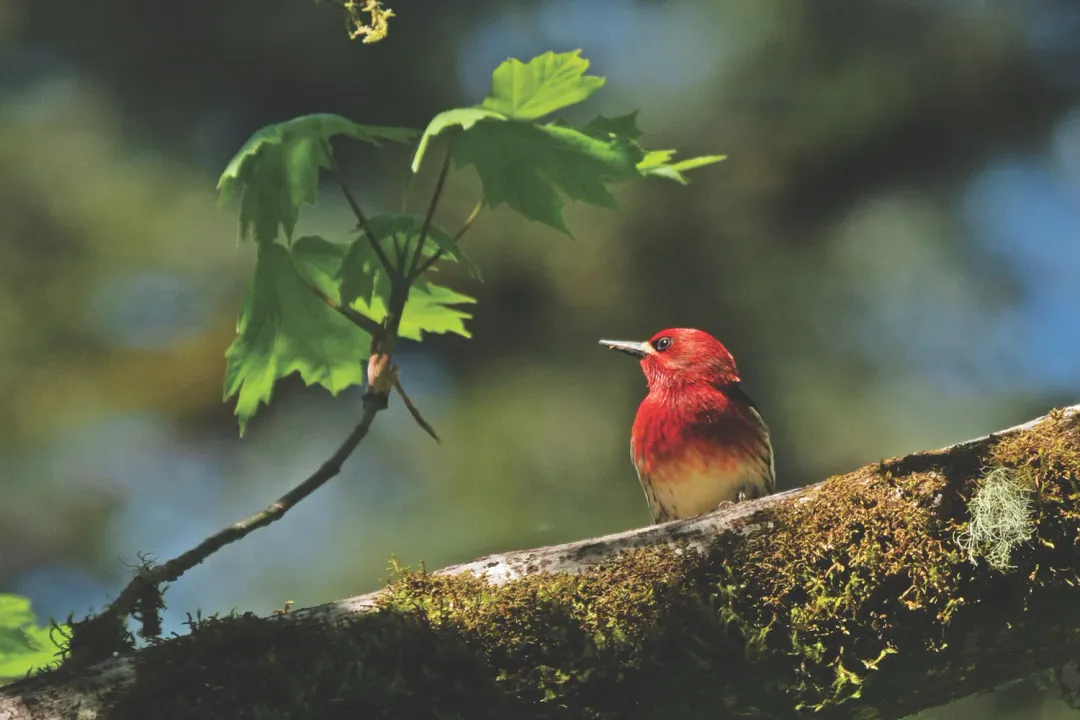
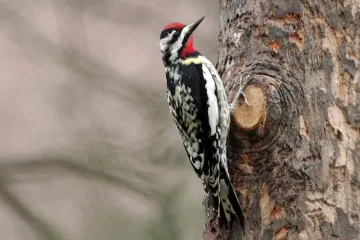
The Yellow-bellied Sapsucker, a striking member of the woodpecker family, occupies a highly specialized ecological niche defined by its unusual feeding habits. Unlike its relatives that primarily excavate wood for insects, this bird dedicates much of its time to methodically drilling precise rows of holes—known as sap wells—into the bark of trees to consume the flowing sap and the insects trapped within it. [1][4][7] This behavior is not merely a minor variation; it represents a fundamental adaptation that has shaped its evolution and its relationships with other closely related species across the continent. [3] The distinctive black-and-white patterned body, red throat patch (on males), and the namesake yellow wash on the flanks make it a visually memorable bird, often spotted during winter months across much of the eastern United States, even when its breeding grounds are far to the north. [5][7]
# Specialized Feeding
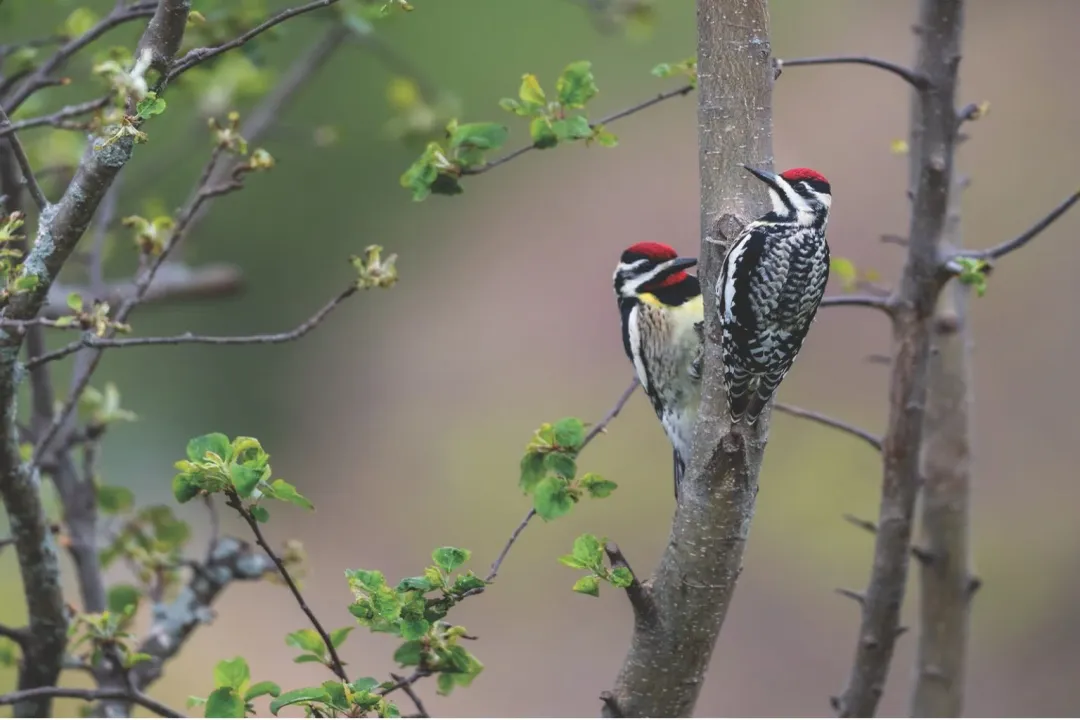
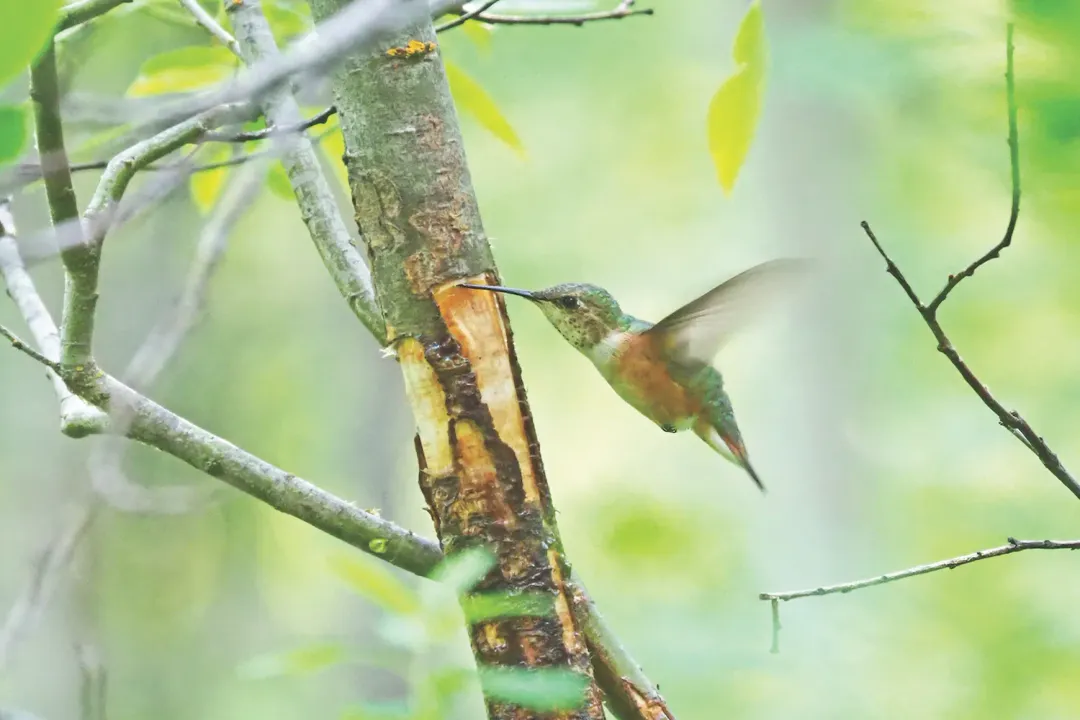
The mechanism of sapsucking is fascinatingly detailed, reflecting a long evolutionary path toward this specific diet. Sapsuckers, unlike other woodpeckers, create wells that allow sap to flow without deeply damaging the tree, often preferring specific species that yield high-quality sap. [4] They use their specialized tongues, which are rough or fringed at the tip, to lap up the sugary liquid that oozes from these carefully bored holes. [1][4] They revisit these wells over time, sometimes for days or weeks, suggesting a keen memory for profitable feeding sites. [4] While sap forms the bulk of their diet during certain seasons, they are opportunistic feeders, consuming small insects, ants, and spiders that are also attracted to the sticky exudate. [1][7]
This feeding strategy ties directly into their survival and geographic dispersal. In early spring, particularly in the colder northern forests, the flow of sap is a critical energy source before insects become widely available. [4] For instance, observations suggest that hummingbirds might even adjust their migratory timelines based on the availability of sapsucker wells in certain ecosystems, indicating the profound importance of this behavior to other wildlife. [6] The energy expenditure required to drill these wells is significant, yet the consistent, accessible energy source it provides has clearly been successful enough to support this distinct lineage within the Picidae family. [1]
# Evolutionary Divergence
The most compelling area of study concerning the Yellow-bellied Sapsucker’s evolution lies in its relationship with two other similar species: the Red-naped Sapsucker (Sphyrapicus nuchalis) and the Red-breasted Sapsucker (Sphyrapicus ruber). [3] These three species are often grouped together as a "superspecies complex". [3] This concept suggests they share a recent common ancestor and have only recently begun to diverge, or perhaps are currently undergoing processes of speciation that are incomplete. [3]
The boundaries between these forms are notably porous. While historically they were treated as three distinct species, modern taxonomy recognizes that they frequently interbreed where their ranges overlap, producing intermediate birds known as "hybrids" or "intergrades". [3] For example, where the Yellow-bellied Sapsucker meets the Red-naped Sapsucker in the Rocky Mountains, there is evidence of extensive gene flow. [3] This mixing blurs the lines used to define separate species, a classic sign of ongoing evolutionary transition rather than fully separated lineages.
Consider the plumage differences as an example of this divergence:
- Yellow-bellied Sapsucker (S. varius): Characterized by heavy black-and-white barring across the back and flanks, and a white wing patch. [1][3]
- Red-breasted Sapsucker (S. ruber): Predominantly red on the head, breast, and upper belly, lacking the heavy barring seen in the Yellow-bellied species. [3]
- Red-naped Sapsucker (S. nuchalis): Has a black-and-white head pattern, a solid black back (less barred than varius), and a distinctive red patch on the nape. [3]
When you look at a map of their ranges, the Yellow-bellied Sapsucker is primarily an eastern species, while the Red-breasted occupies the Pacific coast, and the Red-naped is found in the interior West. [3] The zones where these colors and patterns meet—especially in the Great Basin and the transitional areas of the Rockies—are where ornithologists observe the most variation and interbreeding. [3]
This variation suggests that different selective pressures across North America acted on the ancestral stock. In the dense eastern forests, perhaps disruptive coloration that contrasted strongly with the bark (the barring pattern) was favored, whereas in the drier, more open western woodlands, solid colors (red or black/white patterns) might have conferred better camouflage or signaling advantages. [3]
One analytical observation here is that the degree of difference between varius and nuchalis (intergrades) often seems less pronounced than the historical separation suggested, implying that isolation was relatively recent or that environmental pressures favoring divergence lessened across certain parts of the continent. [3] If a strong, consistent barrier (like an ocean or a vast, unsuitable desert) had been in place for a long time, we would expect to see fixed differences in behavior or morphology that prevent interbreeding—the hallmark of true speciation—which is not entirely the case here. [3]
# Migratory Patterns and Range Shifts
The Yellow-bellied Sapsucker's migratory status further complicates the evolutionary picture, as different populations exhibit different levels of migratory commitment. While some populations breed across Canada and migrate south into the eastern and southern United States for the winter, others may be year-round residents in milder climates. [1][5] For instance, birds breeding in the northernmost regions undertake significant seasonal movements, traveling thousands of miles to reach areas like Florida, the Gulf Coast, or central Mexico. [1]
Tracking these movements, often through bird banding programs, helps scientists understand gene flow dynamics. If the most southern populations are predominantly year-round residents, they might slowly evolve different traits suited to year-round resource use compared to their northern, strictly migratory cousins. [5][2] The ability to track and return to specific feeding territories year after year speaks to sophisticated spatial memory, an adaptation potentially selected for by the long-term reliance on high-quality, specific tree stands. [4] A bird that efficiently locates the best sap sources survives to breed, passing on those traits.
It is interesting to consider how subtle changes in climate might affect the relative fitness of the resident versus migratory morphs within the species range. Warmer winters might allow more northern Yellow-bellied Sapsuckers to remain on their breeding grounds, potentially increasing competition with resident populations and altering local selective pressures on features like plumage or drumming patterns. [5]
# Life History Context
Understanding the evolution of the sapsucker requires looking at its entire life cycle, not just its diet. Their nesting habits are typical of many woodpeckers: they excavate cavities in dead or dying trees. [1][7] The male often initiates the excavation of a new nest cavity each year. [1] This dependence on standing deadwood or dying limbs means that forest management practices, particularly the removal of "snags," directly impact their reproductive success. [7] The choice of tree for nesting, which might be influenced by wood density or decay rate, could also be a subtle area where local adaptation is occurring, though less studied than their feeding preferences. [1]
Reproductively, they typically lay between four and six eggs, with both parents sharing incubation duties, which last about two weeks. [1] The young, once fledged, still rely on the parents for a period, often feeding at the parents' established sap wells until they can drill their own—a crucial skill transfer that ensures the survival of the next generation of specialized feeders. [4]
# Interpreting Variation and Conservation
The existence of the sapsucker superspecies complex offers a living model for observing evolutionary processes in action, specifically the interplay between divergence and gene flow. The primary contrast between the three forms—Yellow-bellied, Red-naped, and Red-breasted—highlights how geographic separation (allopatry) can lead to differences in appearance, but when those populations meet (sympatry or parapatry), the level of reproductive isolation determines whether they remain separate species or merge back into a single, variable one. [3] In this case, the barriers appear incomplete, suggesting that either the divergence event was very recent, or the selective pressures that favored distinct color patterns in the east versus the west are not strong enough to completely prevent hybridization where ranges meet. [3]
This complexity has practical implications for conservation. If the Red-naped Sapsucker were determined to be evolving along a separate trajectory within the Rocky Mountains, management efforts might need to focus specifically on maintaining its distinct habitat requirements, even if it occasionally hybridizes with the more numerous Yellow-bellied birds. [3] However, if they are treated as a single, genetically linked unit, conservation strategies can afford to be broader. For example, protecting large tracts of mixed deciduous and coniferous woodland across the continent might benefit the entire Sphyrapicus group better than focusing narrowly on localized populations with distinct plumages. [5][7]
The continued study of sapsuckers, especially through genetic analysis alongside field observations of intergrades, provides real-world examples that complement theoretical models of speciation. The subtle yellow wash on the flanks of the Yellow-bellied Sapsucker, often overlooked in favor of the red throat patch, is an inherited trait that likely has a history tied to the evolution of the entire group, perhaps representing an ancestral feature or a specific adaptation to the lighting conditions of eastern deciduous forests. [1][3] Understanding the evolutionary pressures that shaped this coloration, compared to the full red wash of the Red-breasted, is central to grasping the full story of the Sphyrapicus genus.
Related Questions
#Citations
Yellow-bellied Sapsucker Life History - All About Birds
Yellow-bellied sapsucker - Wikipedia
A Sapsucker Superspecies Is Evolving In Our Midst - Bay Nature
More Cool Facts About the Yellow-Bellied Sapsucker
The Return of the Yellow-Bellied Sapsucker - North Carolina Wildlife ...
Some Sapsucker Feathers Stick Around - IBP - Blog Post
Yellow-bellied Sapsucker - Indiana Audubon
Sphyrapicus varius (yellow-bellied sapsucker) - Animal Diversity Web
[PDF] Yellow-bellied Sapsuckers (Sphyrapicus varius) - Eric L. Walters
Yellow-bellied sapsuckers: So vital to ecosystem that hummingbirds ...