What material makes up the interlocking, hollow segments forming the distinctive rattle structure of the Western diamondback?
Answer
Keratin
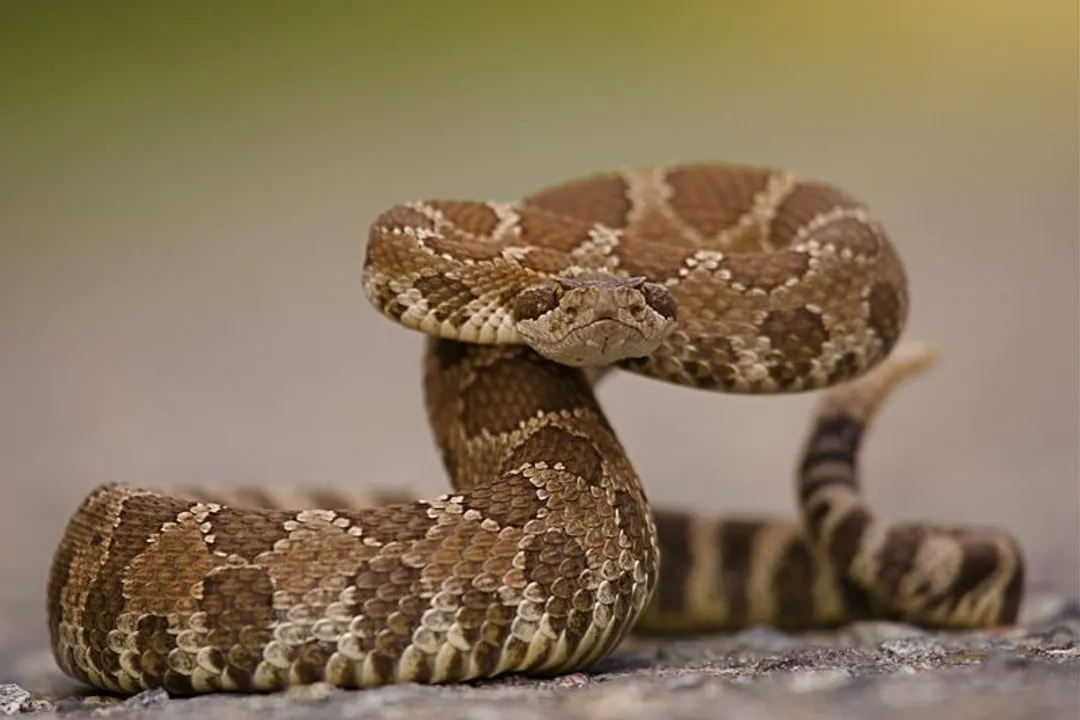
The defining feature of the Western diamondback, its rattle, is an evolutionary adaptation serving as an aposematic, or warning, signal. Structurally, this organ is constructed from interlocking, hollow segments. These segments are explicitly composed of keratin, which is the identical structural protein that forms human fingernails and hair. The rattle grows incrementally as the snake periodically sheds its skin, with a new segment being added to the tip of the structure during each successful shed cycle.
Related Questions
What evolutionary event characterized the ancestral lineage of rattlesnakes before the major diversification into modern, venomous New World pit vipers?What material makes up the interlocking, hollow segments forming the distinctive rattle structure of the Western diamondback?What specific anatomical feature is responsible for giving pit vipers, including *Crotalus atrox*, their common taxonomic descriptor?How is the segment count of a Western diamondback rattlesnake rattle reliably linked to its age, given the shedding process?In the context of the provided evolutionary trait analysis, what is described as the primary evolutionary cost associated with possessing venom?What environmental conditions are characteristic of the regions where the Western diamondback rattlesnake maintains a significant presence?What hypothesis is proposed to explain why some rattlesnakes in areas with frequent human interaction might exhibit less vigorous or shorter rattles over generations?Which two other North American pit vipers are specifically named in contrast to the Western diamondback because they lack the defining rattle adaptation?What is the functional relationship between the Western diamondback's potent venom cocktail and its typical diet, according to the analysis of its co-evolution?What physiological adaptation enables *Crotalus atrox* to thrive in high-temperature environments where many other ectotherms struggle during peak heat?