Western Rattlesnake (Northern Pacific Rattlesnake) Locations
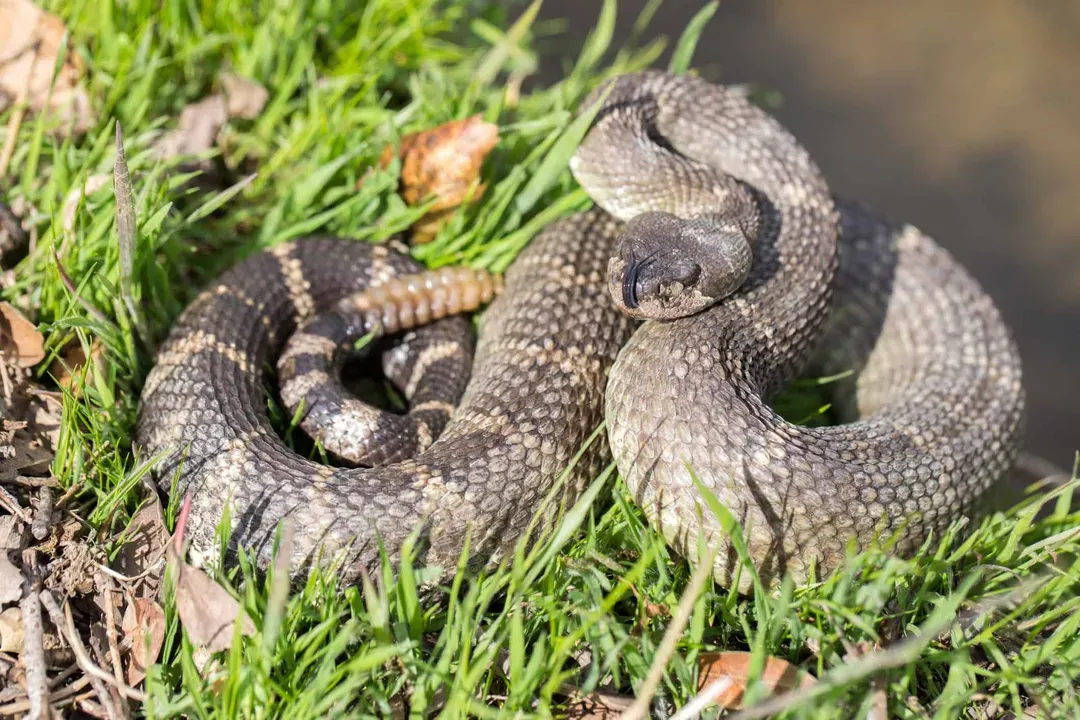
The geography of the Western Rattlesnake, often called the Northern Pacific Rattlesnake (Crotalus oreganus), covers a vast swath of western North America, making pinpointing its "location" dependent on whether you mean a specific state, a particular habitat type, or its seasonal whereabouts. This species claims territory from the Baja California Peninsula in Mexico northward through the western half of the United States and into the southern interior of British Columbia, Canada. In Canada, it is one of only three remaining rattlesnake species, and its presence there is generally confined to the southern interior of British Columbia.
# North American Extent
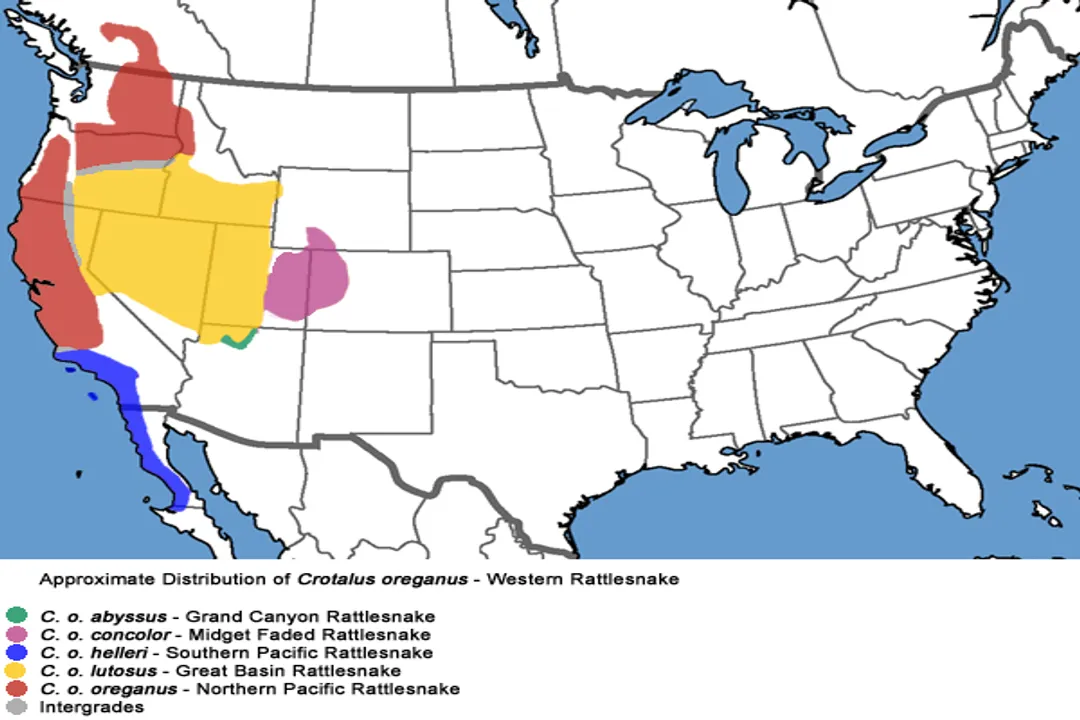
Tracing the range across the United States reveals that this snake is highly adaptable to western environments, occurring in Washington, Oregon, California, western and southern Idaho, Nevada, Utah, Arizona, western Colorado, and even small pockets of New Mexico and Wyoming. The very name oreganus refers back to its type locality near the "banks of Oregon or Columbia River". However, the species' distribution is complex, often being broken up by mountain ranges, desert barriers, or simply by local population dynamics that lead to the designation of different subspecies across the landscape.
# California Zones
California serves as a major hub for C. oreganus, where it is the most widespread rattlesnake species, although its presence there is neatly divided among several recognized subspecies. The Crotalus oreganus oreganus, the Northern Pacific Rattlesnake proper, generally dominates the northern and central portions of the state. Its range extends from Santa Barbara County in the south—where it begins to intergrade with its southern relatives—northward, situated generally west of the Cascade and Sierra Nevada ranges and east of the Pacific coast. County records for this specific subspecies include Alameda, Butte, Colusa, Contra Costa, Humboldt, Lake, Marin, Napa, Sacramento, San Joaquin, Santa Clara, Shasta, Sonoma, and Yuba counties, among many others listed along the western side of the state and into the lower Sierra Nevada foothills.
Contrast this with the C. o. helleri, the Southern Pacific Rattlesnake, found further south and west, with recorded observations in Los Angeles, San Diego, and Ventura counties, although its range touches Santa Barbara County where overlap with oreganus occurs. Then there is the C. o. lutosus, the Great Basin Rattlesnake, inhabiting the eastern side of the Sierra Nevada, including counties like Mono and Inyo, though defining these boundaries precisely can sometimes be a point of taxonomic debate.
It is useful to see how these ranges partition the state, acknowledging that some border counties feature snakes that possess traits of both forms, leading to intergrade zones. For instance, one report noted an adult oreganus found far south on the east side of the Sierra Nevada in Kern County, exhibiting a lighter coloration resembling lutosus due to the arid habitat, which highlights that local environment can override purely geographic boundaries when identifying these populations.
| Subspecies | General Locality in CA | Key Habitat Association |
|---|---|---|
| C. o. oreganus | Northern and Central California, west of the Sierra Nevada crest | Grasslands, woodlands, rocky outcrops |
| C. o. helleri | Southern and Coastal California | Areas influenced by coastal and lower elevation terrain |
| C. o. lutosus | Eastern California, near the crest of the Sierra Nevada | Great Basin transition zones |
# Habitat Specificity
Regardless of the subspecies designation, the Crotalus oreganus complex shows a preference for specific types of cover and terrain across its range. They are generally found in rocky environments: rocky hillsides, talus slopes, rock outcrops, and along rocky stream courses. Beyond the rocks, they utilize grasslands, woodlands, pinyon-juniper areas, and sagebrush communities. A defining requirement across all these settings, whether it is a woodland in Oregon or a scrub area in California, is the need for adequate hiding spots. These refugia include structures like ground squirrel burrows, rock crevices, or even debris piles and wood stacks in suburban settings where development abuts their territory.
The elevation range these snakes occupy is impressive. The species overall has been documented from sea level up to roughly 11,000 feet (about 3,350 meters). Observations in the Sierra Nevada of California confirm they thrive at elevations exceeding 11,000 feet, suggesting that exposure to sunlight and the availability of suitable rocky dens are more crucial than absolute temperature in setting their upper limit.
The need for specific topographical features becomes most apparent when considering their seasonal movements. The snakes are highly tenacious to their established paths, moving between winter denning sites (hibernacula) and summer foraging grounds. The choice of a winter den is not random; studies indicate a selection for much steeper slopes compared to surrounding terrain, often associated with medium-sized rocks offering ideal thermal mass and protection [1 - initial browse]. If human development interrupts these established migration corridors, residents might find snakes crossing their yards annually, as the snakes attempt to follow the same routes their ancestors used.
# Activity Locations
When an individual is located in the wild, the time of year heavily dictates the setting. Activity generally spans from late March through early November, contingent on local weather conditions. During the heat of summer, the snakes shift their location preference drastically. They become primarily nocturnal, moving after sunset, or crepuscular, active during the twilight hours. In these warmer months, one might find them basking openly during the mild morning hours, only to retreat into crevices, under brush, or into mammal burrows during the hottest midday sun.
Conversely, in cooler climates or higher latitudes, their activity is dictated by daily temperatures rather than a strict day/night cycle. For example, in an area like British Columbia, which faces significant habitat loss, the snakes' movements and body condition have shown a direct negative correlation with human activity, suggesting that disturbance pushes them toward less optimal, perhaps less secure, foraging areas [1 - initial browse]. The contrast in movement ecology across their range is striking: while snakes in Arizona may remain in the same territory year-round, those in colder places like Wyoming can migrate over five miles between their summer and winter locations. This highlights that local climate is a primary driver of where you will find them at any given time of the year. If you are looking for them in the spring, focus on south-facing slopes near known den complexes; by mid-summer, you should focus on the proximity of reliable prey sources—often rodent colonies—rather than the dens themselves [1 - initial browse].
In urban-adjacent areas, like those tracked by citizen science mapping efforts in Los Angeles County, observations often cluster near canyons and hillsides that abut residential zones, suggesting that the fragmented wildlands provide necessary corridors and habitat pockets close to human habitation. Even when development fragments their territory, the snakes often attempt to use the remaining patches, sometimes leading to encounters on trails or even in backyards, especially if a home was built directly over an historical migration route. Recognizing that their preferred rocky terrain often corresponds with desirable human vantage points—such as sunny, rocky ridges—is key to understanding why encounters sometimes occur in unexpected places.
This tendency to occupy the best thermal and structural locations means that simply knowing the state or county is insufficient; one must understand the specific micro-habitat, such as the presence of appropriately sized rocky debris or active rodent populations, to accurately predict a location for Crotalus oreganus. The size of a snake’s territory varies, but for the Western Pacific Rattlesnakes studied near Mount Diablo, California, the home range averages between $0.025$ and $0.05$ square miles, confirming they are generally tied to localized resources.
Related Questions
#Citations
Western Rattlesnakes Species and Range Map - Snake Fencing
Crotalus oreganus - Wikipedia
Crotalus oreganus - Northern Pacific Rattlesnake - California Herps
Western Rattlesnake Observations | City of Los Angeles Geohub
Amazing encounter— western rattlesnake? [Central Coast, CA]
Rattlesnake Research - Mount Diablo Interpretive Association