How was the primary nasal horn of *Coelodonta antiquitatis* typically proportioned or shaped?
Answer
Exceptionally long, flattened, and pointed forward.
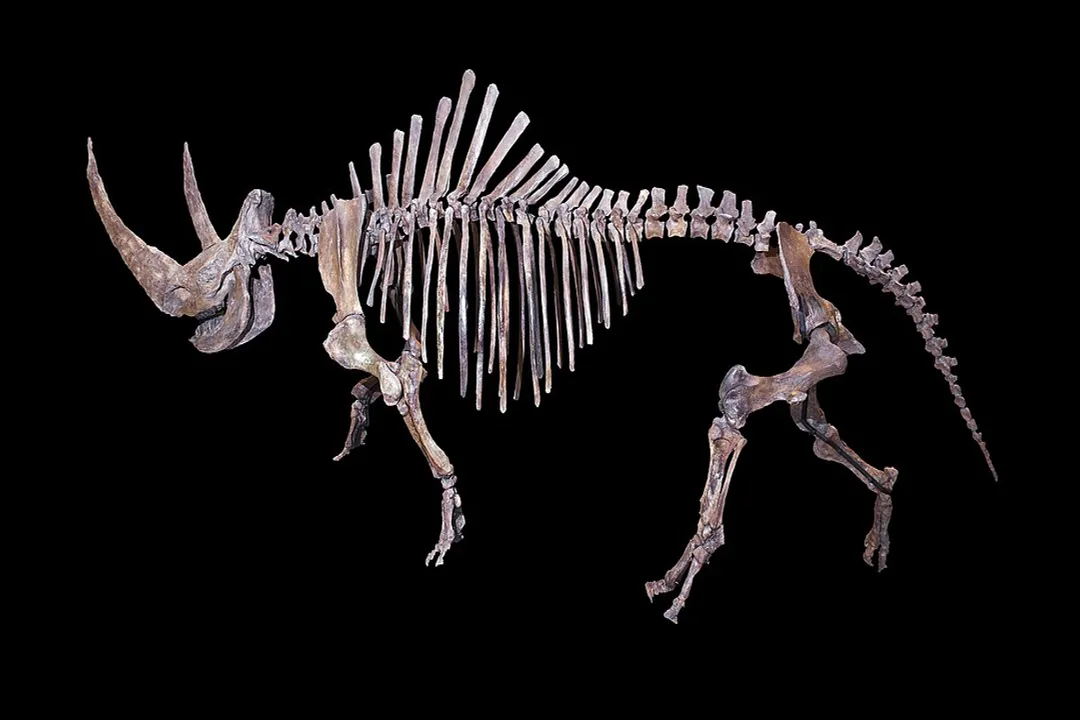
The frontal horn structure was one of the most visually distinctive characteristics of the Woolly Rhino, differing significantly from modern species. The primary horn, located on the nasal bones, was exceptionally long, frequently exceeding one meter in length. Furthermore, its cross-section was flattened rather than round, and it was uniquely oriented, typically pointing forward, sometimes exhibiting a gentle curve. This structure, coupled with evidence of extensive wear, strongly implies a tool-like function related to manipulating the environment, such as clearing snow.
Related Questions
What is the scientific designation for the Woolly Rhinoceros?What characterized the insulating coat of the Woolly Rhino?What function was the exceptionally long front horn likely used for?What feeding behavior characterized the diet of *Coelodonta antiquitatis*?Which geographical regions defined the vast distribution of the Woolly Rhino?What was the preferred ecosystem inhabited by the Woolly Rhinoceros?Approximately how tall did the Woolly Rhino stand at the shoulder?What major environmental shift caused the Woolly Rhino's primary feeding ground to recede?How was the primary nasal horn of *Coelodonta antiquitatis* typically proportioned or shaped?Where are perfectly preserved, complete specimens of the Woolly Rhino often unearthed?