Woolly Rhinoceros Physical Characteristics
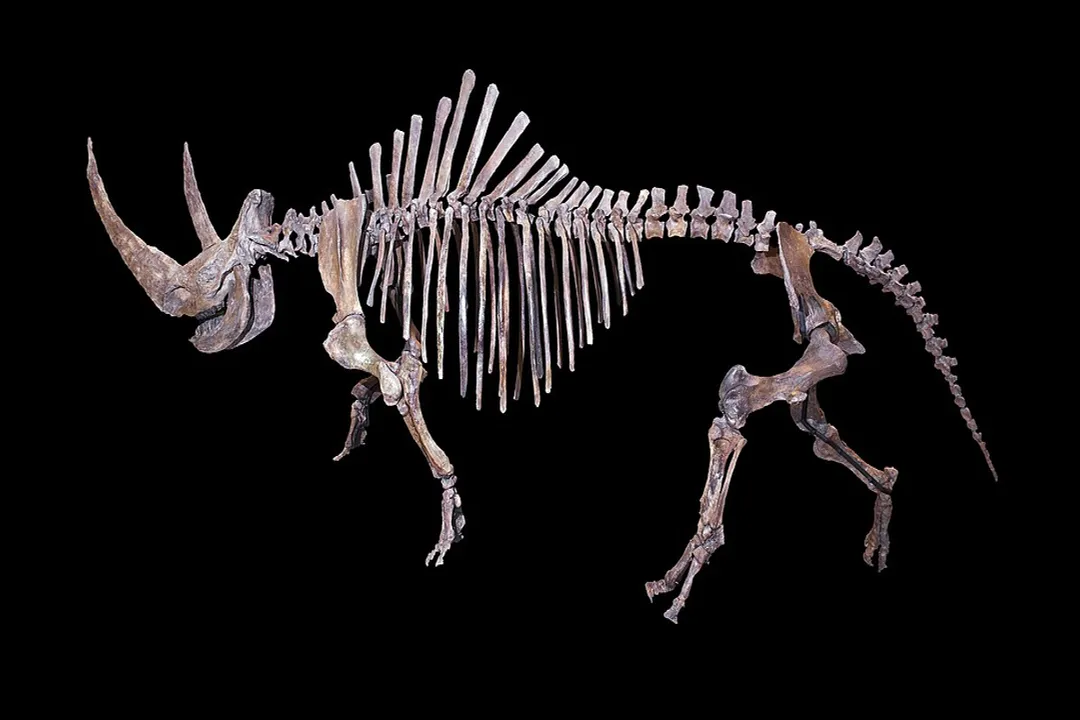
The Woolly Rhinoceros, Coelodonta antiquitatis, presents a striking image in the mind's eye—a beast seemingly built for the brutal cold of the Pleistocene epoch. Far from being just a hairy version of its modern relatives, this creature possessed a suite of unique physical characteristics that allowed it to dominate the mammoth steppe across Eurasia for hundreds of thousands of years. [1][2] Understanding their anatomy reveals an animal perfectly tooled for an environment defined by icy winds and a diet of coarse vegetation. [5]
# Size Stature
When considering the sheer mass of this extinct megafauna, the Woolly Rhino was certainly large, though perhaps not the largest rhinoceros ever to exist. [7] They were roughly comparable in overall bulk to the largest living species, the modern White Rhinoceros. [2] Adults typically reached an impressive shoulder height spanning between 1.5 to 2 meters, or approximately 5 to 6.5 feet. [1][7] Their body length, nose to tail, often stretched to about 3.8 meters, or nearly 12.5 feet. [1]
Estimates for their weight place the average adult male somewhere between 2 and 3 tons. [3][7] Some larger specimens may have approached 4 tons. [1][3] This robust, stocky build, combined with a low center of gravity, would have made them incredibly difficult to move or topple, a significant advantage in an ecosystem where encounters with large predators like cave lions were common. [1] It’s worth noting that while their absolute size was comparable to the White Rhino, the Woolly Rhino’s proportions—particularly the massive head relative to the torso—suggested a different center of gravity, likely optimizing stability while foraging in open, windswept terrain. [2][5]
# Shaggy Coat
The most immediately recognizable feature, which gives the animal its name, is its dense covering of hair. [1][2] Unlike the relatively sparse hair on modern tropical rhinos, the Woolly Rhino was draped in a thick coat designed for insulating against severe cold. [5] This exterior layer consisted of long, shaggy guard hairs, often described as woolly, which could be quite dark brown or reddish-yellow in coloration, though variation certainly existed across their vast range. [1][7]
Beneath this conspicuous outer layer, paleontological evidence strongly suggests the presence of a dense undercoat. [5] This dual layering system is highly effective in cold climates; the long guard hairs shed snow and rain, while the shorter, woolly undercoat traps a layer of insulating air close to the skin. [5] Furthermore, the skin itself was quite thick, providing an additional layer of defense and thermal inertia against frigid temperatures. [5] A fascinating point arises when comparing this insulating strategy to that of other Ice Age contemporaries, like the Woolly Mammoth. While both utilized thick coats, the Rhino’s fur appears even more specialized for deep-cold insulation than the Mammoth’s, perhaps because rhinos, lacking the massive insulating fat layer typical of proboscideans, relied almost entirely on integumentary adaptations for thermoregulation. [1]
# Cranial Structure
The head of Coelodonta antiquitatis was proportionally immense, a feature necessitated by the demands of its specialized dentition and its formidable weaponry. [1] The skull itself is robust and elongated, capable of supporting considerable musculature. [1]
# Horns
The defining characteristic of the genus Rhinoceros is the presence of horns, and the Woolly Rhino was no exception, possessing two. [1][2] The front horn, growing from the nasal area, was significantly larger than the rear one. [2] This massive frontal projection could reach lengths of up to 1 meter, or 3 feet. [1][7] However, unlike the stout, conical horns of many modern species, the primary horn of the Woolly Rhino was often elongated, flattened, and frequently curved backward toward the animal’s shoulders. [1] The exact structure varied between individuals and potentially by sex, but it was a substantial structure, supported by a noticeable bony ridge on the skull. [1] The smaller, posterior horn sat atop the nasal bone. [2]
It’s intriguing to consider the function of this enormous, somewhat unwieldy horn, especially given its curvature. While it undoubtedly served as a defense against predators like large cats and wolves, its shape suggests it may have been heavily utilized for specific tasks related to its environment. For example, paleontologists hypothesize that the flattened front edge could have been perfect for sweeping away snow to uncover buried vegetation, a critical adaptation for winter survival in the steppes. [7][5] A calculation comparing the horn length to the known average body length reveals that, relative to body mass, the frontal horn was exceptionally long, suggesting its utility outweighed the biomechanical cost of carrying such a projection. [1]
# Dentition Adaptations
While the horns are visually dramatic, the dental structure of the Woolly Rhinoceros might be the most critical feature enabling its long tenure during the Ice Age. [5] Modern rhinos exhibit diversity in their diets, with some browsers (eating leaves and twigs) and some grazers (eating grasses). The Woolly Rhino was an obligate grazer, specialized for consuming the tough, abrasive, fibrous grasses that characterized the cold grassland steppes. [2][5]
This specialization is clearly visible in their teeth, particularly the molars. [5] Fossil evidence shows that their molar crowns were low-crowned and curved. [1] This morphology—high ridges and deep valleys in the chewing surface—is an evolutionary response to heavily abrasive food sources. The tough silica content in Ice Age grasses wore down softer tooth material, leaving the enamel ridges high, which provided an efficient grinding surface over time. [2] This contrasts sharply with browser species, which typically have higher crowns suitable for shearing woody material. [5] This commitment to grazing placed the Woolly Rhino firmly within the ecosystem dominated by other grazers like the Woolly Mammoth and steppe bison.

# Skeletal Proportions
The overall skeletal structure speaks to a life spent on firm but often unforgiving ground. While retaining the basic heavy-boned structure typical of Rhinocerotidae, their legs were generally shorter and stockier in proportion to their body mass compared to some of their warmer-climate cousins. [1] This slightly shorter leg structure would have provided greater purchase and stability on uneven or slippery terrain, aiding in navigating snowy or icy landscapes. [4] The robust nature of the limb bones suggests they were built for supporting immense weight and enduring the strain of constant movement across vast grazing territories. [6]
The pelvis and ribcage structure were also adapted to accommodate a very large digestive system capable of processing vast quantities of low-quality forage. In a cold environment, maintaining a high metabolic rate requires significant energy intake, and the sheer volume of the torso reflects the machinery needed to extract energy from dry, nutrient-poor grasses. [5]
# Comparison to Modern Relatives
To truly appreciate the Woolly Rhino's physical blueprint, a comparison with its closest living relative, the Sumatran Rhino (Dicerorhinus sumatrensis), or the larger modern African rhinos, is illustrative. [2] The Sumatran Rhino is the smallest living rhino and is hairy, often considered the most similar in terms of hairiness, though the Woolly Rhino’s coat was far denser and longer. [2][7] The modern White Rhino shares the grazing specialization, evidenced by its square lip adapted for mowing grass, but lacks the extreme cold adaptations. [2]
A key difference lies in the skull and horns. Modern rhinos generally have a more pronounced, upward-pointing cone shape for the front horn, which is used more for defense and dominance displays. The Woolly Rhino’s horn, being longer, flatter, and often sweeping backward, suggests a primary tool function—snow clearing—over purely martial application. [7][1] Furthermore, the sheer volume of insulating hair immediately separates the Woolly Rhino from all extant species, highlighting the intense selective pressure exerted by the Pleistocene climate. [5]

# Skull and Facial Features
The facial structure is another area of significant divergence from modern species. The premaxilla, the bone structure that forms the front of the upper jaw, was proportionally smaller in the Woolly Rhino than in its modern relatives. [1] This is directly linked to its diet; browsers need protruding lips for grasping twigs, while grazers, like the Woolly Rhino, have shorter muzzles ending in a broader, flatter surface for cropping grass close to the ground. [2][5] This adaptation, mirrored in modern grazers like the White Rhino, confirms their primary feeding niche. Moreover, the nasal opening in the skull was relatively small, which might seem counterintuitive for a cold-weather animal needing to warm inhaled air, but this structure may have been related to the attachment point and shape of the massive keratinous horn structure above it. [1]
The overall appearance, dominated by the huge head, massive hump of muscle at the shoulders (likely anchoring powerful neck muscles to support the head and push the horn through snow), and thick, shaggy coat, results in a creature that appears much more heavily built than its modern counterparts, even at similar weights. [1][6] The body plan screams permanence in harsh, open landscapes, a specialized survivor in the world of ice and cold grasses. [5]
# Summary of Key Physical Traits
For clarity, the primary physical characteristics that defined Coelodonta antiquitatis can be summarized by noting the interplay between size, insulation, and foraging tools:
| Characteristic | Feature Detail | Primary Function/Adaptation |
|---|---|---|
| Size | Up to 3.8m long, 1.5-2m high at shoulder | Supporting massive weight for survival |
| Integument | Long, shaggy outer coat over dense underfur | Extreme insulation against cold climate [5] |
| Front Horn | Up to 1 meter long, flattened, often curved | Snow sweeping for foraging and defense [1][7] |
| Dentition | Low-crowned, curved molar crowns | Efficient grinding of abrasive steppe grasses [2] |
| Build | Stocky limbs, massive head, prominent shoulder area | Stability and support for head musculature [1] |
This specialized morphology paints a picture of an animal where every major physical feature—from the hair on its back to the shape of its molars—was tuned for survival in the challenging, cold, grassy plains of the Ice Age. [5][2] The success of this physical plan is evidenced by their long persistence across a massive geographic range until the climate finally shifted away from their preferred steppe environment. [8]
#Videos
The MANY Interpretations of the Woolly Rhino! (Coelodonta)
Related Questions
#Citations
Woolly rhinoceros - Wikipedia
Woolly rhinoceros | Habitat, Extinction, & Facts - Britannica
Woolly Rhinos: Characteristics, Origin and Diet
Woolly Rhinoceros - Kirkby Teaching Resources
Ice Age Explorer: Woolly Rhino | Herefordshire Wildlife Trust
Woolly Rhinoceros | Prehistoric Earth: A Natural History Wiki - Fandom
Woolly rhino Facts, Habitat, Pictures and Range - Extinct Animals
The Rise of the Woolly Rhino | Science | AAAS
The MANY Interpretations of the Woolly Rhino! (Coelodonta)