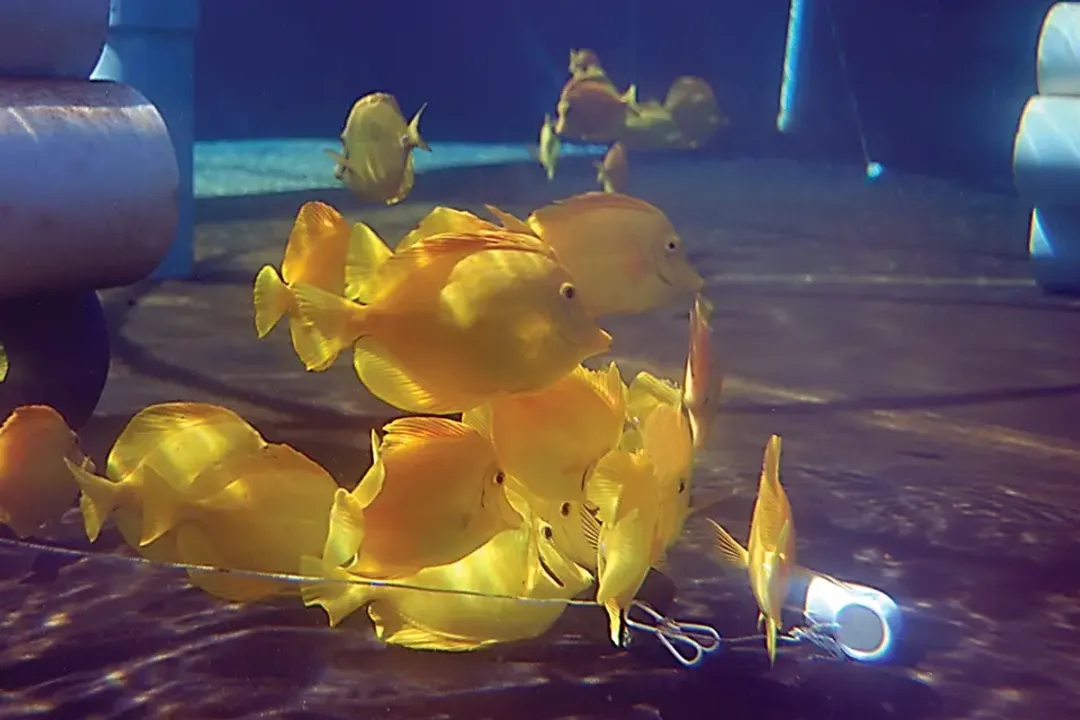
How do traits advantageous in a busy reef setting contrast with those favored in aquaculture for *Z. flavescens*?
Wild tangs are selected for defense and foraging behaviors; captive tangs are selected for docility and efficient conversion of artificial feed.
The selective pressures exerted in a natural reef environment are fundamentally different from those present in a closed-loop aquaculture system, leading to contrasting profiles of fitness. Wild Yellow Tangs face constant predation risk, meaning traits like keen eyesight and the readiness to deploy their caudal spines for defense are highly advantageous. Conversely, the captive environment removes predation and emphasizes efficiency in controlled settings. Therefore, captive-bred fish are selected for traits such as docility, which reduces stress in tanks, and superior efficiency in converting manufactured feed (biomass conversion) into body mass, characteristics that would likely be disadvantageous if those fish were suddenly returned to a demanding wild reef.