What dangerous attribute separates the Family Viperidae, housing Crotalus atrox, from families like Colubridae?
Answer
Venom delivery via specialized, hinged fangs.
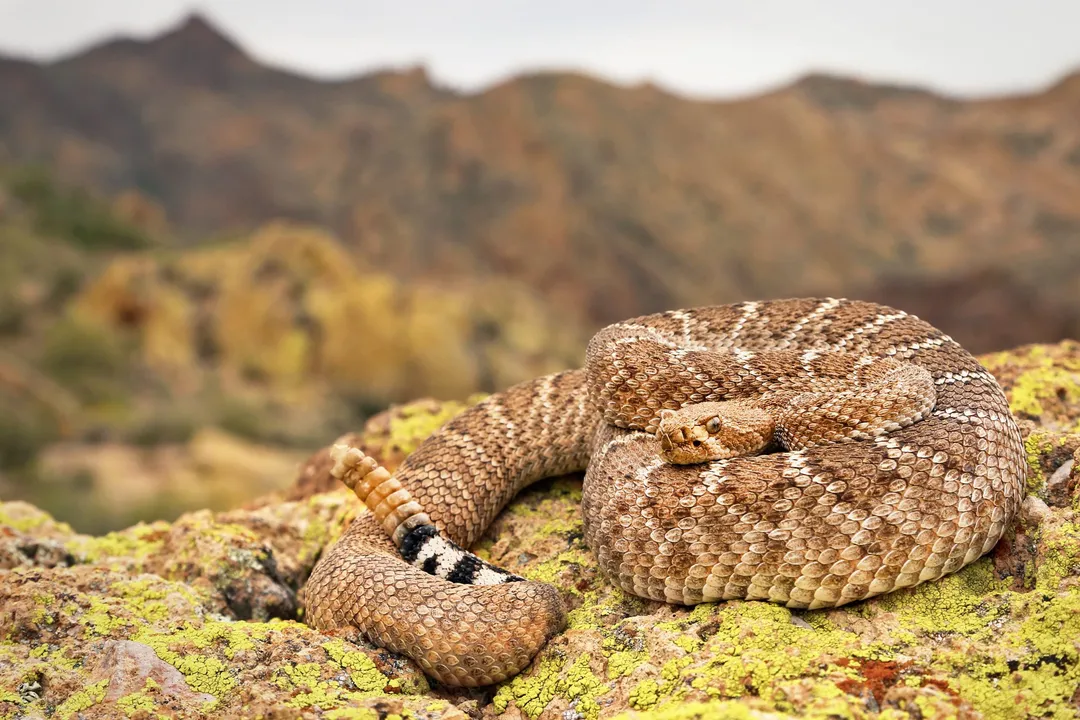
The defining feature of the Family Viperidae, which places the Western Diamondback Rattlesnake here, is its mechanism for venom delivery. Viperids possess specialized fangs that are hinged, allowing them to fold back against the roof of the mouth when not in use and swing forward for injection. This contrasts sharply with the Elapidae family (like cobras), which possess fixed front fangs, and many snakes in the Colubridae family, which are generally non-venomous or utilize different delivery systems.
Related Questions
What structure characterizes the genus Crotalus according to its Greek derivation?What specialized thermoreceptive organ defines the subfamily Crotalinae, placing Crotalus atrox within it?What is the likely Latin translation of the species epithet atrox in Crotalus atrox?What unifying morphological characteristic defines the reptile Order Squamata, which includes Crotalus atrox?What dangerous attribute separates the Family Viperidae, housing Crotalus atrox, from families like Colubridae?What type of venom is primarily implied by placing Crotalus atrox within the family Viperidae for medical personnel?What is the global conservation status assessment (G-rank) provided for Crotalus atrox by NatureServe?Which Phylum designation does Crotalus atrox share with earthworms and blue whales?How does Crotalus atrox generally compare physically to the Eastern Diamondback Rattlesnake (C. adamanteus)?Which geographical areas primarily encompass the distribution where Crotalus atrox is concentrated according to ecological observation?