How does the A. seemanni physically eject its urticating hairs toward an actual or perceived threat?
Answer
Flicking them from the spider's abdomen using its hind legs.
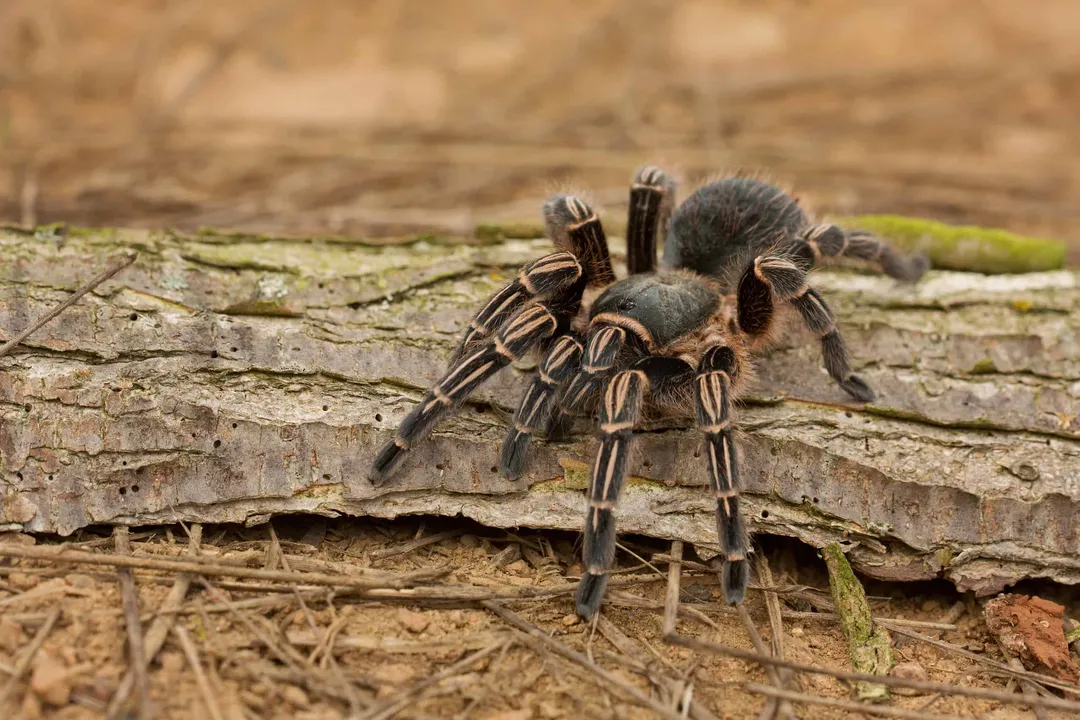
The mechanism for deploying the urticating hairs is a specific, active action involving the rear appendages of the spider. When the *A. seemanni* feels threatened, it uses its hind legs to rapidly flick these fine hairs off its abdomen, directing them toward the source of stress or danger. This contrasts with species that may bite first or rely on different defensive secretions. The efficacy of this defense lies in the physical contact of the hairs with the threat, causing irritation upon contact with skin, eyes, or the respiratory tract, emphasizing that this is a deliberate, targeted physical action rather than a passive emission.
Related Questions
What specific location on the legs features the prominent white or cream-colored banding of the Aphonopelma seemanni?What chemical defense mechanism does the A. seemanni utilize when feeling threatened or stressed?What is the typical lifespan disparity noted between mature female and male Aphonopelma seemanni?To what specific type of terrestrial environment is the native Aphonopelma seemanni adapted in Central America?What substrate depth is generally recommended in an A. seemanni enclosure to facilitate natural burrowing behavior?Which common name for the A. seemanni is deemed the most taxonomically descriptive regarding its visual markings?How does the A. seemanni physically eject its urticating hairs toward an actual or perceived threat?When setting up an enclosure for the terrestrial Aphonopelma seemanni, what spatial dimension should be prioritized over vertical height?What is the characteristic color contrast observed on the cephalothorax and abdomen versus the leg markings of the A. seemanni?Why is the Zebra Tarantula sometimes recommended as suitable for individuals new to keeping tarantulas?