Zebra Mussels Facts
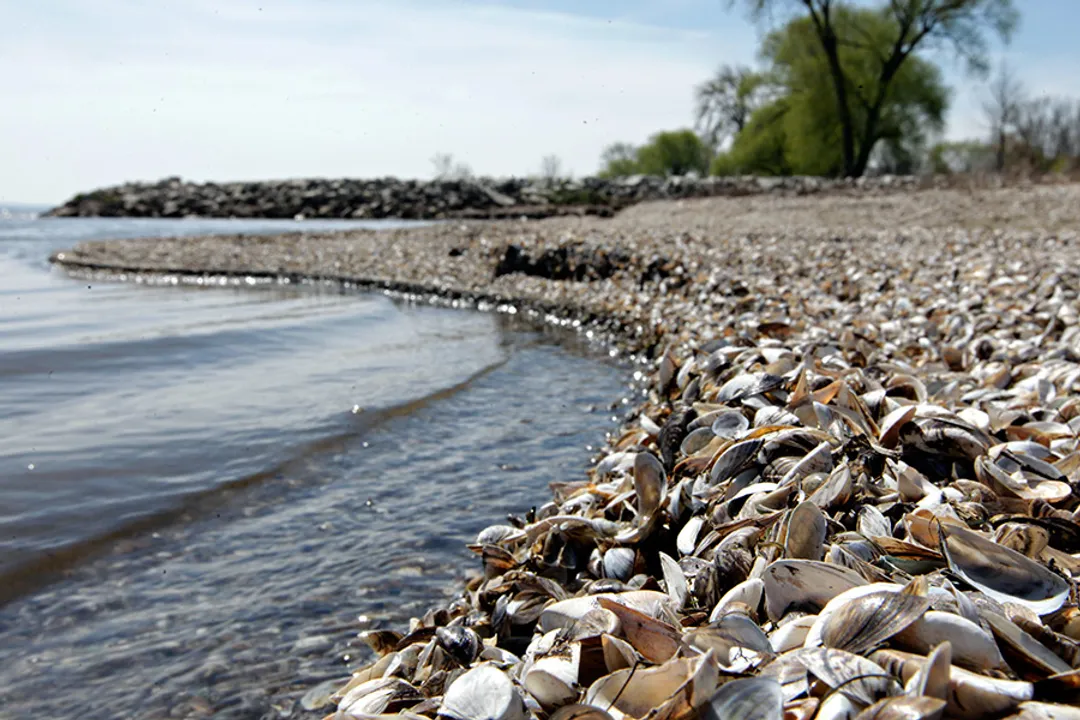
Zebra mussels, those small, deceptively delicate-looking bivalves, represent one of the most disruptive aquatic invasions the world has ever witnessed, fundamentally altering the ecology and infrastructure of countless freshwater systems. [4][7] They are not native to North America, originating instead from the Black and Caspian Seas region of Eastern Europe and Western Asia. [7][2] Their arrival here, first documented in the Great Lakes in the mid-1980s, is credited almost entirely to the release of ballast water from ocean-going ships. [4][7] These tiny creatures, often measuring less than an inch across, possess an alarming ability to colonize surfaces and reproduce at staggering rates, leading to ecological chaos and billions of dollars in damages annually. [4][5]
# Origins History
The initial introduction into the Great Lakes area occurred around 1985 or 1986, likely via ships docking in Lake St. Clair before they spread to the other Great Lakes. [7][4] Once established, their spread outward from the lakes began, moving into connecting river systems and down the Mississippi River basin, often propelled by recreational boating, commercial shipping, and the aquarium trade. [4][7] Though they thrive in freshwater, their larval stages can survive brief periods in brackish water, which aided their initial dispersal. [7]
# Shell Features
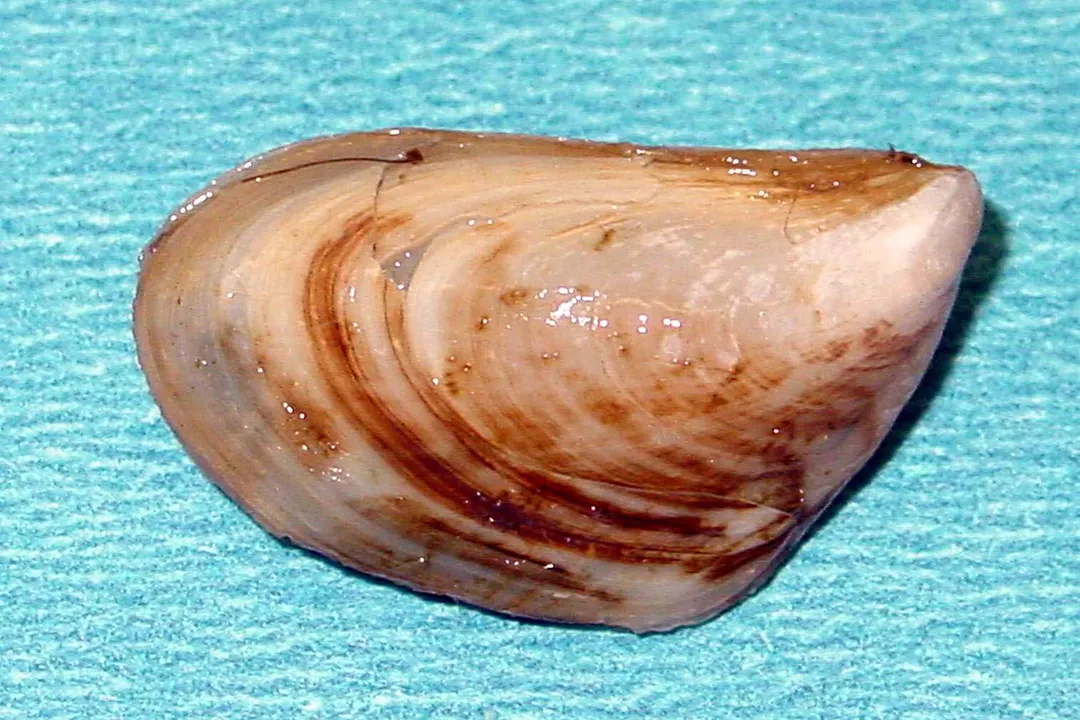
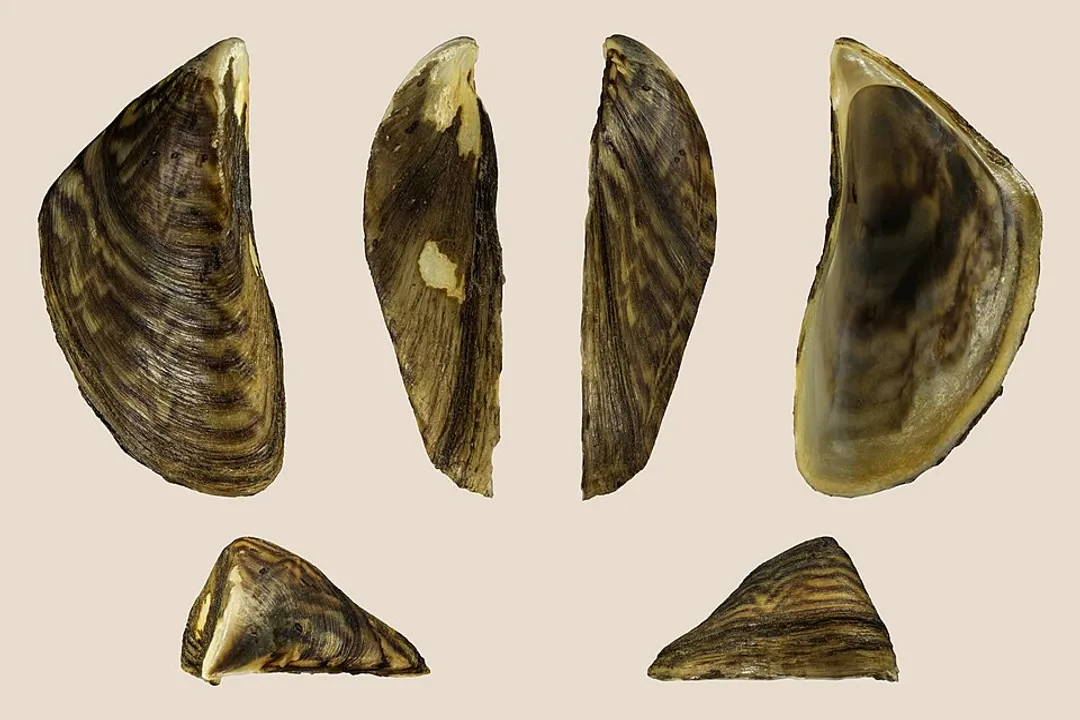
A defining characteristic of the zebra mussel is its shell, which is typically small, ranging from less than half an inch up to about one inch in length. [1][7] The name derives from the distinctive dark, wavy, zigzag stripes found on the shells of adults, although this patterning can sometimes be faint or absent, leading to potential misidentification. [1][7] These shells are generally triangular or D-shaped and possess a sharp, flattened edge. [1]
One critical point for resource managers and boaters is distinguishing the zebra mussel from its close cousin, the quagga mussel. [1][2] While both are invasive species originating from the same general geographic area and often coexist, they have key physical differences. Zebra mussels are typically more flattened on the underside and tend to settle with their flat side down, securing themselves firmly to surfaces. [1] Quagga mussels, conversely, are more rounded, giving them a dome-like appearance, and they are not as strongly attached to substrates, often being found in looser piles. [1][2] Another noticeable difference: a zebra mussel's shell profile, when viewed from the top, is sharply angled, whereas the quagga is more smoothly curved. [2] If you crush a zebra mussel, the meat inside usually remains attached to both halves of the shell, whereas in a quagga mussel, the meat often separates cleanly from the shell halves. [2]
# Habitat Requirements
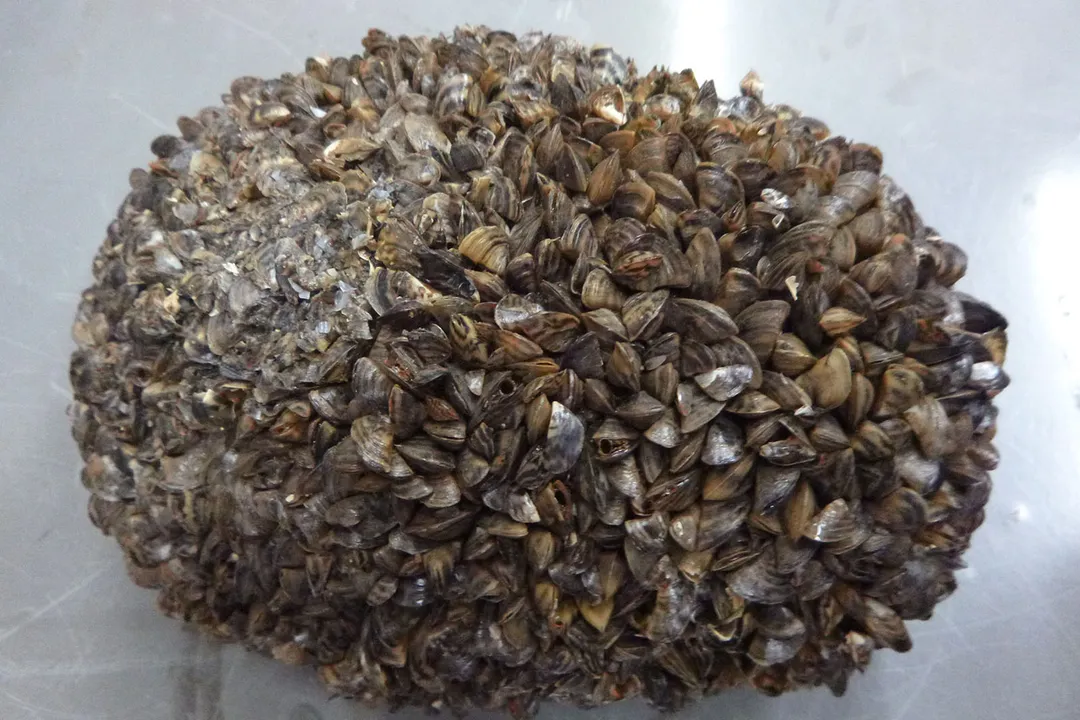
Zebra mussels are primarily attached organisms, meaning they prefer to anchor themselves to hard surfaces like rocks, docks, submerged logs, or manufactured materials. [1][4] They do require some depth but can tolerate a wide range of conditions, including varying temperatures and salinities, though they thrive best in clean, clear, hard-water lakes and rivers. [4] They are notably absent from soft-bottomed areas. [1] A single square meter of suitable substrate can potentially host tens of thousands of these mussels, creating thick mats of biomass. [4]
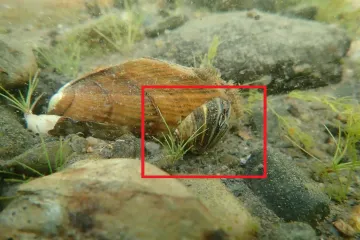
An interesting ecological observation is that zebra mussels prefer being attached to the shells of other mussels, including native species, which can physically smother the host organism, effectively using a living creature as a new substrate for colonization. [3] This aggressive attachment strategy is a major component of their invasive success.
# Filtration Feeding
The feeding mechanism of the zebra mussel is perhaps the single most powerful driver of ecosystem change. These mussels are incredibly efficient filter feeders. [4] They draw water in through their siphons and pass it over their gills, filtering out phytoplankton and zooplankton—the base of the aquatic food web. [4][3] An adult mussel can filter liters of water per day, making them biological water purifiers on an industrial scale. [4]
The sheer volume of water processed has a direct, observable impact: it increases water clarity. [3] In Lake Huron, for instance, researchers noted that the water became dramatically clearer following their arrival, allowing sunlight to penetrate deeper than before. [3] While clear water might sound beneficial, this profound change fundamentally shifts the ecosystem dynamics. By removing phytoplankton, they starve the zooplankton that rely on those tiny plants, which in turn removes a primary food source for larger native fish species. [3][4]
To illustrate the scale of their appetite, consider this: If one square meter of substrate is covered with about 30,000 adult mussels, this community could potentially filter the entire volume of water in a modest-sized bay once every few days under peak summer conditions. [1] This rapid nutrient cycling means that energy is rapidly transferred from the water column (plankton) to the lake bottom (mussel biomass), starving pelagic (open water) fish populations that rely on drifting food sources. [3]

# Reproduction Proliferation
The reproductive capacity of zebra mussels contributes significantly to their invasive potential. They are broadcast spawners, meaning they release eggs and sperm into the water column to fertilize externally. [4] Reproduction is highly dependent on water temperature, typically beginning when the water warms above 60 degrees Fahrenheit (about 15.5 degrees Celsius) and peaking when temperatures reach the mid-70s Fahrenheit. [4] A single female mussel can produce between 100,000 and 1 million eggs per year. [4]
After fertilization, the organisms develop into microscopic, free-swimming larvae known as veligers. [4] These veligers drift in the water column for several weeks, feeding on plankton before undergoing metamorphosis to settle onto a hard surface as tiny juveniles. [4] It is this extended planktonic stage that allows them to be transported long distances by currents or through water discharge systems before settling down and beginning to colonize new areas. [4] If the water conditions are favorable—warm, clear, and nutrient-rich enough to support the larval food source—the settlement rates can be astronomical, leading to rapid density increases in newly invaded areas. [1]
# Infrastructure Damage
The attachment behavior that helps them colonize rocks also translates into severe economic problems when they settle on man-made structures. [6] This process is called biofouling. [4] Water intake pipes for power plants, municipal water treatment facilities, and industrial cooling systems are particularly vulnerable. [6] The mussels colonize the interior of these pipes, often growing tightly packed together, which severely restricts water flow. [4]
This restriction leads to reduced efficiency, increased pumping costs, and eventual blockages that require costly cleanouts. [6] The cleaning methods themselves can be abrasive and damaging to the infrastructure. For example, in areas where they have become established, power generation plants have reported losses totaling millions of dollars due to the necessity of periodic shutdowns for mechanical or chemical removal of the mussels. [5] Considering that intake systems are often designed with significant safety margins, a 50% reduction in effective pipe diameter due to mussel buildup can translate to an exponential increase in the energy needed to push the remaining water volume through, meaning that even a small initial infestation can rapidly balloon maintenance costs beyond simple manual removal expenses.
Beyond pipes, they attach to boat hulls, boat lifts, buoys, and navigation markers, increasing drag on vessels and requiring frequent, sometimes abrasive, scraping to maintain efficiency. [4][5]
# Identification Control
Detecting zebra mussels early is crucial for limiting their spread. Because they are often small and can resemble native species or other organisms like barnacles, careful inspection is required. [5] When examining a boat hull, trailer, or any submerged equipment that has been in the water, look for small, ribbed shells adhering to the surface. [5]
The most effective management strategy relies on prevention, especially concerning the transport of water and materials between water bodies. [5] Agencies across invaded regions strongly promote a simple, three-step protocol for boaters and anglers: CLEAN, DRAIN, DRY. [5][10]
- CLEAN: Thoroughly inspect and physically remove any visible mussels, attached plants, or mud from the boat hull, trailer, motor, anchor, and any other gear that contacted the water. [5][10] Scrubbing the hull with a stiff brush can help dislodge smaller individuals.
- DRAIN: Completely empty all water from the boat, including the bilge, live wells, bait buckets, and the lower unit of the motor. [5][10]
- DRY: Allow all water-contacted gear to dry completely before launching into another body of water. [5][10]
To ensure full eradication of microscopic veliger larvae or tiny post-larval settlers that might be hiding in crevices, the drying phase should ideally be prolonged. While sources suggest drying is effective, allowing equipment to sit in direct sunlight for at least five days in warm, dry weather, or 15 days in cooler, humid conditions, provides a much higher probability of killing any remaining organisms, as the desiccation process is lethal to them. [10] This goes beyond simply wiping down surfaces; complete atmospheric exposure is the goal.
# Comparison Quaggas
As mentioned previously, the Quagga mussel often accompanies the zebra mussel, sometimes outcompeting it in colder, deeper waters. [1][2] While zebra mussels are generally found attached to hard surfaces in shallower water, quaggas are more adaptable. [2] Quaggas do not need to attach firmly to a surface; they can simply settle on the bottom sediment, forming thick layers in soft substrates where zebra mussels cannot easily establish themselves. [2] This means that if you find mussels in deep water or on soft bottoms, you are almost certainly dealing with quaggas, whereas zebra mussels prefer firmer anchors in sunnier, shallower areas. [1][2]
| Feature | Zebra Mussel | Quagga Mussel |
|---|---|---|
| Shape | Triangular/D-shaped, flatter | Rounded/Dome-shaped |
| Attachment | Must firmly attach to hard surfaces | Can settle on soft bottoms or attach |
| Location Preference | Shallows, hard substrates | Deeper water, soft sediments also common |
| Meat Separation | Meat usually adheres to both shell halves | Meat often separates cleanly from shell halves |
# Ecological Consequences
The effects of zebra mussel colonization are not limited to food web disruption; they also alter the chemical composition of the water body. [6] By filtering out suspended particles, they reduce turbidity, which allows light penetration deeper into the water column. [3] This increased light availability can promote the growth of submerged aquatic vegetation in areas where it previously struggled to grow due to cloudiness. [3] While this might seem positive, the rapid shift in plant growth patterns can displace native species adapted to lower light conditions, further destabilizing the established biological balance. [3] Furthermore, the massive amounts of mussel feces and pseudo-feces deposited on the lake bottom recycle nutrients in a way that favors filamentous algae growth near the shore, sometimes leading to unpleasant algal blooms in formerly clear areas. [3]
The problem of invasion is compounded by the fact that once these mussels become established in a system, eradication is practically impossible using current technologies. [4] The sheer scale of their population, their ability to attach to virtually any surface, and the persistence of their larval stage make complete removal unfeasible and prohibitively expensive. [4] Management efforts therefore shift from eradication to containment and mitigation of damage. [5]
# Global Spread Risk
While the primary focus in North America remains on the Great Lakes and connecting rivers, the risk of global spread continues as long as vectors like recreational boats, live bait buckets, and aquaculture equipment are moved between water bodies without proper decontamination. [7][5] Some of the sources indicate that zebra mussels can sometimes be mistaken for native mussels or even be intentionally sold as "aquarium cleaners" before being improperly dumped into local waterways, highlighting the danger of the pet trade as a vector. [7][10] Any equipment that has been submerged in infested waters—canoes, fishing gear, scuba tanks—must be treated as a potential transport vehicle unless thoroughly cleaned and dried. [5] Because these mussels can survive for a short period out of water, especially if kept moist, simply pulling a boat out and driving it home is not enough to guarantee safety for the next lake. [7] This persistent threat means that vigilance across all levels of water recreation and commerce remains the primary line of defense against new invasions. [5]
Related Questions
#Citations
[PDF] Zebra Mussels Fact Sheet - NH.gov
Mussel Facts
Zebra Mussel Fact Sheet - Cary Institute of Ecosystem Studies
What are zebra mussels and why should we care about them?
Learn about zebra mussels - Mass.gov
Zebra Mussels (Dreissena polymorpha) | Virginia DWR
Zebra mussel - Wikipedia
Zebra mussel (Dreissena polymorpha) | Minnesota DNR
Zebra mussel Facts for Kids
[PDF] ZEBRA MUSSEL FACT SHEET