When questing, how does a tick utilize its legs to sense potential passing hosts?
Answer
Its front legs are held outstretched to sense carbon dioxide, heat, and vibrations.
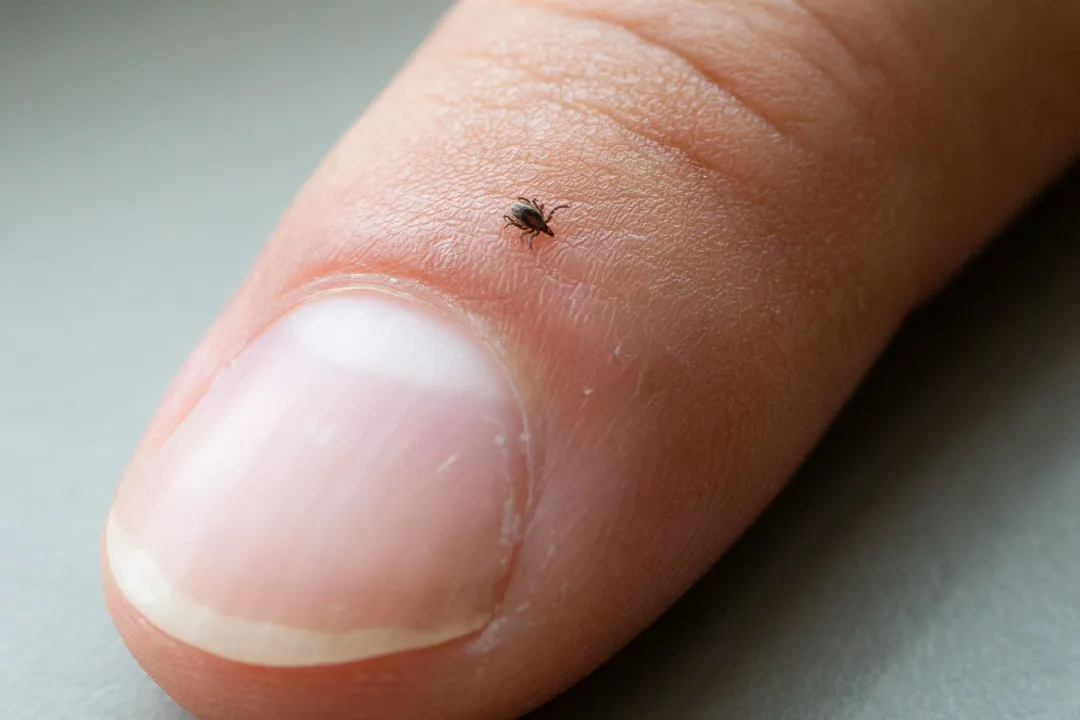
The behavior known as questing is a highly specialized waiting strategy employed by ticks when actively seeking a blood meal. During this process, the tick elevates itself by climbing onto low-lying vegetation, such as grass blades or small shrubs. To maximize its sensory input, the tick anchors itself securely to the plant stem using its hind legs. Its front legs, conversely, are held high and fully extended into the air. These outstretched front appendages act as sensory organs, detecting critical cues like the carbon dioxide exhaled by a passing host, thermal signatures (heat), and subtle ground vibrations indicating movement nearby.
Related Questions
What is the absolute dietary requirement for *Dermacentor* tick development?How does the adult male wood tick's blood meal requirement compare to the female's?What substance is secreted by the tick's *capitulum* to prevent immediate host detection?What small mammals are typical hosts for larvae and nymphs of *D. andersoni*?Which group of animals defines the common host preference for adult *D. variabilis*?When questing, how does a tick utilize its legs to sense potential passing hosts?What physical height range corresponds to the common questing posture of nymphs and adults?What happens after a tick ingests blood that prepares it for future pathogen injection?Which specific disease is transmitted by *D. andersoni* but not generally associated with *D. variabilis*?Why is the feeding dependency of *D. andersoni* larvae/nymphs on small mammals ecologically significant?