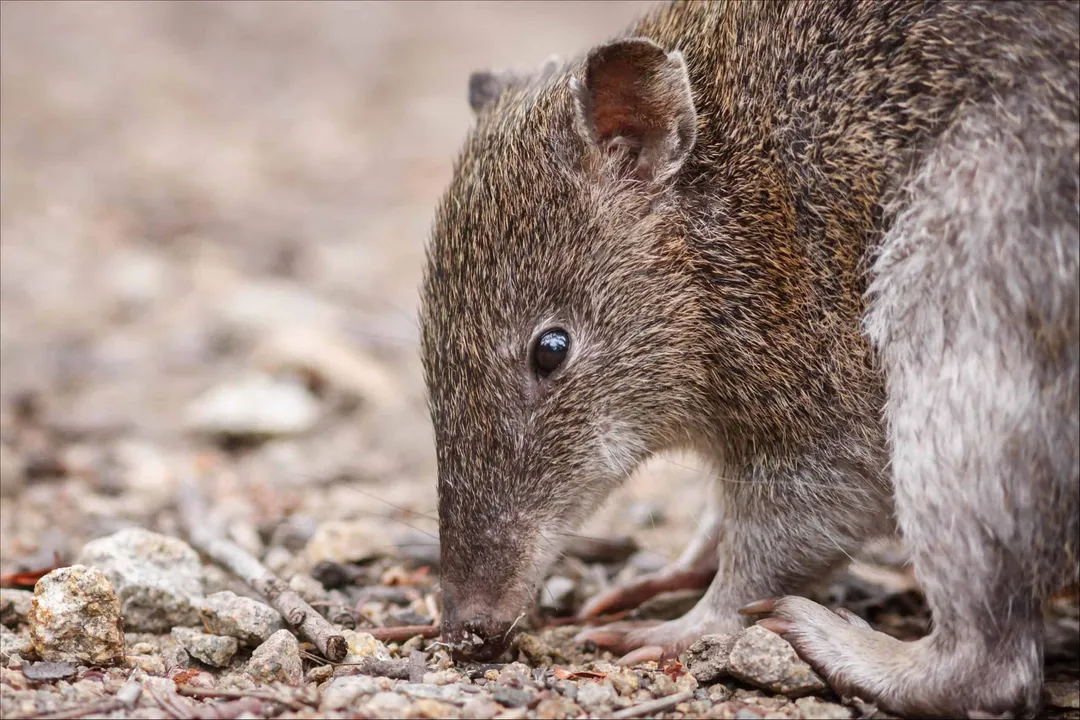
What is the primary function of the earthy coloration and coarse fur seen on the Northern Brown Bandicoot?
Answer
It provides cryptic coloration to blend into leaf litter and shadows for passive defense
The fur of the Northern Brown Bandicoot (*Isoodon macrourus*) serves a vital passive defense role through camouflage. The coloration, typically consisting of browns, tans, and grayish hues, allows the stout-bodied animal to merge seamlessly with its environment—the soil, leaf litter, and shadows found on the forest floor or grassland. This cryptic coloration means that when the bandicoot pauses its movement or remains still while resting in shallow scrapes during the day, it becomes significantly harder for visual predators to detect it, thereby acting as a fundamental, non-energetic defense mechanism.
Related Questions
What system is optimized for elastic recoil in the bandicoot's disproportionately long hind limbs?How does the elongated snout of the Long-Nosed Bandicoot aid in foraging efficiency?Why do ground-dwelling bandicoots typically have tails short relative to body length?What characteristic of bandicoot teeth reflects their omnivorous diet requiring varied processing?What is the primary function of the earthy coloration and coarse fur seen on the Northern Brown Bandicoot?Which term describes the characteristic locomotion driven by the bandicoot's long and powerful hind legs?What primary evolutionary pressure is highlighted by the functional separation of hind and forelimb duties?What is the functional specialization of the bandicoot's shorter, immensely strong forelimbs?Due to their small, compact body size, what physiological tendency related to temperature regulation do bandicoots face?How do the hind limbs compare biomechanically to the forelimbs during the power stroke of digging for the bandicoot?