What are some physical characteristics and adaptations within the Chinese giant salamander?
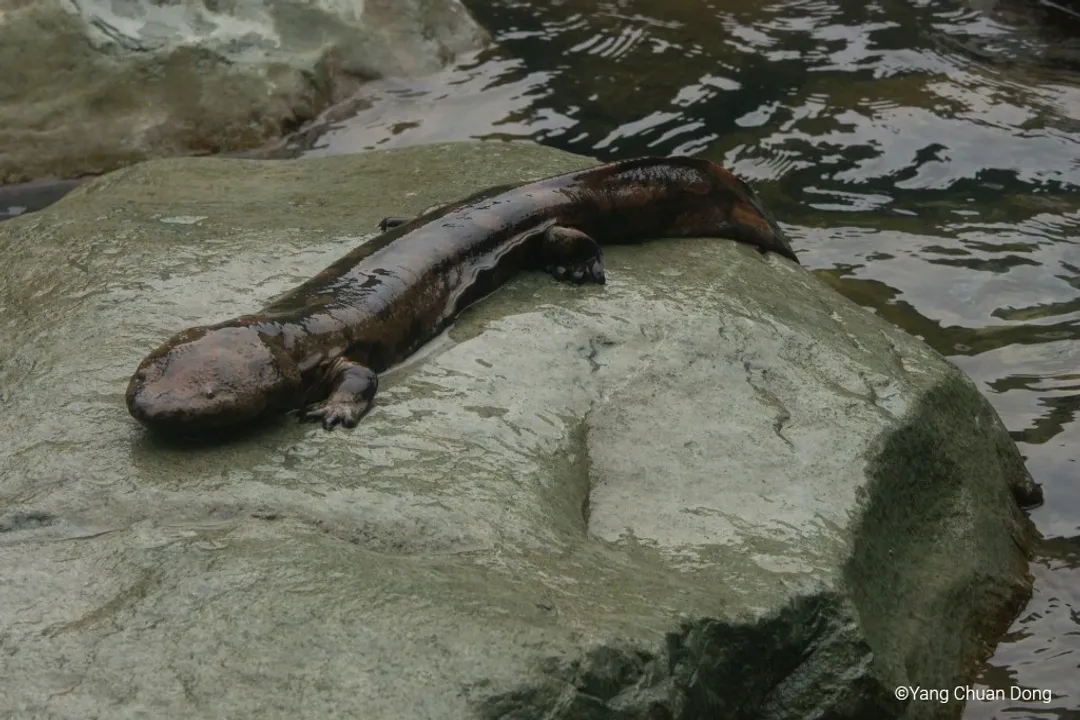
The Chinese giant salamander, Andrias davidianus, holds a remarkable place in the world of amphibians, recognized globally as the largest living amphibian species. [2][3][5] These creatures are titans of the freshwater world, capable of reaching impressive lengths, sometimes up to 1.8 meters (6 feet), [2][3] and weighing as much as 50 kilograms (110 pounds). [2][3] Such massive dimensions place them in a category far exceeding most of their cold-blooded relatives.
# Body Form
The overall physique of the Chinese giant salamander is geared toward a bottom-dwelling, sedentary existence in cool, flowing water. Their body is notably broad and flattened, [1] a shape that likely aids in pressing themselves against the substrate, minimizing drag from currents, and perhaps even assisting in camouflage among river rocks. They possess four short, stubby legs, [1][3][5] which are not built for swift terrestrial movement but are adequate for a slow, deliberate crawl along the riverbed. [1] The head is large relative to the rest of the body, [1][3] providing ample room for the powerful jaws needed to secure prey.
# Skin and Coloration
One of the most immediately striking physical aspects of the Andrias davidianus is its skin. It is characteristically slimy, [7] providing a moist, permeable surface vital for gas exchange. Furthermore, the skin is wrinkled and loose, [1][3] a feature that directly translates into a significant functional adaptation.
The coloration displayed by these giants is typically a mottled pattern of brown, grey, or black. [1][3][5] Some individuals may exhibit lighter spots against this dark background. [5] This pigmentation serves as excellent cryptic coloration, allowing the animal to blend seamlessly with the muddy or rocky bottoms of its native streams and rivers. [1] It’s fascinating to consider that this large, slow-moving creature relies so heavily on remaining visually undetected by both predators and unwary prey, given its size. For an animal of this magnitude, maintaining effective camouflage is an absolute necessity for survival, particularly when compared to smaller, more agile amphibians that might rely on speed for escape.
# Respiration Adaptation
Perhaps the most significant adaptation linked to the salamander’s physical structure concerns how it breathes. Adult Chinese giant salamanders lack true gills and rely minimally on lungs, if they possess functional ones at all in some life stages. [3][7] Their primary mode of respiration is cutaneous—breathing directly through the skin. [2][3][7]
This reliance on the skin dictates several physical requirements. First, the skin must remain perpetually moist, which is why they inhabit aquatic or semi-aquatic environments. [3] Second, to achieve sufficient oxygen uptake for a creature of such large mass, the surface area of the skin needs to be maximized. This is precisely where the loose, folded, and wrinkled texture comes into play. [1][3] These numerous folds drastically increase the effective surface area available for absorbing dissolved oxygen from the water, a crucial trade-off for an amphibian that foregoes the more efficient respiratory structures of fish or terrestrial vertebrates. This heavy dependence on skin respiration also imposes a lower metabolic ceiling; they cannot sustain high activity levels for long periods without depleting their oxygen supply, which explains their predominantly sedentary lifestyle. [1]
# Sensory Systems
The sensory apparatus of the Chinese giant salamander presents a clear picture of specialization toward a dark, murky, low-visibility habitat. Physically, they possess small eyes, [1][3][7] which translates directly to poor vision. [1][3][7] Daylight is often avoided, and in the dark river bottoms they frequent, sight is not a reliable tool for navigation or hunting.
To compensate for this visual limitation, the salamander has evolved an exceptional reliance on its lateral line system. [1][3][7] This system, common in fish and aquatic amphibians, consists of a series of neuromasts—sensory cells—that detect minute changes in water pressure, vibration, and water movement. [1][3] In the Chinese giant salamander, this system runs along the sides of its body, acting as an incredibly sensitive radar for detecting the presence, size, and direction of anything moving nearby. [1] An observer watching one of these animals in a clear enclosure might note that it often ignores slow-moving objects in its direct line of sight but reacts instantly to a subtle ripple created by a hand waved nearby—a clear demonstration of the lateral line system overpowering visual input. [8] This adaptation underscores a life lived in tactile awareness of its surroundings rather than through sight.

# Size and Growth Variation
The massive size attained by this species is a key characteristic, yet the specimens encountered in the wild today often fall far short of the documented maximum size. [4] While museum specimens and historical records boast lengths near 1.8 meters, many wild individuals are considerably smaller, reflecting pressures like habitat degradation and historical over-exploitation. [4]
| Characteristic | Typical Adult Measurement | Maximum Recorded Measurement |
|---|---|---|
| Length | Varies significantly; often less than 1m | Up to 1.8 meters (6 feet) [2][3] |
| Weight | Relatively unknown for wild adults | Up to 50 kilograms (110 pounds) [2][3] |
| Lifespan | Can exceed 50 years in captivity [2][5] | N/A |
It is noteworthy that in captivity, where food is predictable and threats are absent, these salamanders can achieve impressive longevity, sometimes living for 50 years or more. [2][5] This suggests a naturally slow metabolism and development rate, which pairs logically with their low-energy, skin-breathing lifestyle in the wild.
# Locomotion and Posture
When not using its short limbs to drag itself along the bottom, the Chinese giant salamander exhibits a unique behavior in water: it frequently holds its head above the surface. [6] While this might seem counterintuitive for an animal that breathes through its skin, this behavior is often observed in individuals resting near the surface or when conditions—perhaps water temperature or low dissolved oxygen content—prompt them to seek the air interface, even if lungs are vestigial. [6] In terms of movement, whether on land or water bottom, it relies on a slow, crawling motion facilitated by its short limbs. [1] This contrasts sharply with the quick, darting movements characteristic of many smaller, more agile amphibians.
# Physical Traits Summary Table
To better visualize the specialized nature of this amphibian, we can summarize its key physical features and their direct adaptive purpose:
| Physical Feature | Description | Primary Adaptation |
|---|---|---|
| Size | Largest living amphibian, up to 1.8m [2][3] | Survival advantage; limited predation as an adult. |
| Skin | Loose, wrinkled, and slimy [1][3][7] | Maximizes surface area for cutaneous respiration. |
| Eyes | Small [1][3][7] | Reduced energy expenditure for a poorly utilized sense in dark water. |
| Sensory Pits | Well-developed lateral line system [1][3][7] | Detects movement and pressure in dark/turbid water environments. |
| Limbs | Short and stubby [1][3][5] | Suited for slow locomotion on the substrate. |
The sheer disparity between their potential size and their primary respiratory method—relying on highly convoluted skin—is a study in evolutionary compromise. A very large lung would require complex musculature to inflate and a high metabolic rate to support the necessary oxygen demands, which would clash with the energy-saving strategy of skin breathing in a cool, oxygen-limited habitat. The wrinkled skin is, therefore, a magnificent adaptation allowing the maintenance of large body mass while adhering to a low-energy respiratory budget. [1][3] When viewing these animals, whether in a scientific context or a carefully managed public display, recognizing that their primary mode of sensing the world involves feeling vibrations rather than seeing shapes changes the entire interaction, moving the observer's focus from direct sightlines to subtle disturbances in the water column. [8]
Related Questions
#Citations
Chinese Giant Salamanders (Andrias spp.) Fact Sheet - LibGuides
Chinese Giant Salamander | San Diego Zoo Animals & Plants
Andrias davidianus | INFORMATION - Animal Diversity Web
Chinese giant salamander - Wikipedia
Chinese Giant Salamander | San Diego Zoo Wildlife Explorers
Chinese Giant Salamander | Life in Water Wiki | Fandom
Chinese Giant Salamander Behavior - Facts and Details
Chinese Giant Salamander Facts - Earth's Endangered Creatures