What anatomical feature, besides the feet, is critical for support when the Yellow-bellied Sapsucker clings to vertical surfaces?
Answer
Stiff, pointed tail feathers functioning as a critical tripod.
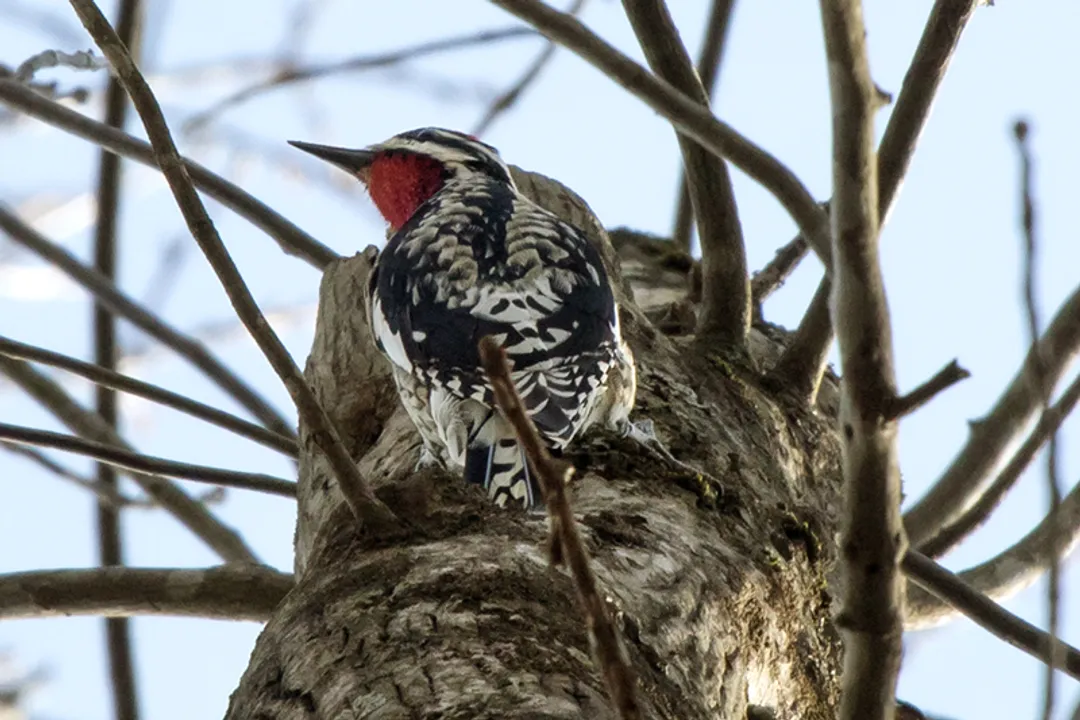
To maintain balance and leverage while feeding or clinging vertically on tree trunks, the Yellow-bellied Sapsucker utilizes specialized stiff, pointed tail feathers. These feathers are angled downward and press into the bark, effectively creating a rigid support system that functions as a tripod. This bracing mechanism allows the bird to lean back away from the trunk while using its chisel-shaped bill to drill or sip sap, a common requirement for its lifestyle.
Related Questions
What characteristic feeding behavior defines the Yellow-bellied Sapsucker?Which physical characteristic is highly conspicuous, appearing as a distinct white block on the wings?What term describes the specialized foot arrangement of the Yellow-bellied Sapsucker for clinging to vertical surfaces?How does the general size of the Yellow-bellied Sapsucker compare when viewed alongside a Red-bellied Woodpecker?What is the primary difference in head markings used to sex an adult Yellow-bellied Sapsucker in the field?What plumage characteristic distinguishes juveniles from mature Yellow-bellied Sapsuckers?What anatomical feature, besides the feet, is critical for support when the Yellow-bellied Sapsucker clings to vertical surfaces?Where is the red coloration found on an adult male that helps clearly flag his sex, alongside the throat patch?Why should field observers often prioritize looking for sap wells over confirming the belly color for identification?How do the bill and overall build of the Yellow-bellied Sapsucker relate to other woodpeckers?