Yellow Bellied Sapsucker Facts
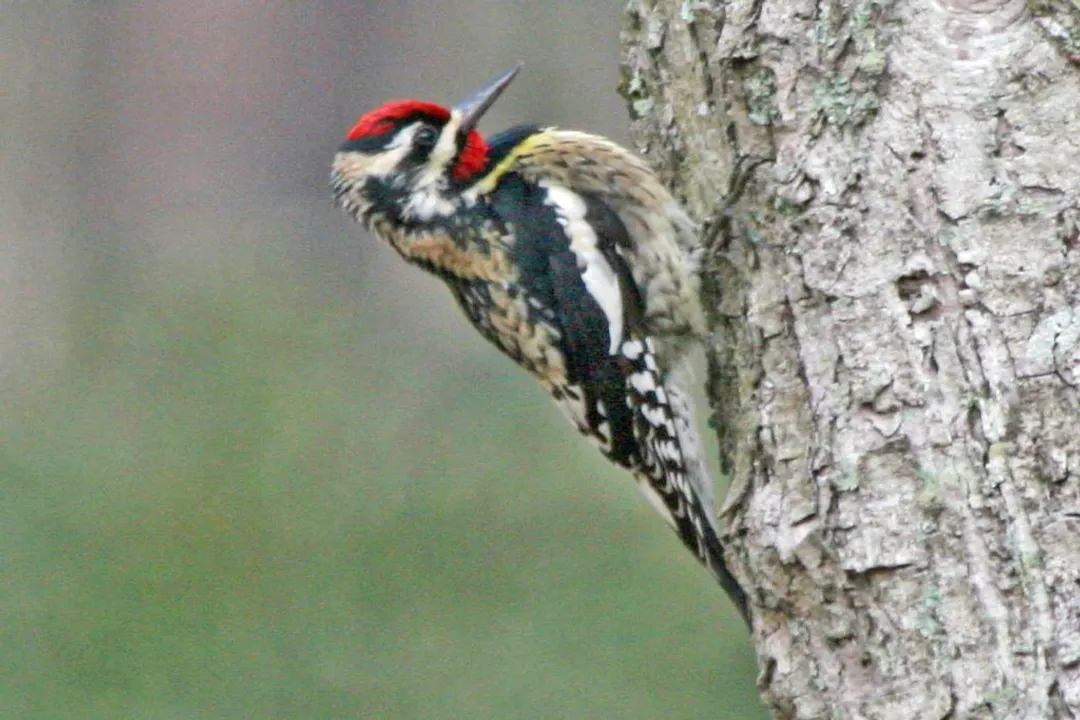
The Yellow-bellied Sapsucker is a fascinating resident of North American woodlands, often recognized not by sight, but by the unique, geometric patterns of holes it leaves drilled into the bark of its favorite trees. [1][4] Unlike many of its woodpecker cousins, this bird is less focused on excavating deep cavities for insects and more interested in the sugary liquid flowing just beneath the surface. [1][3] This specialized feeding technique sets it apart within the Picidae family, making it a subject of both curiosity and occasional concern among tree owners. [1][2]
# Markings Plumage
Identifying the Yellow-bellied Sapsucker requires a close look, as they are subtly patterned compared to the bold contrasts of a Hairy Woodpecker or a Flicker. [1] Males and females share a striking black-and-white barred pattern across their backs and flanks. [1][4] The bird gets its name from the faint yellowish wash visible on its otherwise white belly and flanks, though this color can be difficult to spot in the field. [1][5] Key distinguishing features involve the head markings and throat patches. [5] Adult males display a solid black throat, a bright red forehead patch, and a red throat. [1][5] Adult females, in contrast, lack the red on the throat, featuring a white or buffy throat patch instead, though their forehead may still show some red. [1][5] Juvenile birds are generally duller, often lacking significant red markings entirely. [5] They are medium-sized woodpeckers, generally measuring around 7 to 9 inches in length. [4]
# Where Found
The distribution of the Yellow-bellied Sapsucker shifts dramatically with the seasons, covering a vast swath of North America. [1][4] During the breeding season, these birds venture quite far north, inhabiting mixed and deciduous forests across the boreal regions of Canada and the northern United States, including the Great Lakes region. [1][4][10] They show a preference for areas with abundant sap-producing trees like birch, maple, and cherry. [1][10] When autumn arrives, the majority of the population undertakes a significant migration south. [1][4] Wintering grounds extend through the eastern and southern United States, reaching into Mexico, Central America, and the Caribbean islands. [1][4] It is interesting to note that while most populations migrate, some individuals may remain year-round in areas where suitable food sources persist, often near human habitation or in regions that avoid deep freezes. [1]
# Sap Wells
The defining characteristic of this species is its method of procuring food, which centers entirely around drilling sap wells. [1][3] They do not drill large, deep holes as other woodpeckers might; instead, they create rows of small, perfectly round holes, usually about 1 to 2 inches apart, often piercing the sapwood just beneath the bark. [1][3] These neat arrangements of holes are known as sap wells. [1][3] The bird returns repeatedly to these wells to lap up the oozing sap, which forms its primary sustenance for much of the year. [1][3] While sap is the main attraction, sapsuckers supplement their diet with the insects—ants, beetles, and flies—that are inevitably drawn to the sugary flow. [1][3] This reliance on sap means that the preferred tree species are those with copious sap flow, such as sugar maples, paper birches, and various fruit trees. [2] If you are ever trying to confirm a sighting during the non-breeding season, looking for these distinct rows of holes, sometimes described as looking like neat rows of punctures or even looking like an insect emerging from the tree, can be a reliable indicator of their recent activity, even when the bird itself is elsewhere. [6] A mature, healthy tree can often sustain this light tapping without significant long-term damage, though dense concentrations of wells can stress weaker individuals. [2]
# Calls Drumming
The vocalizations of the Yellow-bellied Sapsucker are quite distinct from the loud hammering associated with many other woodpeckers. [1] Their typical call during the breeding season is often described as a lazy, nasal mew or quee-ah, frequently repeated in short series. [1][5] This call is generally less emphatic than the vocalizations of their relatives. [1] In addition to their calls, they have specialized drumming patterns used for territorial display and mate attraction. [1][4] The drumming is a rapid, uneven series of taps, often mixed with a rattling sound. [1] It sounds somewhat deliberate and almost hesitant compared to the steady, powerful drumming of a Pileated Woodpecker. [4] Observers often note that the drumming sequence sounds like a series of stops and starts, rather than a continuous, rapid roll. [1]
# Nesting Cycle
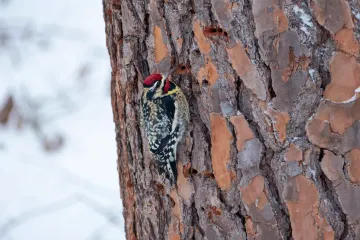
Like most woodpeckers, the Yellow-bellied Sapsucker excavates cavities for nesting, usually selecting dead or decaying trees or limbs. [1][4] They typically create nests in hardwoods or conifers. [1] The entrance hole is often circular and relatively small, usually less than 2 inches in diameter. [4] Once the cavity is finished, the female typically lays between four and six white eggs. [1] Both parents share the duties of incubating the eggs and caring for the young, though the female often takes on a larger role in incubation during the day. [1] The nest cavity itself might be lined with wood chips excavated during construction. [4] Young sapsuckers remain in the nest for several weeks before fledging, relying entirely on the parents for food, which at that stage consists of both insects gathered from sap wells and, occasionally, excavated wood-boring larvae if the parents deem it necessary. [1]
# Seasonal Travel
The migratory habits of the Yellow-bellied Sapsucker tie directly into the availability of sap flow. [1] When the cold sets in and tree sap congeals or stops flowing readily, the impetus to move south becomes strong. [1] Their migration is not always swift; they often move deliberately, pausing in suitable wooded areas along the route to exploit temporary food sources. [1] For instance, a flock moving through an area might shift from tapping maples in a northern hardwood forest to exploiting cherry trees further south as they work their way toward the Gulf Coast or the southern United States for the winter. [1] This movement pattern ensures they can maintain their specialized diet throughout the year, adapting to the seasonal dormancy cycles of their preferred trees. [1]

# Tree Impact
The interaction between the Yellow-bellied Sapsucker and forest trees presents a spectrum of outcomes. [2] For the bird, the practice is essential for survival. [3] For the tree, the effect varies based on the tree's health and the intensity of the drilling. [2] In high densities, especially in young orchards or ornamental trees, the drilling can cause significant dieback in branches or even girdle the tree, leading to its death. [2] However, in a natural forest setting, the bird is generally considered a minor component of forest ecology. [1] The abandoned sap wells sometimes become secondary homes for smaller insects or even tiny, later-nesting birds that may utilize the holes once the sapsucker has moved on. [1] If you observe these drilling patterns on your property, especially on large, established trees, consider leaving the area alone for a season. A few sap wells are just a sign of natural foraging, and interfering might simply drive the bird to a more vulnerable sapling if it feels its immediate food source has been disturbed. [2] Furthermore, if you note a particular tree being heavily worked on, check the tree itself for signs of underlying stress or insect infestation; sometimes, the sapsucker is capitalizing on a tree already weakened by other factors. [2]
#Videos
Yellow-bellied Sapsucker. A real bird! Exciting Facts for You!
Related Questions
#Citations
Yellow-bellied Sapsucker - All About Birds
More Cool Facts About the Yellow-Bellied Sapsucker
Yellow-bellied sapsucker - Wikipedia
Yellow-bellied Sapsucker | Audubon Field Guide
Yellow-bellied sapsucker
Yellow-bellied Sapsuckers in Eastern North America ... - Facebook
Yellow-bellied Sapsucker. A real bird! Exciting Facts for You!
Yellow-bellied Sapsucker | State of Tennessee, Wildlife Resources ...
Yellow-bellied Sapsucker "Sphyrapicus varius" | Boreal Songbird ...