Yellow Tanager (Black-and-Yellow Tanager) Physical Characteristics
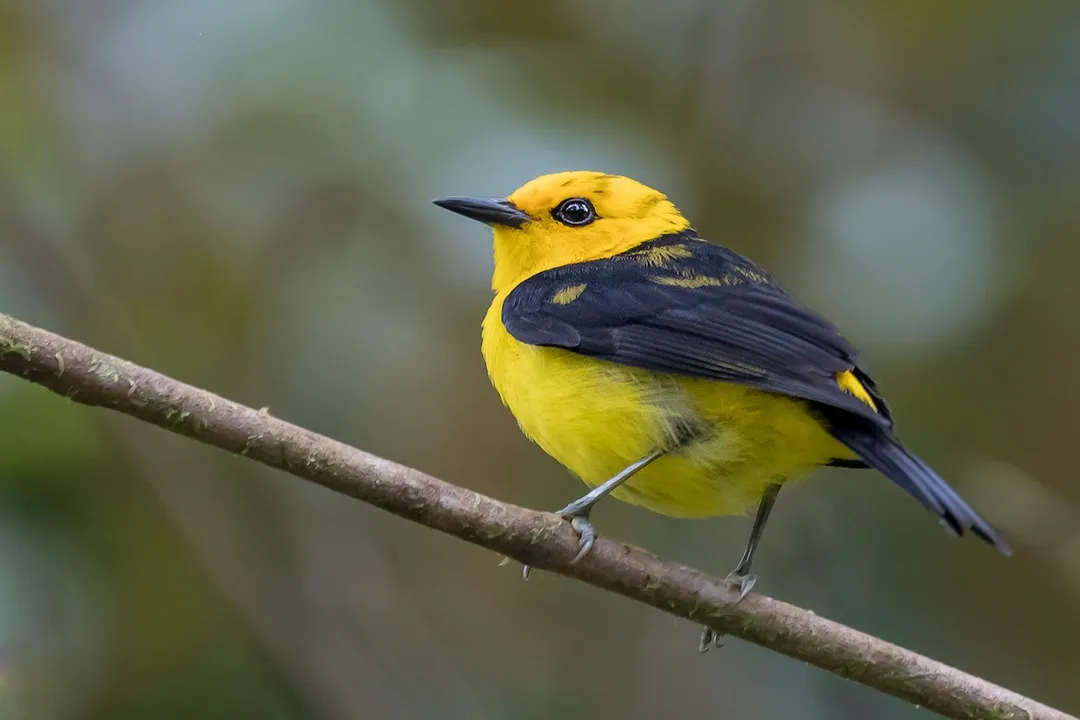
The Black-and-Yellow Tanager, often simply called the Yellow Tanager, presents one of the most striking visual contrasts among the tanager family, immediately earning its common moniker. Distinguishing this species relies heavily on recognizing the sharp delineation between its brilliant yellow and deep black plumage, a pattern that remains relatively consistent across its range, though subtle variations exist between the sexes. [1][3][5]
# General Dimensions
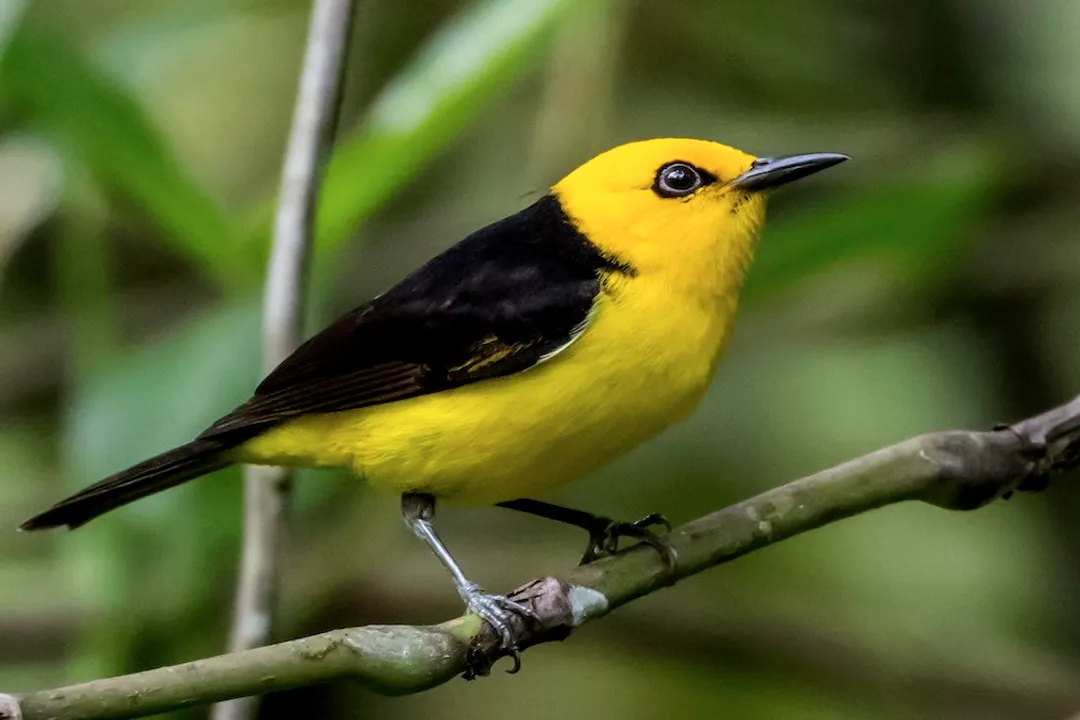
This is a relatively small bird, fitting neatly within the typical measurements for many neotropical passerines. The total length for an adult bird generally falls between 13 and 14 centimeters. [1][4] In terms of mass, they are quite light, usually weighing in the range of 13 to 19 grams. [1][2] When you consider that a typical small songbird might be slightly lighter, the Black-and-Yellow Tanager occupies a familiar, compact niche in the forest canopy. [4] The consistency of these measurements across different observational reports—noting lengths around 13.5 cm or weights near 17 grams—suggests a very uniform body plan for this species, unlike some relatives where size variation might be more pronounced. [3][4][5]
# Plumage Detail
The signature feature of this tanager is its coloration. The majority of the body, particularly the underside, is a vibrant, almost pure yellow. [2][7] This bright hue covers the throat, breast, belly, and undertail coverts, making the bird highly conspicuous when glimpsed in a sunlit patch of foliage. [4]
Contrasting sharply with this yellow is the extensive black patterning. The head, in adult males especially, is dominated by a black hood that covers the face, throat, and extends onto the upper breast. [1][2][5] The back, upperwing coverts, and tail feathers are also predominantly black, often appearing dark olive or greenish-black in certain light, which helps them blend slightly when viewed from above or when they are foraging in denser shade. [3][7] The wings themselves display this black base color, sometimes interspersed with yellow edging on the tertials or secondaries, creating a scaled or barred effect when the wings are folded. [1]
When observing this bird in the dense, filtered light common in its habitat, the intensity of the yellow versus the depth of the black becomes a crucial identification point. A slightly duller bird might lead an observer to consider a juvenile or female, but even the dullest individual retains that characteristic strong contrast, which is rare among species that transition more smoothly between yellow and olive tones. [7]
# Sex Distinction
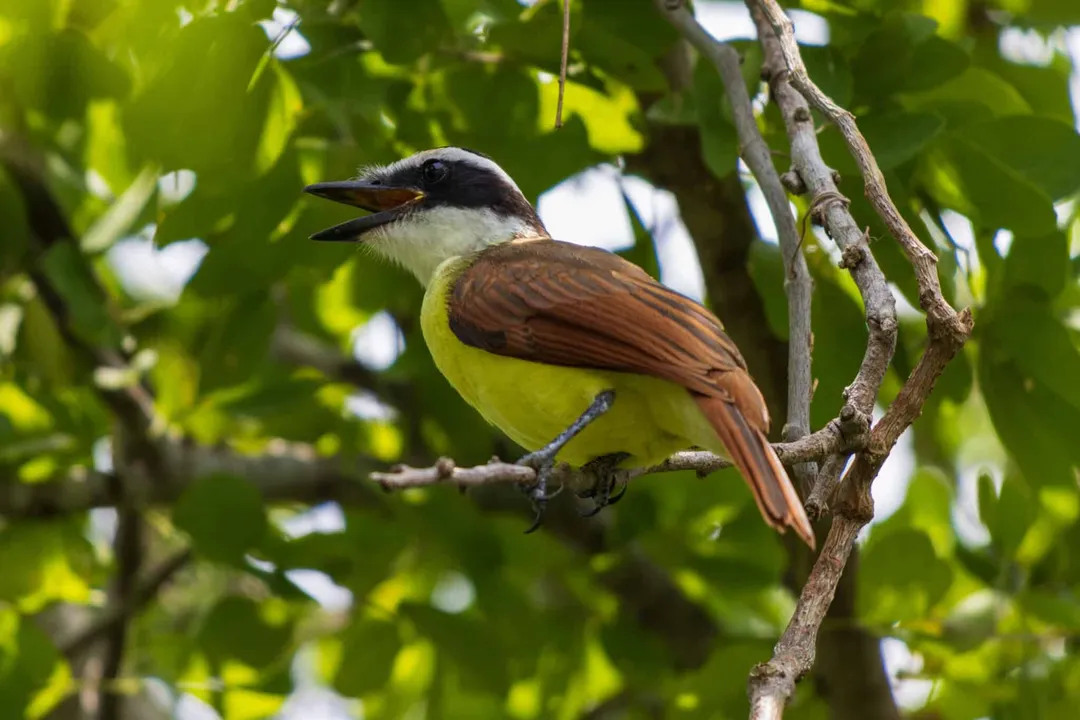
Sexual dimorphism is present in the Black-and-Yellow Tanager, though it is usually a matter of degree rather than completely different color schemes. [1][5]
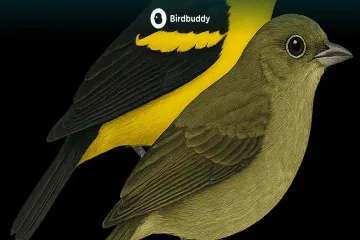
The adult male exhibits the brightest and most extensive black hood, often covering nearly the entire head down to the upper chest, and possessing the deepest black on the back and wings. [3]
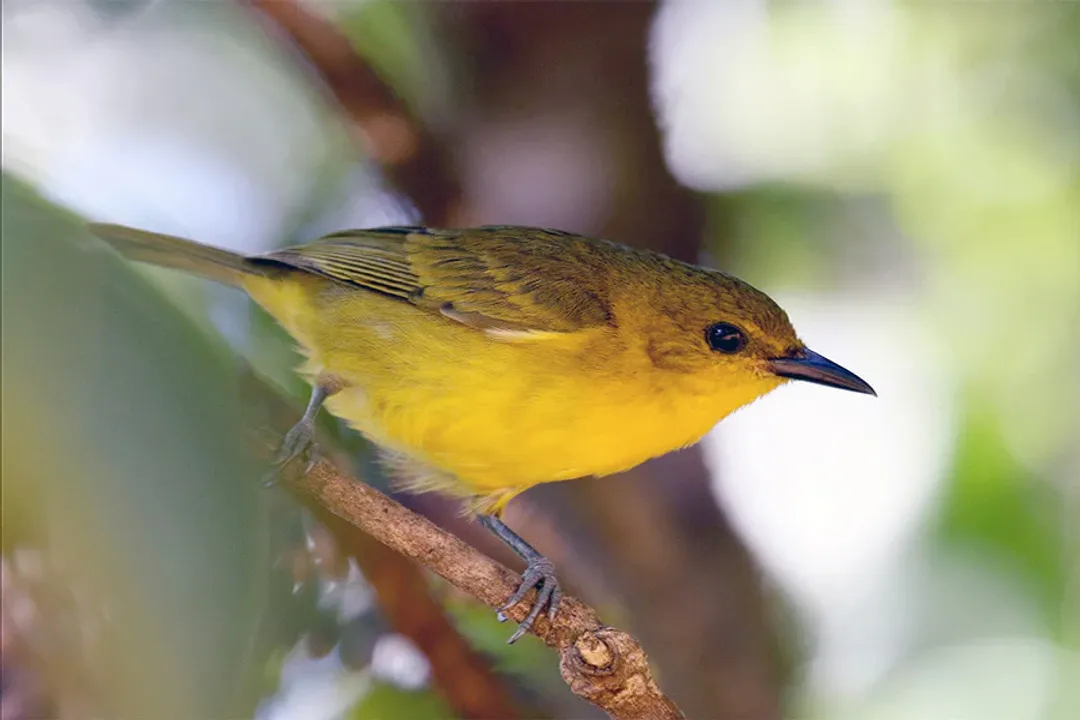
Females, conversely, are generally duller overall. [1][5] Their yellow may appear slightly paler, sometimes leaning toward an orangey-yellow or even a greenish-yellow wash, particularly on the flanks. [5] Crucially, the black hood on the female is often reduced. Instead of a solid black head, a female might show a yellowish wash mixed into the throat or show black restricted primarily to the lores (the area between the eye and the bill) and upper back, allowing more yellow to show on the crown and face. [1][3] While the male presents a distinct black-and-yellow dichotomy, the female presents a more variegated or muted version of the same pattern. [5]
# Facial Features
The head structure is typical for a tanager: relatively robust but streamlined. The bill is short, thick, and conical, which is characteristic of seed and fruit eaters, though their diet also includes insects. [2][4] The bill itself is usually dark—often described as black or dark gray—providing a stark focal point against the bright plumage of the face, especially in males. [2] The eyes are dark, blending into the black mask area in males, making them difficult to discern unless the bird is positioned perfectly. [2][4]
# Limb Appearance
The legs and feet of the Black-and-Yellow Tanager are dark, typically appearing black or dark gray, matching the bill color. [2] These sturdy appendages are perfectly adapted for perching on thin branches and maneuvering through the dense foliage where they spend much of their time feeding. [4]
# Identifying Juveniles
Young birds look considerably different from the adults, which is a common trait across many bird species where camouflage is prioritized early in life. [1] Juvenile plumage lacks the sharp, distinct black areas seen in mature birds. Instead, they are generally more olive-green or grayish-yellow overall. [1] The head and back often show dusky or olive mottling rather than solid black patches. As they mature, the clear yellow underparts and strong black patterning gradually replace this duller juvenile dress. [1]
# Field Identification Consideration
For anyone actively seeking this bird in the field, one helpful observation concerns the feather texture and shine. While the yellow is bright, the black areas on a healthy adult male often exhibit a slight gloss or sheen, particularly on the back and crown, making them appear richer and deeper black than a simple matte color. [7] This subtle difference in light reflection between the two main colors aids in separating it from congeners that might share similar hue but lack this specific sheen contrast. Knowing the expected size (~14 cm) is also key; if a bird appears significantly larger, you might be looking at a different, though perhaps similarly patterned, species in the region. [3][4]
Related Questions
#Citations
Black-and-yellow Tanager Chrysothlypis chrysomelas - eBird
Yellow Tanager (Black-and-Yellow Tanager) Bird Facts - A-Z Animals
Black-and-yellow Tanager - Birds of Colombia
Black-and-yellow tanager - Facts, Diet, Habitat & Pictures ... - Animalia
Black-and-yellow Tanager
Black-and-yellow Tanager - Chrysothlypis chrysomelas
Yellow Tanager (Black-and-Yellow Tanager) Facts & Photos
Western Tanager - Montana Field Guide