Yellow Bellied Sapsucker Physical Characteristics
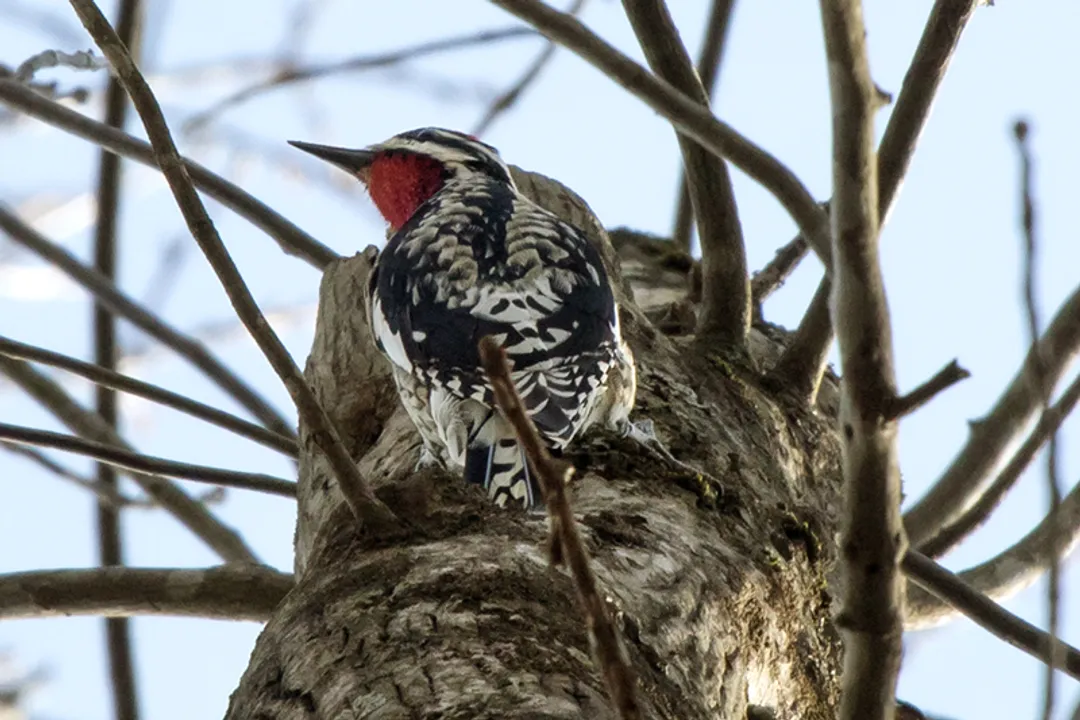
The Yellow-bellied Sapsucker presents a striking, yet sometimes confusing, black-and-white pattern that characterizes many North American woodpeckers, though closer inspection reveals subtle yet crucial details setting it apart from its relatives. These medium-sized birds generally measure between 7 and 9 inches in length. They possess a fairly stocky build, distinguishing them from some of the more slender woodpecker species. While they share the typical woodpecker structure, their characteristic feeding behavior—drilling neat rows of small holes, or sap wells, into trees to drink the flowing sap—often gives away their identity before their specific coloration is clearly visible.
# Size and Shape
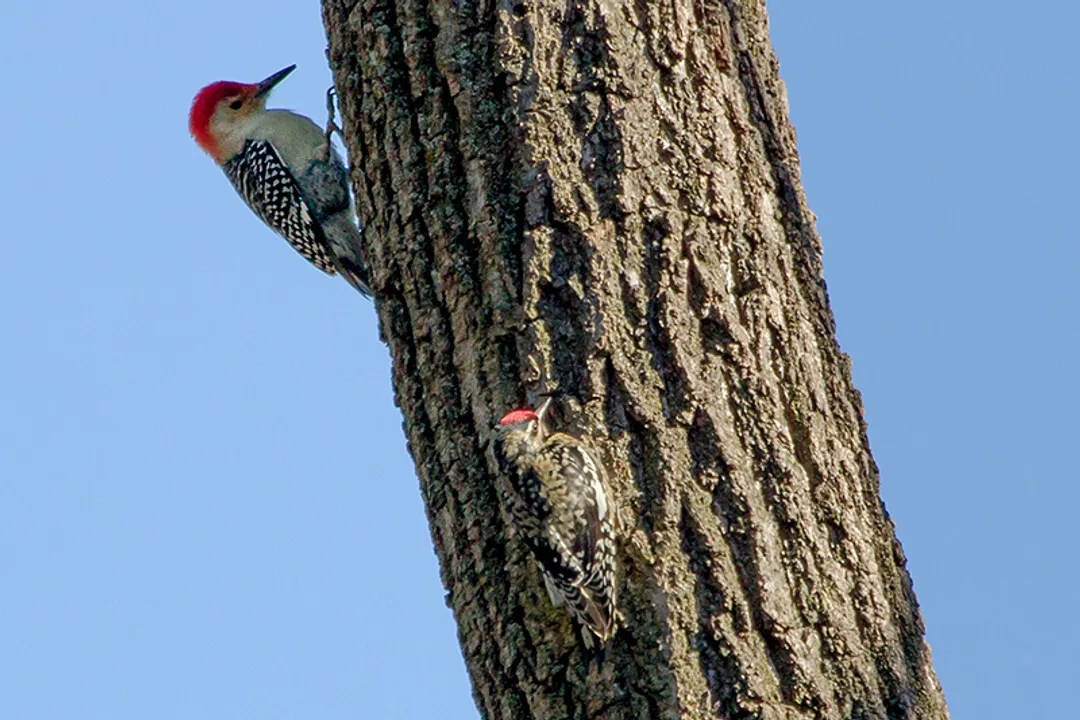
When assessing the size of the Yellow-bellied Sapsucker, one might compare it to more familiar species encountered in the same habitats. It is generally considered similar in size to the Downy Woodpecker, though it tends to appear bulkier or more substantial in the field. Conversely, when placed next to a larger species like the Red-bellied Woodpecker, the Sapsucker appears noticeably smaller. Their overall posture and shape are classic woodpecker, featuring stiff tail feathers that help prop them up against tree trunks while they work.
# Adult Plumage
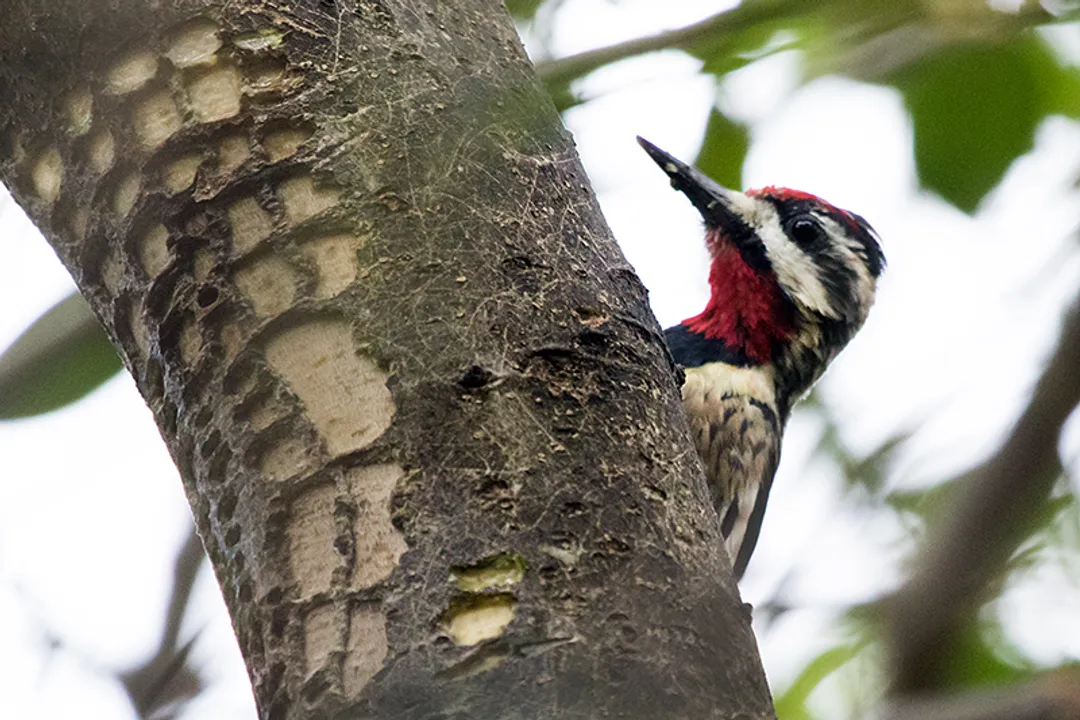
The plumage of the adult Yellow-bellied Sapsucker is dominated by a bold, high-contrast black and white appearance. The back is distinctly black, heavily marked with horizontal white barring, giving it a heavily patterned look from a distance. A significant field mark visible when the bird is perched or flying is a large, prominent white square patch located on the wing. The breast and belly area is where the namesake color lies, appearing buffy white or exhibiting a pale yellowish wash. It is worth noting that this yellowish hue is often quite subtle, making the bird appear predominantly black and white in dimmer light or when seen briefly, which can lead to misidentification if one relies solely on catching that specific color flash.

# Sexual Dimorphism
Sexual differences in this species are most apparent on the head and throat, providing reliable means for distinguishing males from females during breeding season. The adult male sports a brilliant red throat patch situated just below the black-and-white striped face pattern. The female, however, lacks this red throat; her corresponding area is a plain white. Both sexes share the overall black-and-white striping on the head, featuring broad white stripes running from the base of the bill down the sides of the neck, contrasting sharply with the surrounding black areas. This clear difference in the throat coloration means that a sharp observation of the throat area is the quickest way to sex an adult bird in the field.
# Juvenile Appearance
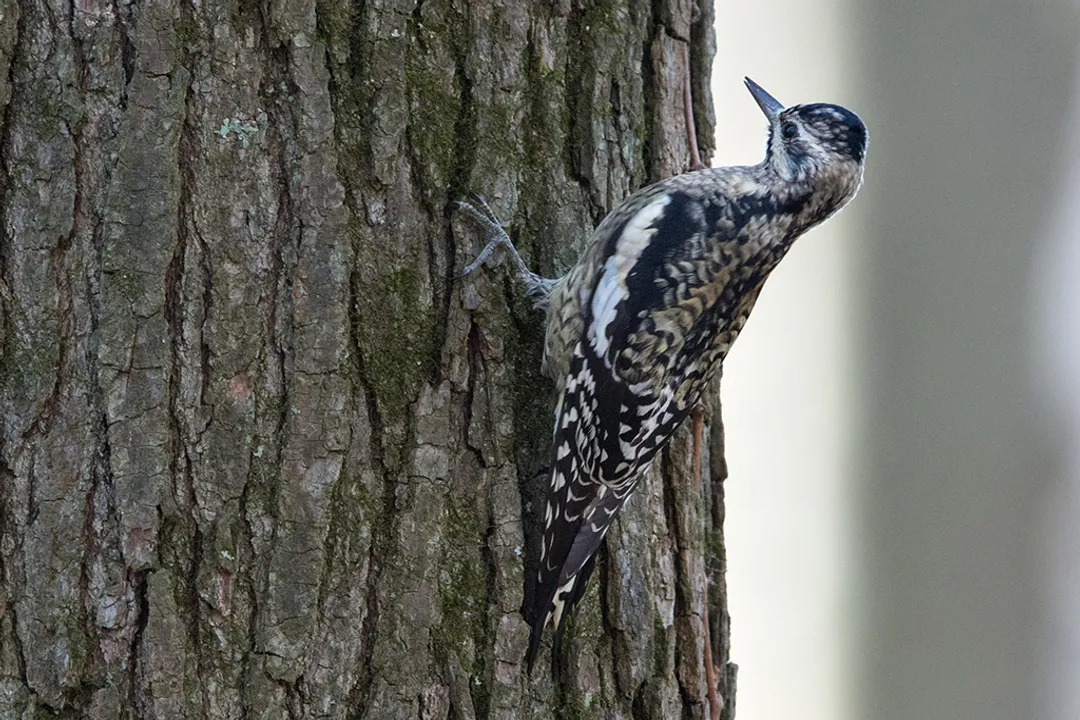
Young birds, or juveniles, present a somewhat duller and less defined version of the adult pattern, which can complicate identification for those expecting the bright contrasts seen in mature birds. Juveniles generally display browner tones throughout their plumage instead of the stark black and white of the adults. Crucially for identification of young birds, they lack the bright red markings entirely. Young males will begin to acquire their adult red throat patch later in their first year, but until then, both sexes appear similar to a drab adult female, relying more on the overall black-and-white barring and the distinct white wing patch for confirmation.
# Head Markings
The head pattern itself is a masterpiece of avian camouflage and signaling. The face is characterized by alternating black and white stripes, a common trait among many woodpeckers, but the specific arrangement here is diagnostic. The white stripes frame the eyes and extend downward, creating a clean, orderly appearance. In the adult male, the forecrown—the very front of the top of the head—also displays red coloration, often alongside the red throat. This combination of red on the forecrown and throat clearly flags the bird as an adult male.
# Defining Field Marks
Beyond the head colors, two other physical characteristics are paramount for identifying the Yellow-bellied Sapsucker, one being easy to see and the other frequently overlooked. The white wing patch is highly conspicuous; it appears as a distinct white block against the otherwise barred black wings, making identification straightforward even when the bird is moving quickly or seen from a distance. As mentioned, the yellow wash on the belly is the source of its name, yet it remains one of the hardest features to verify. A helpful tip for field observers is to not rely on catching this color, especially in dense woodland or during overcast weather; instead, focus on the combination of the black-and-white barring, the prominent white wing patch, and the head pattern. If you are in an area where you know sapsuckers occur, observing the pattern of neat, orderly sap wells in the bark, often in straight horizontal or vertical lines, is a better indicator of presence than trying to confirm the faint belly color. Thinking about how this subtlety contrasts with other black-and-white woodpeckers, where perhaps only the head markings might differ, emphasizes the importance of checking the wing patch and the uniformity of the barring, even when the yellow is hidden.
# Sapsucker Structure
Like all members of the woodpecker family (Picidae), the Yellow-bellied Sapsucker possesses specialized anatomical adaptations for its lifestyle. Their bill is strong, straight, and chisel-shaped, perfectly suited for drilling into wood to create those signature sap wells or deeper foraging holes when necessary. Their feet exhibit the classic woodpecker arrangement known as zygodactyly, meaning they have two toes pointing forward and two toes pointing backward. This configuration provides an exceptional grip on vertical surfaces, allowing them to cling securely while hammering or sipping sap. Although not unique to this species, the stiff, pointed tail feathers function as a critical tripod, offering support as they lean back from the trunk.
# Integrated Identification Study
When examining a bird for positive identification, it can be instructive to visualize the key differences side-by-side, especially when considering potential confusion species or the bird's own age variations.
| Feature | Adult Male | Adult Female | Juvenile |
|---|---|---|---|
| Throat | Red | White | Dull, often grayish/whitish |
| Forecrown | Red | Black/White striped | Black/White striped |
| Belly Color | Faint Yellow Wash | Faint Yellow Wash | Faint Yellow Wash |
| Back | Black with White Bars | Black with White Bars | Duller, Brownish/Grayish |
| Wing Patch | Large White Square | Large White Square | Large White Square |
If you are trying to confirm the identity of a bird that is clinging to a lower branch in bright afternoon sun, look past the faint belly color. The sheer geometry of the head stripes combined with that unmistakable, large white square on the wing surface should confirm the identification instantly. Conversely, if the bird is high up and obscured by leaves, the presence of perfectly aligned, small, shallow holes drilled into a birch or maple trunk is often a stronger clue to the Yellow-bellied Sapsucker's presence than a fleeting glimpse of its physical form. The species selects its trees based on the suitability of the sap flow, meaning the physical characteristic of the bird is often secondary to the physical evidence it leaves on the habitat. For instance, observing an individual repeatedly returning to the same tree to refresh its sap wells confirms its specialized feeding method, cementing the identification even if the lighting prevents a clear view of its throat or belly color. The consistency in size, typically hovering around 8 inches, also helps rule out smaller downy or larger hairy woodpeckers that share similar barring patterns but lack the other defining markings.
Related Questions
#Citations
Yellow-bellied Sapsucker Identification - All About Birds
Yellow-bellied sapsucker - Wikipedia
Yellow-bellied Sapsucker | Audubon Field Guide
Sphyrapicus varius (yellow-bellied sapsucker) - Animal Diversity Web
Yellow-bellied Sapsuckers - Maryland News
Yellowbellied sapsucker - Yard and Garden - Iowa State University
Yellow-bellied Sapsucker - Monticello Park Birds
Yellow-bellied Sapsucker | State of Tennessee, Wildlife Resources ...