In arid desert environments, what frequently happens to the characteristic dark diamond markings of the *Crotalus atrox* pattern?
Answer
The diamond markings become largely obscured due to pale ground coloration.
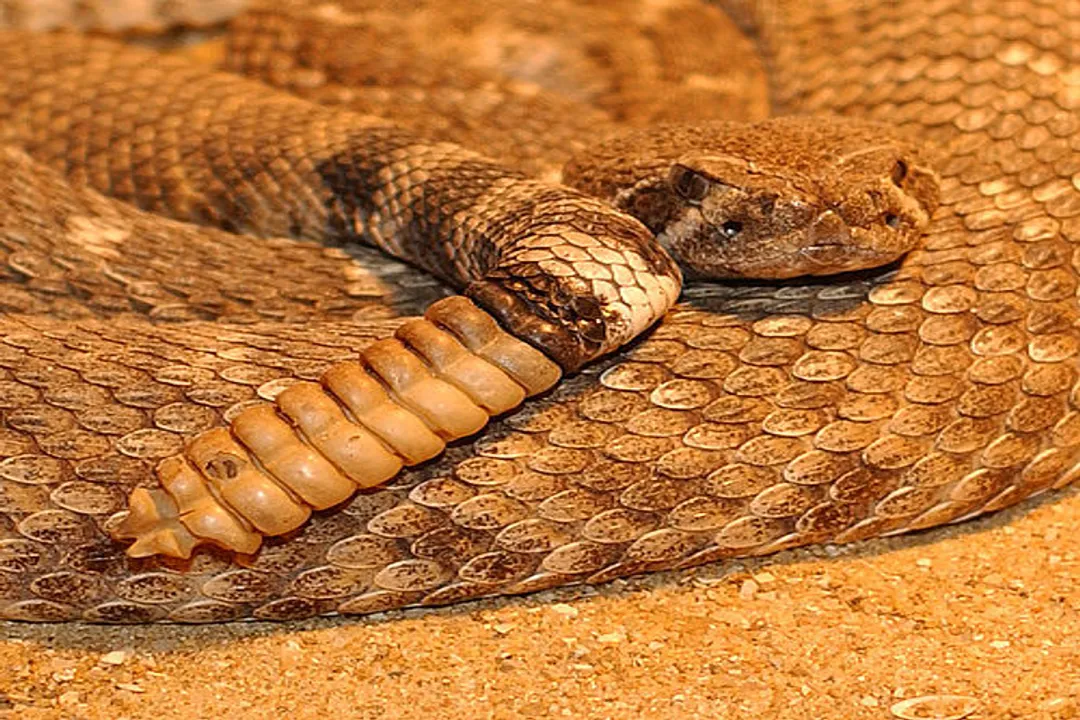
The base coloration of the Western Diamondback is highly variable, adapting to local substrate, ranging from dull gray to reddish hues. In specific arid desert environments where the sand or soil is lighter, the snake's ground color can become so pale that the overlaying dark, diamond-shaped blotches become substantially obscured or nearly invisible. In these cases, the high-contrast paler scales that border the diamonds might remain the most apparent feature of the dorsal pattern, suggesting an evolutionary advantage where matching regional soil color dictates pattern visibility.
Related Questions
What protein constitutes the structure of the *Crotalus atrox* rattle segments?What is the primary function of the specialized loreal pits on the *Crotalus atrox* head structure?What authenticated maximum length has been recorded for *Crotalus atrox* individuals?What common nickname, referencing a mammal's tail pattern, is given to the Western Diamondback Rattlesnake due to its tail rings?What specialized locomotion movement does the *Crotalus atrox* employ when navigating tunnels or tight spots efficiently?Regarding sexual dimorphism in *Crotalus atrox*, how do males compare to females in physical stature?Besides the postocular stripe, what specific stripe configuration is sometimes noted on the side of the *Crotalus atrox* head?How does the body temperature of a *Crotalus atrox* influence the speed and perceived danger of its rattle vibration?In arid desert environments, what frequently happens to the characteristic dark diamond markings of the *Crotalus atrox* pattern?How frequently must the *Crotalus atrox* shed its old skin to accommodate its growth cycle?