Western Green Mamba Physical Characteristics
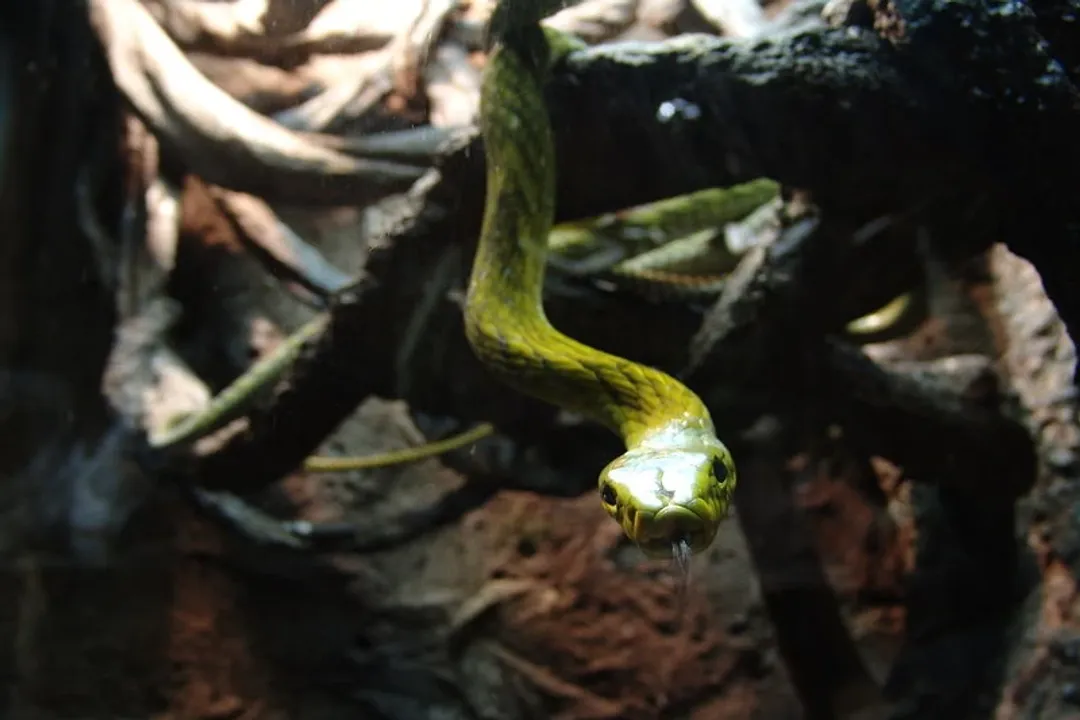
The Western Green Mamba, Dendroaspis viridis, [8] presents an immediately striking image defined by its vibrant, uniform coloration and exceptionally slender build. This snake is instantly recognizable as an arboreal specialist, adapted for life high in the forest canopy. [1][2] Its appearance is one of sleek elegance, though this beauty belies its highly potent venom. [1][2]
# Visual Profile
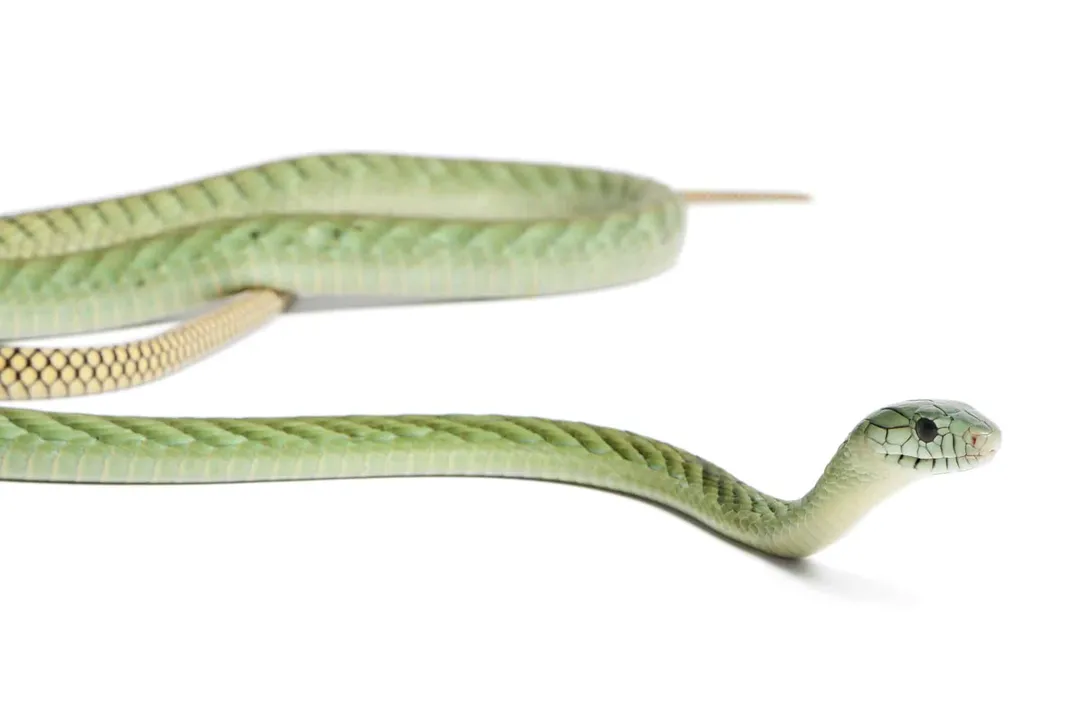
The most defining feature is, naturally, its color. Adults are primarily characterized by a bright, uniform green hue that allows them to blend perfectly with foliage. [1][3][6] This camouflage is essential for a snake that spends the vast majority of its life off the ground. [5] While typically described as green, variations exist across its range, sometimes leaning toward a yellowish-green or even exhibiting darker, almost blue-green tints in certain locales. [3][6] The overall impression is one of grace, typical of the Dendroaspis genus. [1]
# Body Dimensions
When considering the Western Green Mamba's size, the measurements place it among the longer elapids, though perhaps slightly smaller than its close relative, the Eastern Green Mamba. [1] Mature individuals commonly range between 1.8 to 2.4 meters (6 to 8 feet) in length. [1][3][5] Some reports suggest they can occasionally stretch past 2.5 meters. [1] It is worth noting that the perception of length is significantly influenced by the tail, which is proportionately long for a snake of its build. [1] Given that the tail can constitute a substantial fraction of the total length, the body mass itself remains relatively light for a snake reaching these dimensions, contributing to its agility in the trees. [1][5]
# Coloration Spectrum
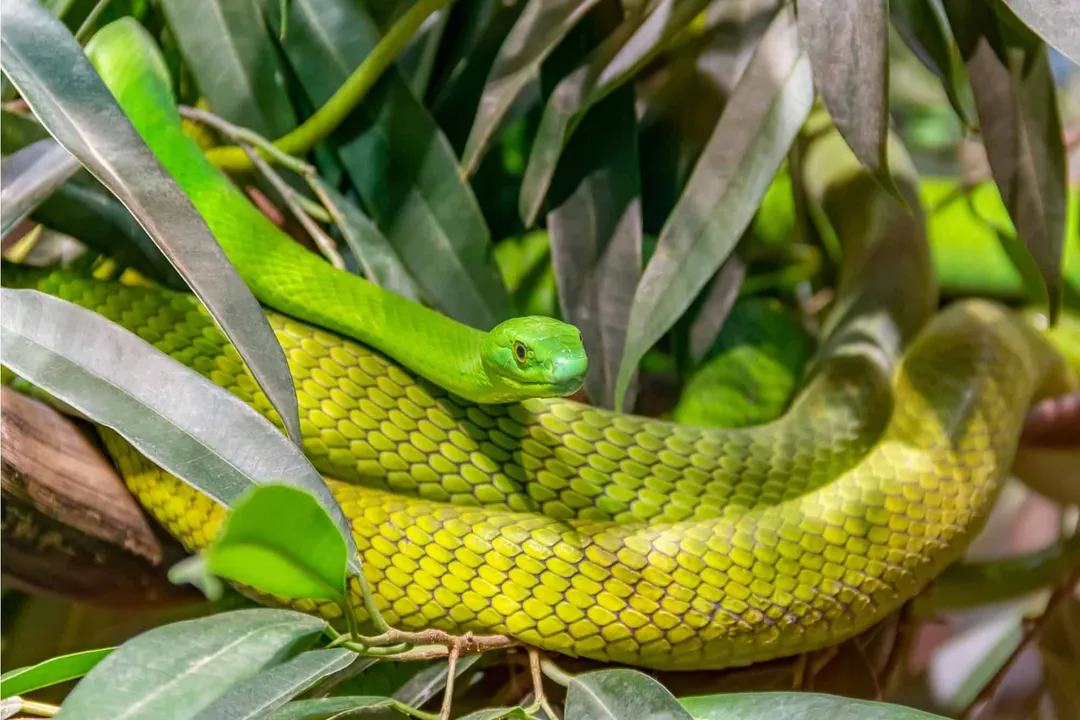
The transition from juvenile to adult coloration provides an interesting physical marker of development. Hatchlings or very young snakes often do not possess the signature bright green of the adults. [1][3] Instead, they may appear olive-green or even brown, frequently marked with distinct black crossbands. [1][3] This dramatically different pattern suggests a period where ground-level camouflage or hiding among leaf litter is more advantageous than high-canopy blending. As the snake matures, these bands fade, and the snake gradually adopts the vivid, monochromatic green that characterizes the species. [3] The underside, or belly, offers a contrast, usually remaining a paler shade, such as whitish-yellow or light green. [1][3]
# Scale Structure
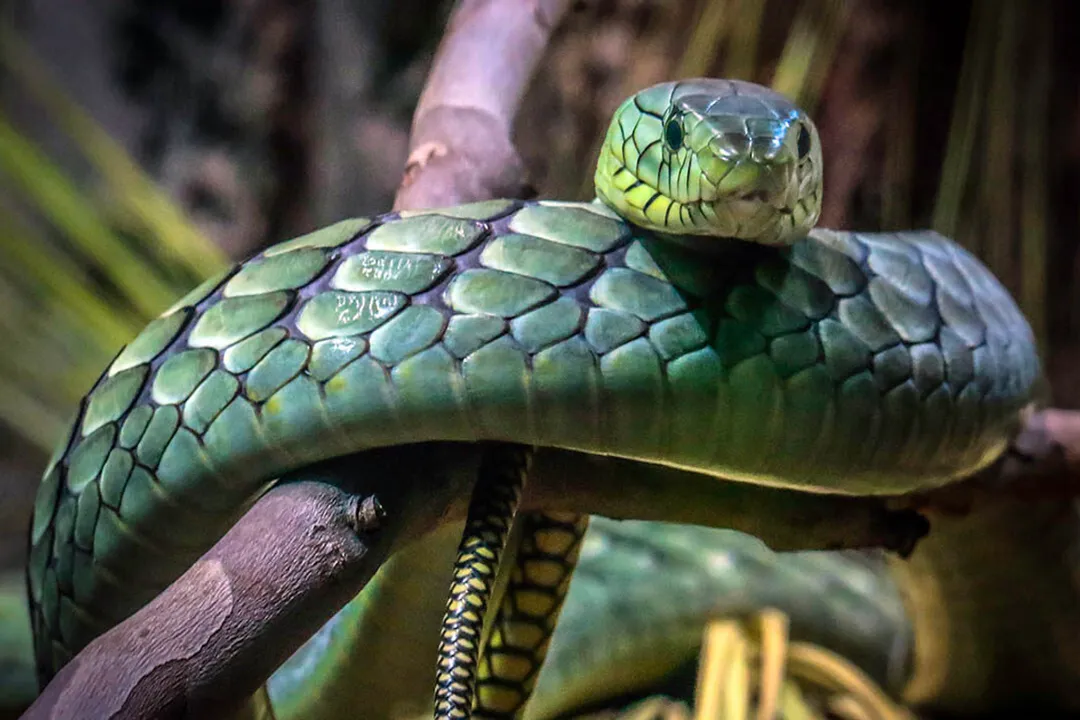
The texture of the snake's scales plays a functional role in its arboreal existence. Descriptions often emphasize that the scales covering the body are smooth. [5] However, some taxonomic descriptions note that the dorsal scales can be weakly keeled. [1] This subtle difference might seem minor, but for a snake moving rapidly through branches, a smoother profile reduces friction against bark and leaves, offering less snag potential during quick escapes or pursuit of prey. The scales across the head are also typically smooth. [5]
# Cranial Features
The head structure of the Western Green Mamba is characteristic of the genus, being distinctively slender and elongated, often set off from the neck by a slight constriction. [1] This streamlined profile aids in navigating dense foliage. [5] The eyes are proportionally large, providing excellent vision necessary for judging distances between branches. [5] Within these eyes, the pupils are black and distinctly round, which is typical for diurnal (day-active) snakes. [1][5] The scales on the head, particularly the large shields, contribute to this smooth, tapered look. [5]
# Dentition and Venom
Physically speaking, the mamba's feeding apparatus is a critical component of its structure. Like other elapids, the Western Green Mamba possesses fixed fangs located at the front of the maxilla. [1] These specialized teeth are designed not for chewing or grasping, but for quickly injecting venom upon striking. [1] While the venom itself is biochemical, the physical adaptation of the fangs—their position and structure—is a key physical characteristic that dictates how the snake engages with its prey and defends itself. [2]
# Comparison with Relatives
Understanding the Western Green Mamba's physical traits is often aided by comparison with its close relatives, the other green mambas. While all share the characteristic green coloration and arboreal lifestyle, there are subtle differences in size and build. [1] For instance, the Jameson's Mamba (Dendroaspis jamesoni) tends to be bulkier than the Western Green Mamba, and the Eastern Green Mamba (Dendroaspis angusticeps) can sometimes show a slightly more pronounced hourglass pattern on its neck in certain stages. [1] The Western species often maintains a more consistently slender silhouette throughout its life, emphasizing speed and arboreal dexterity over sheer girth, a physical trait that may be tied to the specific density or architecture of the West African forests it inhabits compared to the ranges of the other two species. [1][3]
Related Questions
#Citations
Western green mamba - Wikipedia
Western Green Mamba Animal Facts - Dendroaspis viridis
Western Green Mamba - Facts, Diet, Habitat & Pictures on ... - Animalia
Green Mamba - Los Angeles Zoo and Botanical Gardens
Western green mamba facts, distribution & population - BioDB
West African Green Mamba Attraction | Central Florida Zoo Animals
GREEN MAMBA – National Zoological Garden, Pretoria
Western Green Mamba (Dendroaspis viridis) - iNaturalist
Western Green Mamba | Animal Database | Fandom