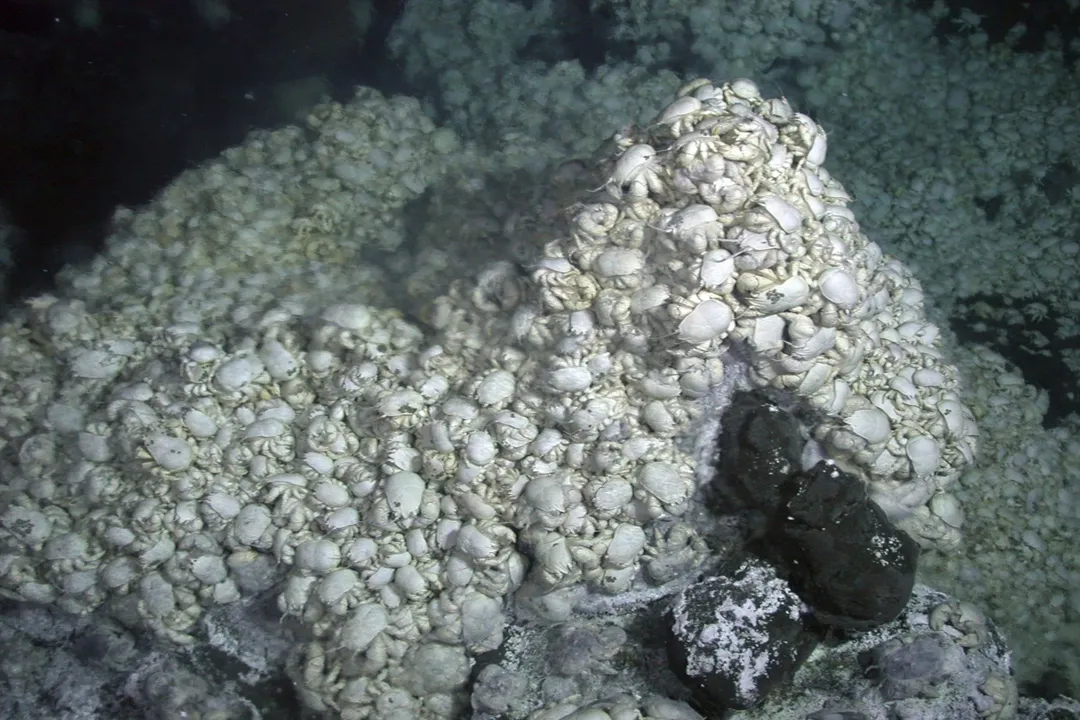
What specialized appendages do Yeti Crabs use for farming chemosynthetic bacteria?
Dense, hair-like setae covering legs and pincers
The most defining feature enabling the Yeti Crab's survival strategy is the covering of dense, hair-like filaments, formally termed setae, found on its walking legs and pincers. These structures are crucial because they are utilized as a substrate upon which symbiotic chemosynthetic bacteria are cultivated. The crab actively farms these bacterial mats directly on its appendages. Since these deep-sea environments lack sunlight, the bacteria derive their energy by oxidizing reduced chemicals spewing from the vents, such as hydrogen sulfide. The crab then harvests this bacterial growth directly from its own limbs as its primary source of nutrition, eliminating the need to hunt or scavenge sparse organic matter drifting in the water column. This bacterial farming strategy, enabled by the setose appendages, is central to its existence in the vent ecosystem.