White Sturgeon Evolution
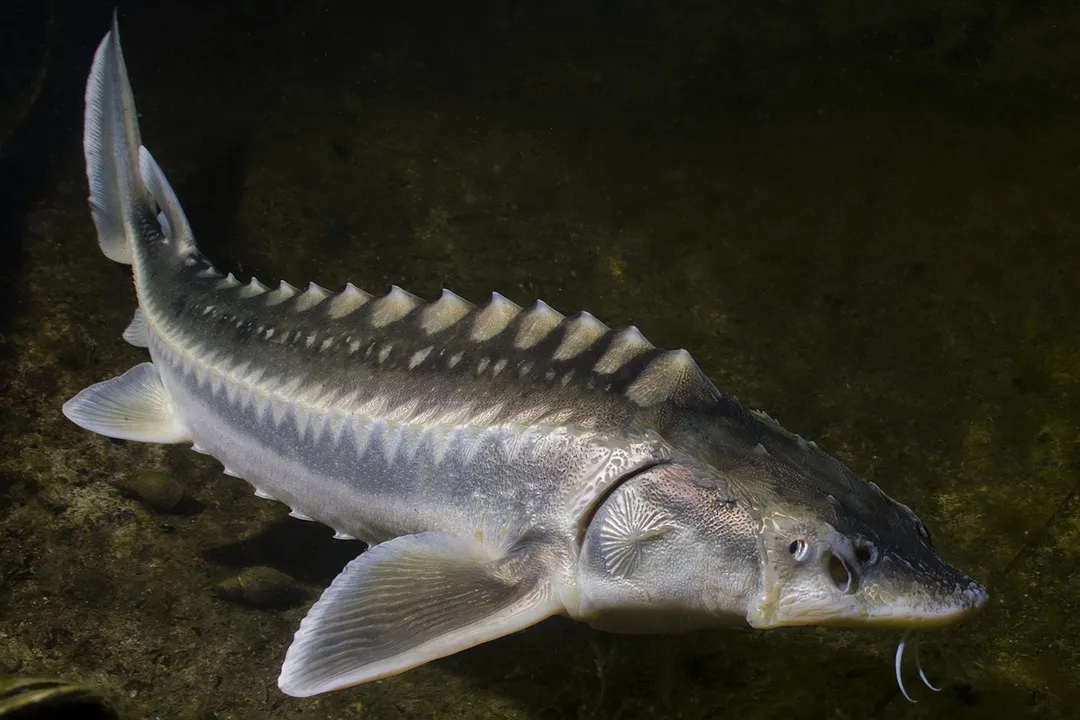
The White Sturgeon, Acipenser transmontanus, represents a remarkable connection to Earth's deep past, often earning the moniker of a "living fossil" among contemporary fish species. [6] Their lineage stretches back through epochs, making them one of the most ancient groups of bony fishes still swimming in our waters today. [9] To understand this giant of the Pacific Northwest, one must appreciate the span of geological time they have successfully navigated, existing essentially unchanged across vast stretches of Earth's history. [6]
# Ancient Lineage
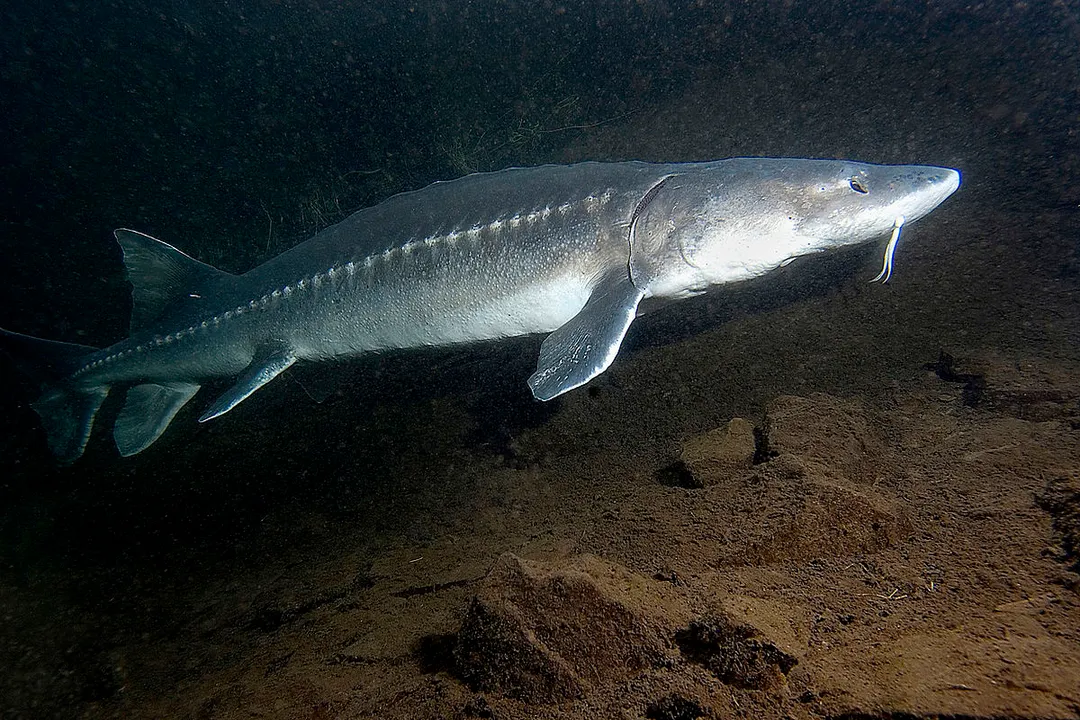
Sturgeons belong to the family Acipenseridae, a group whose fossil record extends far back into the Triassic period. [9][1] Considering that the Triassic period ended roughly 201 million years ago, the very structure and biology of the White Sturgeon reflect an evolutionary blueprint that predates the dinosaurs’ peak and the appearance of most modern fish groups. [9] This long tenure suggests an evolutionary design that proved exceptionally well-suited for survival across major environmental shifts, even if it struggles with the rapid alterations imposed by the modern era. [6]
When comparing the White Sturgeon to other extant bony fishes, which are often derived from more recent radiations, the sturgeon presents a more primitive morphology. [9] They represent a very early divergence within the Osteichthyes (bony fishes), maintaining features that their more evolutionarily recent relatives have lost or significantly modified over time. [9] Their persistence highlights a successful, albeit specialized, evolutionary strategy that prioritized hardiness and longevity over rapid diversification into numerous forms. [6] If one imagines the vast tree of fish life, the sturgeon sits near a very thick, foundational branch, while many other well-known fish species sprout from newer twigs. [1][9]
# Basal Morphology
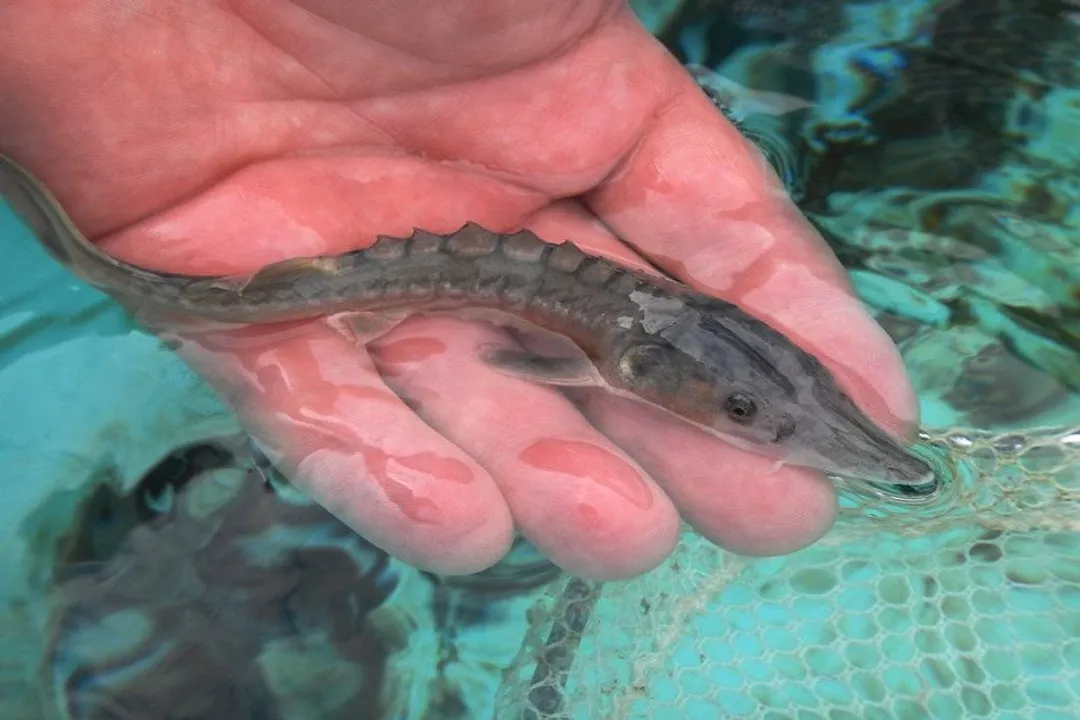
The physical appearance of the White Sturgeon is perhaps the most immediate evidence of its ancient evolutionary trajectory. Unlike most modern teleost fish, sturgeons lack true scales; instead, their skin is covered by five distinctive rows of bony plates known as scutes. [1][9] These large, heavily mineralized scutes run along the flanks, back, and belly, serving as dermal armor—a feature characteristic of many early ray-finned fishes—rather than the overlapping, cycloid, or ctenoid scales found on most contemporary fish. [1][9]
Another fundamental primitive feature is the skeletal structure. While they are bony fish, their internal skeleton retains a significant amount of cartilage, particularly in the backbone, which includes a persistent, unossified notochord—a flexible rod that provides primary support in the embryos of all vertebrates but is usually replaced by bone in higher fish. [1][9] This combination of bone (in the scutes and some parts of the skull) and persistent cartilage lends the fish a flexible yet heavily protected body plan. [9]
The mouth also speaks to their ancient feeding strategy. The White Sturgeon possesses a ventral, protrusible mouth that lacks teeth in the adult stage. [1][9] This structure is perfectly adapted for bottom-feeding, allowing the fish to suck up benthic invertebrates and smaller organisms from the substrate—a dietary niche they have occupied for millions of years. [4] Furthermore, the presence of four sensory barbels located just in front of the mouth aids in locating food on the dark, muddy bottoms of rivers and estuaries where they often reside. [1] This suite of physical traits—scutes, cartilaginous elements, and a specialized suction mouth—represents a successful, long-term evolutionary adaptation to specific aquatic habitats. [6]
It is fascinating to observe how this ancestral body plan, while slow to change, dictates modern behavior. For instance, a common misunderstanding when handling these fish is underestimating the density and rigidity of those external scutes; they are not pliable like modern scales and can cause significant abrasion or injury if the fish thrashes, a direct consequence of a defensive structure honed over eons. [5]

# Geographic Spread and Adaptation
The White Sturgeon (A. transmontanus) is the largest freshwater fish in North America and is native to the Pacific basin, ranging from the Aleutian Islands down to California. [1][7] Their presence spans a wide range of environments, from large rivers like the Columbia and Fraser systems to estuaries and even the open ocean, making them anadromous (migrating between salt and fresh water). [1][7][9]
This anadromy itself is a significant evolutionary adaptation, allowing them access to rich marine feeding grounds while returning to freshwater systems—often the very rivers where they hatched—to reproduce. [4] The ability to regulate osmotic balance across such varied salinity levels demonstrates a high degree of physiological adaptation built upon their ancient chassis. However, their preference for large, free-flowing river systems, particularly for spawning, highlights a constraint that modern human development has severely impacted. [8]
The evolutionary success of the sturgeon is intrinsically linked to the health and connectivity of these large riverine environments. Their life cycle demands access to deep, cool water in the main stem of the river for overwintering and specific gravel substrates for spawning. [8] When considering the distribution of the species historically versus today, it becomes clear that while their evolutionary armor protects them from many natural predators, it does not shield them from the blockage of migration routes by dams built over the last century. [3][5]
# Life History and Evolutionary Pacing
The evolutionary strategy of the White Sturgeon leans heavily on longevity and slow maturation. This is a common trade-off in life history theory: species that are heavily armored or secure in their niche may invest less energy into rapid reproduction, opting instead for surviving many decades. [6] White Sturgeon can live for over a century, with some individuals estimated to live more than 100 years, and females may not reach sexual maturity until they are 15 to 20 years old, sometimes even older. [1][4]
This slow pace of life, which served them well for millennia in stable river environments, becomes a critical vulnerability in the modern era of rapid environmental change and intense historical exploitation. [6]
For example, a key observation when looking at their evolutionary history versus current status is the concept of evolutionary lag. A fish that takes two decades to reproduce simply cannot adapt its population dynamics quickly to sustain losses from overfishing or habitat degradation in the way that a shorter-lived species might. [8] The population structure reflects this slow turnover; a decline in recruitment due to poor spawning habitat today will not manifest as a population crisis for another decade or two, and recovery will take exponentially longer. [6]
When we analyze historical data from fisheries records, we see a stark contrast. In the late 1800s, sturgeon were considered abundant across their range. [3] For instance, in the Sacramento-San Joaquin River system, while precise historical catch numbers are fragmented, reports suggest massive harvests prior to large-scale water diversion and damming. [5] The fish's natural lifespan and slow reproductive cycle meant that these high harvest rates caused an immediate, nearly unrecoverable crash, as the rate of removal far outstripped the rate of replacement achievable by the species' inherent life history strategy. [4]
# Modern Challenges to an Ancient Survivor
The White Sturgeon’s ancient adaptations provide protection against historical threats, such as predation by other large animals, but they offer little defense against modern anthropogenic pressures. [6] Their reliance on large, connected river systems for migration and spawning makes them highly susceptible to habitat fragmentation caused by dams and levee construction. [5][8] Furthermore, they are subject to bioaccumulation of contaminants throughout their long lives, a risk magnified by their position as apex benthic feeders. [4]
The conservation status of many White Sturgeon populations reflects this mismatch between ancient biology and modern conditions. [8] While populations in some regulated systems, like the Columbia River below Bonneville Dam, have seen some localized management success through stocking programs, the overall picture remains one of a species clinging to existence in the face of profound habitat alteration. [7]
Understanding their evolution—specifically, their slow life history—is essential for effective management. It mandates a management philosophy that prioritizes habitat protection and connectivity over short-term harvest considerations. [6] Any stocking or restoration effort must account for the decades required for a newly introduced juvenile to reach reproductive age, meaning that conservation investment must be viewed in generational terms, matching the sturgeon's own immense lifespan. [1] The continued existence of this lineage, which spans geological eras, depends on recognizing that its evolutionary pace requires human intervention to be slower and far more patient than typical conservation efforts. [9] The White Sturgeon, truly a dinosaur among fish, asks us to think across millennia, not just seasons. [6]
# Physical Characteristics Summary Table
To appreciate the evolutionary traits, it helps to contrast key features with a more modern bony fish (like a salmon or trout, though not explicitly sourced here, the comparison aids clarity based on the descriptions):
| Feature | White Sturgeon (A. transmontanus) | Implication for Evolution |
|---|---|---|
| Body Covering | Five rows of bony scutes [1] | Primitive armor, predates modern scales. |
| Skeleton | Significant cartilage; persistent notochord [1][9] | Relic feature of early bony fish development. |
| Mouth Position | Ventral and protrusible [1] | Adapted for bottom-feeding and suction feeding. |
| Life History | Very long lifespan (100+ years); slow maturity (15-20+ years) [1][4] | Evolutionary strategy prioritizing survival over rapid reproduction. |
This comparison underscores that the White Sturgeon is not merely an old species; it is a living museum of early bony fish evolution, perfectly adapted for a riverine world that is now fundamentally different from the one that forged its form. [9] Their survival into the present day is a testament to the efficacy of that ancient design under historical conditions. [6]
The sheer size they attain—some exceeding 1,500 pounds and 20 feet—is also an evolutionary marker, demonstrating that when resources are plentiful and predation is managed (as in the absence of major threats), their inherent growth potential is enormous, a capacity few modern freshwater fish can match. [1] This capacity for massive growth, supported by their durable, long-lived physiology, is a final echo of an age when the rivers were vast and untamed. [4]
Related Questions
#Citations
White sturgeon - Wikipedia
White Sturgeon - National Maritime Historical Society
[PDF] Sturgeon History
[PDF] White Sturgeon Acipenser transmontanus
[PDF] Life History Conceptual Model White Sturgeon (Acipenser ... - CA.gov
Dinosaurs Among Us: A Glimpse Into the Status of Sturgeon - FISHBIO
White sturgeon | Washington Department of Fish & Wildlife
White Sturgeon | Montana Chapter
White sturgeon | fish - Britannica