Yeti Crab Facts
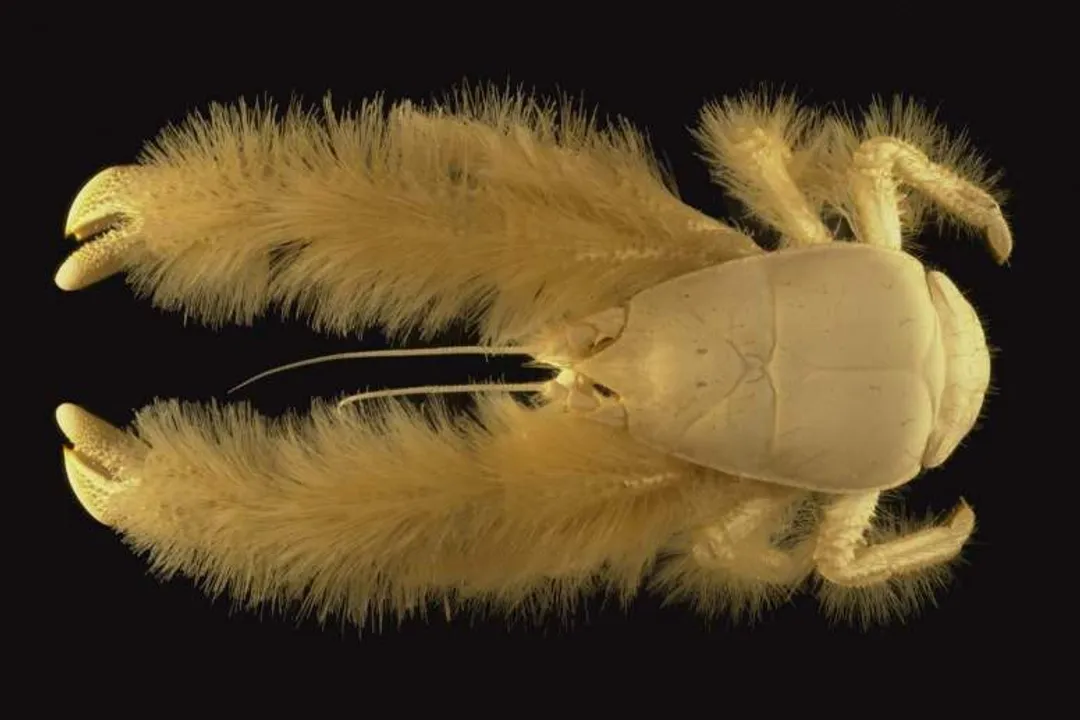
The ocean’s abyss is famous for holding secrets, but few reveal the strangeness of deep-sea survival quite like the creature nicknamed the Yeti Crab. This decapod crustacean, known scientifically as Kiwa hirsuta, conjures images of a mythical, white-furred snowman lurking in the crushing pressure and perpetual night over 7,000 feet below the surface. Its very existence challenges conventional assumptions about where and how life can flourish, turning the harsh environment of hydrothermal vents into a thriving, albeit bizarre, neighborhood.
# First Glimpse
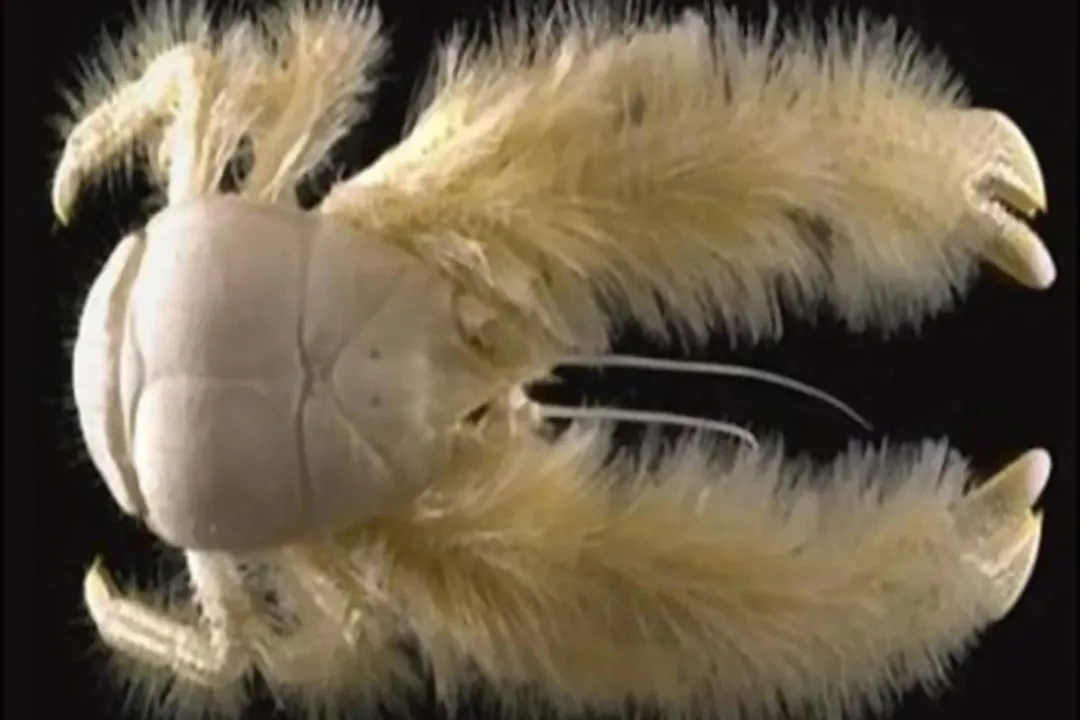
The scientific world first encountered this hairy anomaly in March 2005. It was during a targeted expedition led by scientists from institutions including the Monterey Bay Aquarium Research Institute (MBARI) and the French research body IFREMER. The team was operating the deep-sea submersible DSV Alvin, owned by the US Navy and managed by the Woods Hole Oceanographic Institution, to investigate the mid-ocean ridges in the South Pacific. The primary mission involved understanding how deep-sea animals managed to colonize separate hydrothermal vents hundreds or thousands of miles apart.
The discovery occurred along the Pacific-Antarctic Ridge, south of Easter Island, at depths around 7,200 feet (approximately 2,200 meters). Marine biologist Michel Segonzac first spotted the unusually large, 15-cm-long crab with its distinctively hairy arms. Researchers quickly realized this was no ordinary find; after collection and subsequent analysis, they determined the organism was so distinct it warranted the creation of an entirely new biological family: Kiwaidae. The announcement followed in March 2006.
# Hairy Morphology
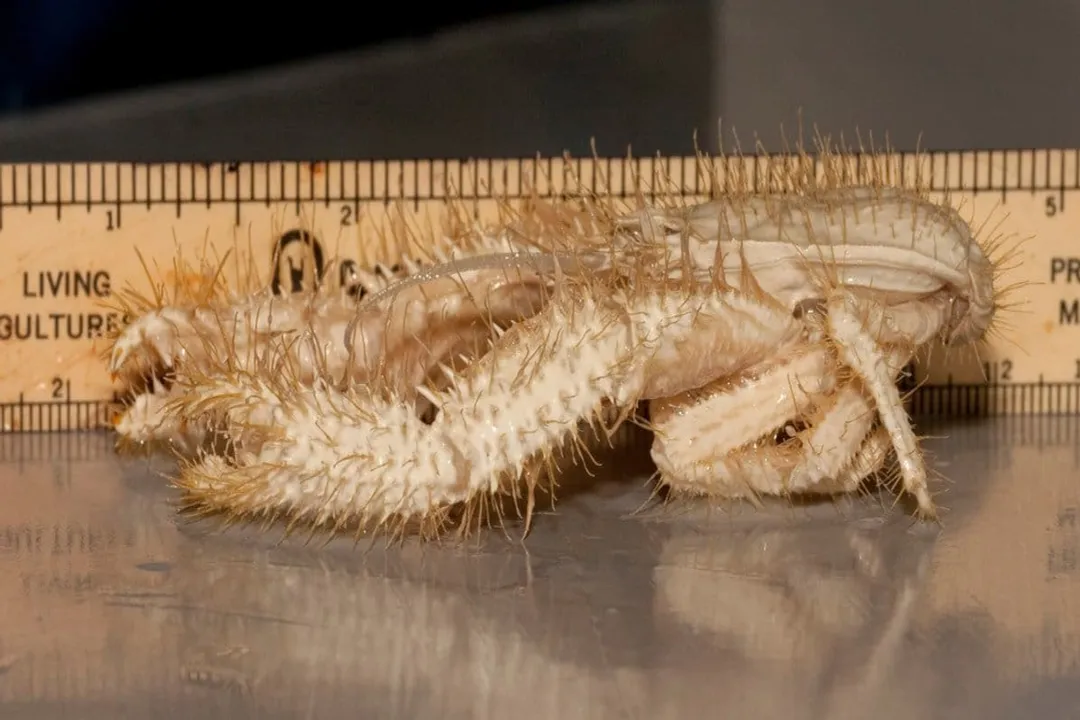
What sets the Yeti Crab apart, and earned it its evocative name, is its striking external features. The body itself is compact and relatively small, measuring around 6 inches (15 cm) long, and is generally a pale white or grey color. This lack of pigment is an expected adaptation for an environment devoid of sunlight.
The most arresting characteristic is the covering of long, blond, silky bristles found primarily on its chelipeds (claws) and legs. These bristles are not true fur but rather specialized, hair-like spines called setae. It is these setae, often waving rhythmically, that evoke the image of the legendary Himalayan Yeti. Adding to its unique identity, the genus name, Kiwa, is drawn from Polynesian mythology, honoring a goddess associated with shellfish. The species epithet for the original find, hirsuta, is Latin, meaning “hairy”.
Adding another layer to its specialized anatomy, the Yeti Crab possesses only highly reduced eyes and is considered virtually blind. In the absence of visual cues, these setae are thought to serve a dual sensory purpose, potentially acting as chemical and physical sensors to locate food sources or potential mates in the absolute darkness.
# Extreme Habitat
Yeti crabs are inextricably linked to the volatile environment surrounding hydrothermal vents and cold seeps. These vents are geological features—cracks in the seafloor where tectonic plates separate—that spew mineral-rich, scalding hot water heated by subsurface lava. While the water ejected from these fissures can reach temperatures as high as (over ), the surrounding deep ocean is frigid, hovering around or .
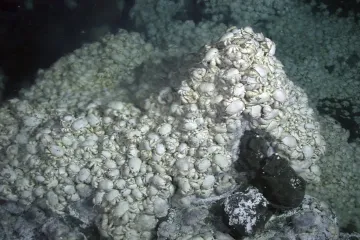
Survival for the Yeti Crab depends on navigating an incredibly narrow thermal gradient, an oasis of warmth in the deep freeze. If they stray too close to the plume, they risk overheating and death; moving too far away results in freezing in the near-freezing ambient water. To manage this precarious existence, they are known to aggregate in dense, highly social groupings. Scientists have observed densities reaching up to 700 crabs packed into a single square meter around the most favorable flow areas near the vents.
It is fascinating to consider the geological dependency of this clustering behavior. The very survival of these dense populations relies on the sustained, localized heat output of a specific vent structure. This means that for a population of hundreds of crabs, their entire existence is tethered to the lifespan of that particular chimney or fissure. Should a local geological shift occur that either shuts down the vent flow or alters the immediate thermal plume, that entire concentrated community faces near-instantaneous death from either freezing or boiling. Their success in such high density around these hotspots speaks to an unmatched tolerance, but it also highlights an inherent, localized fragility dictated entirely by seafloor volcanism.
# Symbiotic Feast
Life near a hydrothermal vent eliminates sunlight as an energy source, forcing ecosystems to rely on chemosynthesis—the process where specialized bacteria convert the vent’s raw chemicals (like sulfur compounds, methane, and hydrogen sulfide) into organic matter. The Yeti Crab has evolved a unique way to access this energy, centralizing its diet around these bacteria.
The primary method involves the bacteria growing in dense colonies directly on the crab’s hairy setae. The crabs have been observed performing a rhythmic movement, described as a dance, where they wave their claws through the water currents flowing from the vents. This waving motion likely serves to maximize the flow of necessary chemicals—oxygen, methane, and hydrogen sulfide—over the bacterial mats, encouraging rapid growth. The crab then appears to harvest this cultivated food source, scraping the bacteria off its own bristles using specialized mouthparts. This suggests a sophisticated farming relationship.
Furthermore, the bacteria growing on the setae may serve a secondary, protective function. Because the vent fluids contain high concentrations of toxic minerals, scientists speculate that the dense bacterial colonies help detoxify these poisonous substances as the crab filters water, potentially shielding the crab’s gills. While bacteria form the staple diet, observations also suggest they are opportunistic feeders; some researchers have seen them consuming mussels, though it appears they need to access the flesh after the shells have already been cracked open, perhaps by external forces like a Alvin submersible landing nearby.
# Squat Ancestry
Despite the common name, the Yeti Crab is scientifically classified outside the realm of true crabs. It is a member of the infraorder Anomura, placing it within the group known as squat lobsters, which also includes the familiar hermit crabs. Its recognition as a distinct lineage led to the formal naming of the family Kiwaidae. While its general structure resembles a crab—hard shell, long appendages, large claws—its internal organization is more congruent with its squat lobster relatives.
The genus Kiwa currently encompasses five recognized species, each adapted to slightly different vent locations across the globe:
| Species Name | Location | Notable Feature/Nickname |
|---|---|---|
| Kiwa hirsuta | Pacific-Antarctic Ridge | The original species discovered. |
| Kiwa puravida | Near Costa Rica | Named for the local saying "pura vida". |
| Kiwa tyleri | East Scotia Ridge | Found in the coldest waters of the group; nicknamed the "Hoff" crab. |
| Kiwa araonae | Australian-Antarctic Ridge | Lacks long, bristly hair. |
| Unnamed Species | Indian Ocean (Longqi) | Possesses shorter claws; closely related to K. tyleri. |
The evolutionary history of these species is complex, with evidence suggesting that the divergence between the different Kiwa groups occurred around the Miocene epoch, possibly linked to the cooling caused by the opening of the Drake Passage. It is important to recognize that while the Kiwa family has developed this incredible method of bacterial farming, they are not the only deep-sea denizens employing chemosynthetic symbionts. Many vent fauna, such as the giant tube worms, depend entirely on internal or associated bacteria for sustenance. What makes the Yeti Crab particularly noteworthy is its apparent strategy of active cultivation and harvesting of these bacterial resources using specialized external structures, suggesting a higher level of interaction than simple, passive grazing on established microbial mats common to other vent grazers.
# Unseen Life
While the discovery of Kiwa hirsuta was a landmark event, many aspects of the Yeti Crab's life cycle remain poorly understood, largely because studying them requires specialized, remotely operated technology like Alvin.
One area of ongoing mystery surrounds their reproduction. While exact details are scarce, scientists have observed that female Kiwa hirsuta employ a distinctive strategy by carrying their eggs in a specialized brooding structure on their abdomen, attaching them directly to setae until they hatch into larvae. This level of direct, specialized parental care is notable among deep-sea inhabitants. Lifespan estimates suggest they might live for up to 20 years.
From a conservation standpoint, the IUCN currently lists the known species as Data Deficient, as comprehensive population assessments have not been completed. Their highly specific habitat requirement—the immediate vicinity of active hydrothermal vents—means they are extremely vulnerable to environmental changes, both natural and anthropogenic. As exploration and resource interest in the deep ocean grow, the fragile ecosystems that support these unique "furry" crabs face potential threats from activities such as deep-sea mining, making continued scientific study essential for future protective measures.
#Videos
Yeti Crab - Animal of the Week - YouTube
Related Questions
#Citations
The Curious Yeti Crab - Ocean Conservancy
Yeti Crab | What's in a Name? - Harvard University
14 Incredible Yeti Crab Facts - Fact Animal
Kiwa hirsuta - Wikipedia
Kiwa hirsuta Facts for Kids
Yeti Crab - Animal of the Week - YouTube
Yeti Crab - A-Z Animals
The Yeti Crab - Critter Science
Yeti Crab Facts - Scubaversity
Discovery of the "Yeti crab" - MBARI