What major environmental change is cited as the reason for the decline of giant wombats?
Answer
Climate shifts at the end of the Pleistocene
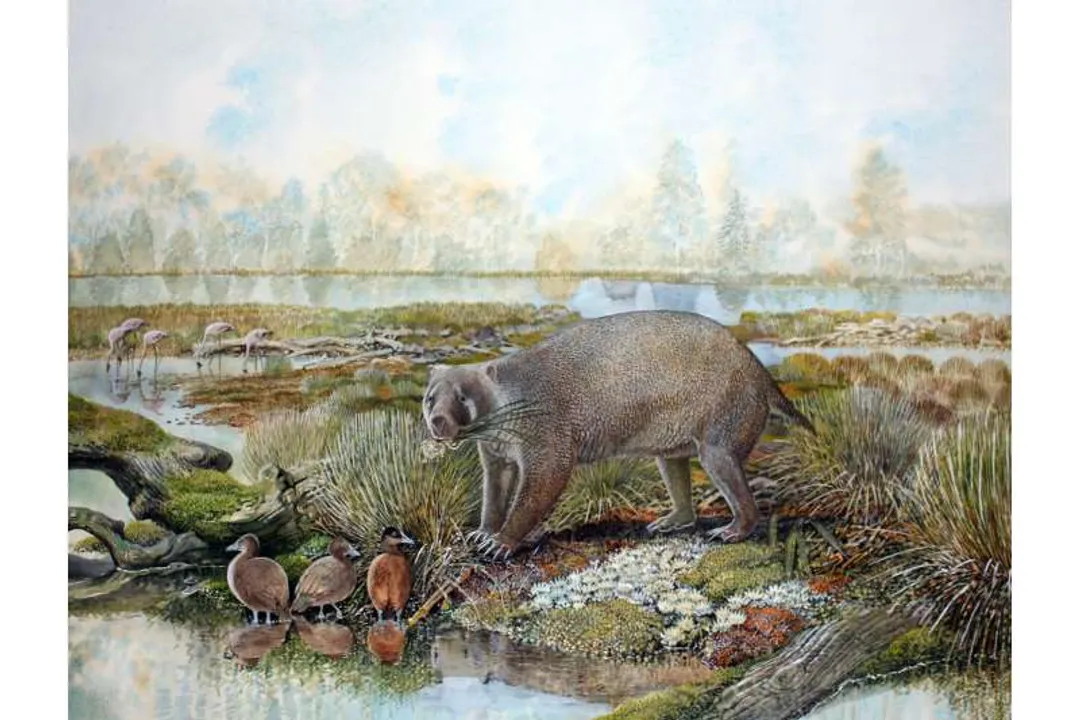
The evolutionary bottleneck that dramatically reduced the population of giant wombats and led to the survival of the smaller modern forms is attributed primarily to the significant climate shifts that occurred toward the conclusion of the Pleistocene epoch. These environmental changes resulted in a decrease in the availability of necessary resources, potentially including the specialized megaflora upon which the massive herbivores depended. The giants, perhaps specialized for these former conditions, could not adapt to the leaner resources, whereas the smaller, more flexible modern wombats possessed the adaptability needed to survive this environmental transition.
Related Questions
To which taxonomic order do wombats belong alongside kangaroos and koalas?What distinctive, geometric shape characterizes the scat produced by wombats?What is the estimated maximum weight attributed to some extinct giant wombat forms?Which fossil giant wombat species is named *Mukupirna*, meaning 'big-boned'?Approximately how long ago are the fossils of *Mukupirna* estimated to have lived?What dental adaptation, characterized by high-crowned teeth, is present in modern wombats?Which marsupial shares a common ancestor with wombats within the suborder *Vombatiformes*?What major environmental change is cited as the reason for the decline of giant wombats?What adaptation relating to their pouch aids wombats in their powerful digging lifestyle?Which family classification encompasses the common wombat (*Vombatus*) and the two hairy-nosed species?