Wool Carder Bee Evolution

The lineage and developmental path of the Wool Carder Bee, Anthidium manicatum, present a fascinating case study in insect adaptation and successful range expansion, even if the ancient evolutionary roots are not fully detailed in current observational literature. What we can observe are the incredibly specialized traits that have allowed this species to thrive far beyond its original home range. This bee is immediately recognizable, often drawing attention due to its striking black and yellow banding, which gives it a superficial resemblance to certain wasps or bumblebees, though it belongs to the Megachilidae family, often known as mason or leafcutter bees. [1][3][5]
# Appearance Distinctive
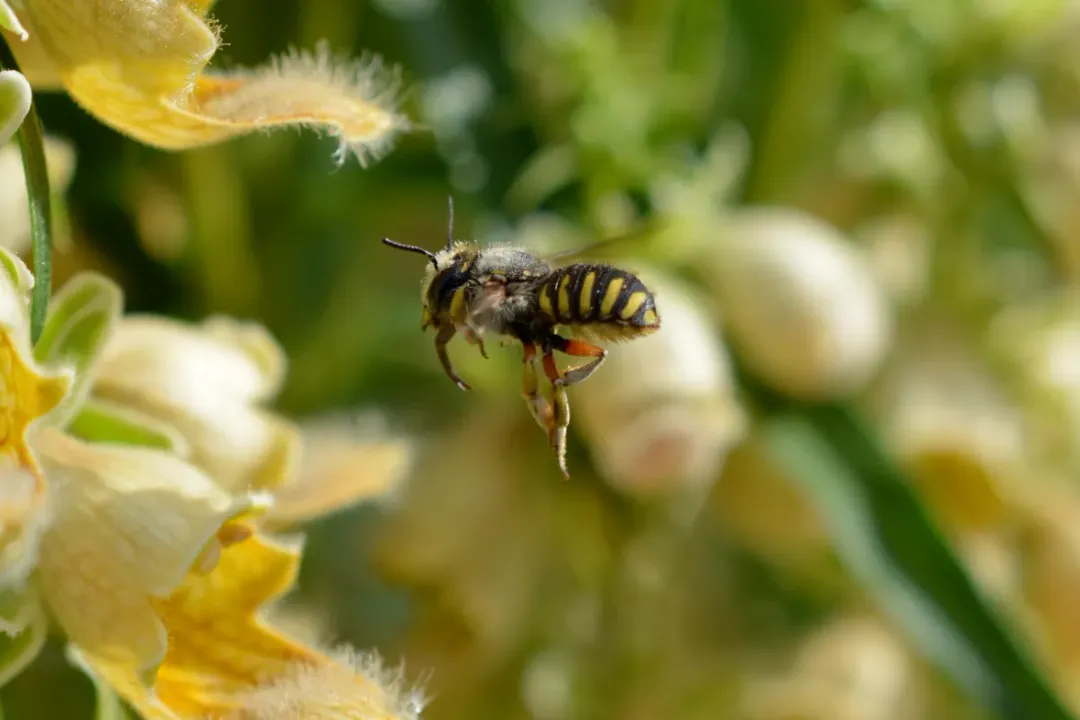
Distinguishing the female from the male is relatively straightforward, primarily due to differences in abdominal segments and hair patterns, though both sexes share the pronounced yellow markings against a black body. [4][7] The females possess dense, pale-colored hairs on their ventral side, which are essential for pollen collection, similar to many other bee species. [4] However, the namesake behavior—the reason for its common name—is tied to how the female gathers nesting material. [5][9] She deliberately scrapes or "cards" fine hairs from the leaves and stems of specific plants to line the individual brood cells she constructs. [1][9]
The males, on the other hand, exhibit more pronounced differences, most notably the presence of large, brush-like tufts of pale, white or yellowish hair on the sides of their abdominal segments. [3][4][7] These specialized hairs, sometimes referred to as ‘scopa,’ are actually used not for pollen transport, but for scent dispersal during territorial displays. [3][4] The males are also generally larger than the females of the species. [4][7]
# Male Defense

The behavior of the male Anthidium manicatum is perhaps the most distinctive characteristic observed in its current ecological interactions, showcasing a highly developed behavioral repertoire likely honed over millennia in its native environments across Europe, Asia, and North Africa. [1][3][6] These males are aggressively territorial, often patrolling specific patches of favored flowering plants for hours on end. [1][4][6][9] They exhibit complex aerial displays intended to ward off other males attempting to access the females or the floral resources the male is guarding. [1][3]
This vigilance is absolute; any perceived rival, regardless of species—be it another male Carder Bee, a native bee, or even a small butterfly—risks being chased away. [1][3][4][9] While this intense guarding ensures that the dominant male has priority access to emerging females, the sheer energetic cost of constant patrol is remarkable. When considering this behavior in newly invaded territories, one might speculate that this ingrained, high-investment territoriality allows the species to rapidly monopolize available floral resources, potentially outcompeting native pollinators who might utilize those same resources more casually or efficiently. [1][6] This level of protective investment suggests strong past selection pressures favoring male dominance over specific floral patches. [3]
# Nest Building
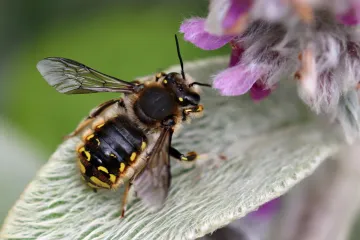
The female’s activities center entirely on reproduction and securing the next generation. Once she has mated, her focus shifts to excavating or selecting an appropriate nesting cavity—often in wood cavities, reeds, or sometimes in the ground, though they are generally known as cavity nesters. [1][4][5] She meticulously builds individual, thimble-sized cells within this cavity. [4][9]
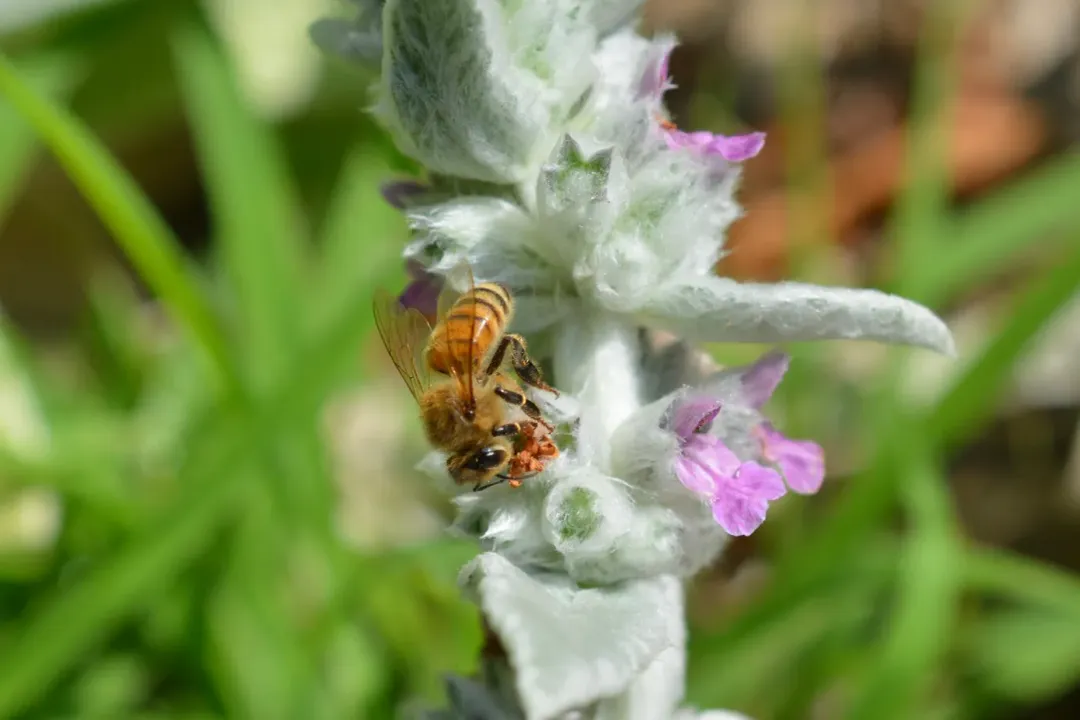
It is in the lining of these cells that the species' name finds its validation. [9] The bee collects copious amounts of fuzzy plant fibers, which she then packs tightly around the developing larval chamber. [1][5] This material creates a soft, insulating envelope for the egg and the subsequent provisions. [4] Once the cell is lined, she provisions it with a mixture of pollen and nectar, lays a single egg on top, and seals it off before repeating the process for the next cell. [1][4] A known favorite source for this fiber is the fuzzy leaves of Lamb's Ear (Stachys byzantina), a common ornamental plant. [2] After the cell is complete, the entrance to the larger nest site is sealed, often with a plug made of more plant material or even small pebbles. [5] The female does not typically provide further parental care after sealing the final cell. [1]
# Range Expansion
The presence of the Wool Carder Bee in North America is a relatively recent phenomenon, marking it as an introduced or non-native species in the United States and Canada, where it has established wild populations. [1][4][6][8] Its native range spans much of Europe, extending into Asia and North Africa. [1][5][6] Its arrival in North America, first documented in New York State in the early 1990s, signifies a successful journey aided by human transport, likely in trade materials. [1][4]
This rapid establishment in new geographic areas speaks volumes about the inherent fitness and adaptability of its core behaviors. The ability of the females to successfully find nesting sites and suitable fiber materials, coupled with the males' aggressive dominance over newly available floral food sources, allows for quick population establishment wherever host plants are present. [6][8] While the species is a generalist pollinator, feeding on flowers from various families like mints, legumes, and asters, its reliance on specific fiber sources creates a subtle ecological pressure point. [1][5] If a new landscape lacks high-quality native fiber-producing plants, the bee may become reliant on introduced ornamentals, which brings up a practical management consideration for gardeners. Fostering local native flora that offers fiber, such as certain types of native lambs-quarters or soft-leaved sages, could potentially mitigate the resource dependency on non-native garden favorites, thereby integrating the bee slightly better into the local ecosystem dynamics. [2][5]
# Ecological Status
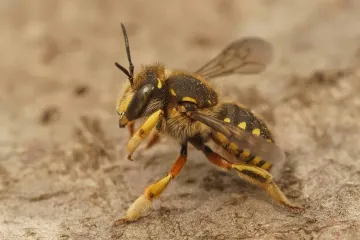
In areas where it has become established, the Wool Carder Bee acts as a competent pollinator, visiting a wide variety of flowers. [1][8] It has been observed visiting flowers such as lavender, sage, thistle, and viper's bugloss. [1][5][6] This generalist feeding behavior means it contributes to pollination services, though its competitive impact remains a subject of study. [8]
Because it is a non-native species in North America, its interactions with native bee populations are often viewed with caution. [4][6] The intense territorial defense by males, as noted earlier, can effectively exclude native pollinators from accessing large quantities of nectar and pollen in the flowers they control. [1][6] This monopolization can represent a real resource drain on native species, especially when the introduced bee is highly abundant in a local area. [4] Unlike some invasive insects, the Wool Carder Bee is not considered a significant agricultural pest, but its presence highlights the complex ecological changes that accompany global movement of species, where traits developed over deep evolutionary time encounter entirely new competitive landscapes. [1][3] Understanding its life cycle—from fiber collection to aggressive male guarding—is key to observing and managing its presence in local environments. [1][9]
Related Questions
#Citations
Wool Carder Bee
“Solitary Bees and Their Plants: The Wool Carder Bee's ...
Anthidium manicatum
Colorado Insect of Interest - European Wool Carder Bee
Meet the Wool Carder Bee
ANTHIDIUM - Wool-carder bees
Wool Carder Bee
Wool-Carder Bees
The Wool Carder Bee