How are the pale forewings of E. sarcitrella further characterized?
Answer
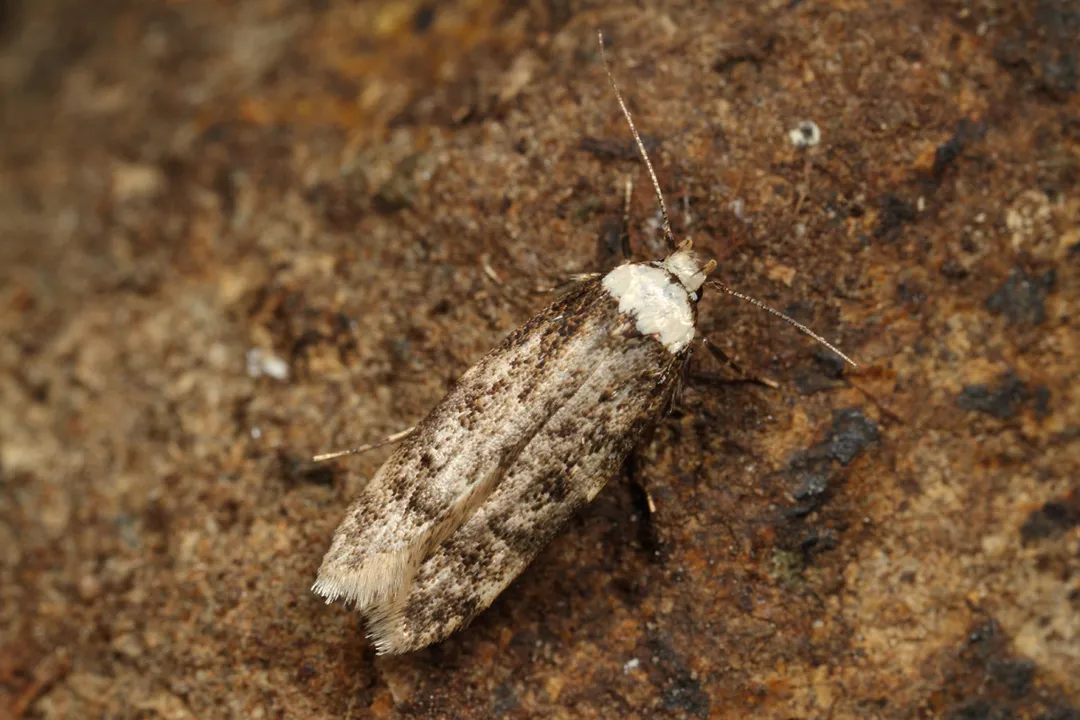
They are distinctly marked with irregular, dusky or greyish-brown speckles and streaks, creating a mottled appearance.
While the common name highlights the white shoulders, the overall appearance of the forewings of the adult moth is more complex than just being pale. The fundamental base color is described as pale creamy white or off-white. Overlaying this pale background are distinct markings composed of irregular, dusky or greyish-brown coloration appearing as speckles and streaks. This combination of pale color interspersed with darker markings results in a characteristic mottled appearance. This specific pattern of coloration and speckling is crucial for identification, distinguishing it visually from other similarly sized micro-moths.
Related Questions
What physical marker gives the White-shouldered House Moth its common name?How do E. sarcitrella larvae protect themselves while feeding in stored commodities?To which family does Endrosis sarcitrella belong, and what is a common ancestral food source for relatives?What evolutionary pressure is cited as driving E. sarcitrella's success in human-modified habitats?What is the general wingspan measurement range for the adult White-shouldered House Moth?How does the E. sarcitrella diet contrast with the specialization of clothes moths (Tineidae)?What genetic concept is suggested by isolated pockets established after E. sarcitrella is transported via commerce?How are the pale forewings of E. sarcitrella further characterized?What is the adaptation seen in the E. sarcitrella pupal case construction?How can temperature fluctuation act as a control method against E. sarcitrella populations?