White-Tailed Eagle Evolution

The White-Tailed Eagle, often called the Sea Eagle, carries a name that hints at a long and varied past across the northern continents. As one of the largest birds of prey in the world, its presence today in specific locales, such as Scotland or the Baltic region, is only the latest chapter in a story spanning millennia. Understanding the evolution of this magnificent raptor involves looking not just at its physical form, but also at the genetic lines that connect populations across vast distances and the dramatic shifts in its historical geographic spread. This lineage ties it closely to other great sea eagles, occupying a specialized ecological niche as both an apex predator and a significant scavenger throughout its range.
# Taxonomy Place

To place the White-Tailed Eagle, Haliaeetus albicilla, within the grand scheme of avian life, we turn to its classification. It belongs to the family Accipitridae, a massive and diverse group encompassing most diurnal birds of prey, including kites, harriers, and buzzards. Within this family, it resides in the genus Haliaeetus, the sea eagles, which are generally characterized by their large size, pale heads (in some related species), and strong association with aquatic environments.
The White-Tailed Eagle is distinct from the Bald Eagle (Haliaeetus leucocephalus), though they share the genus. While the Bald Eagle gained prominence through its association with the United States, the Sea Eagle’s range historically covered a massive swath of Eurasia, suggesting a more ancient and extensive successful colonization event across that landmass. The differences in plumage—the Sea Eagle retains dark heads into adulthood, in contrast to the Bald Eagle’s white head—represent divergences that occurred as the two groups adapted to their specific regional environments and food webs over evolutionary time.
# Genetic Lines

Recent examination of the species' genetic makeup offers insights into its evolutionary partitioning. Research has identified distinct mitogenomic lineages within existing populations, which serve as markers for past demographic events and population structure. These genetic markers help scientists trace how populations have been separated or connected, illustrating evolutionary patterns that are invisible in the field alone.
One study specifically analyzed genetic diversity, noting that populations from the Baltic Sea region, for instance, exhibit unique genetic traits. The genetic structure observed across the species' historical range implies periods where different geographic areas hosted isolated breeding groups, allowing them to drift genetically from one another—a fundamental process of evolution. If we map these genetic lineages against the historical ranges, it becomes apparent that the older, more widely distributed populations likely harbored greater initial genetic variation before modern pressures caused severe fragmentation. The persistence of certain lineages in relatively stable areas, contrasted with the near-extinction in others, provides a real-time look at how genetic bottlenecks shape future evolutionary potential.
It is striking to consider how environmental shifts, perhaps large-scale climatic oscillations over the last several thousand years, might have acted as the primary partitioning agents, forcing groups onto islands or into isolated inland valleys where they developed these detectable genetic distinctions long before humans began extensively managing their habitats.
# Range History

The historical distribution of the White-Tailed Eagle paints a vivid picture of its former ecological dominance and subsequent decline, which inherently shapes its evolutionary trajectory through selection pressures. Its historical range stretched across much of Europe and Asia, extending from the British Isles eastward, reflecting an adaptation to coastlines, large rivers, and major lake systems.
The most dramatic evolutionary shift in recent times has been the contraction of this range, often referred to in conservation as a retreat. In the United Kingdom, for example, the species became extinct in the early 20th century due to persecution and loss of habitat. Similarly, populations across much of continental Europe faced severe declines. This massive reduction in occupied territory represents a profound evolutionary filter; the genes best suited for survival under conditions of heavy pesticide use, direct human hostility, and reduced prey availability were lost from the gene pool of the remnant populations.
In contrast, areas that maintained stable, albeit smaller, populations, such as parts of Scandinavia or the Baltic, acted as evolutionary reservoirs. These pockets of birds retained a broader genetic base that was essential for the later reintroduction programs. The ability of the species to survive in the Baltic, for example, is tied to the complex dynamics of seabird populations and relatively intact coastal feeding grounds, which presented a different set of selective challenges than those faced by inland birds.
# Morphology and Niche

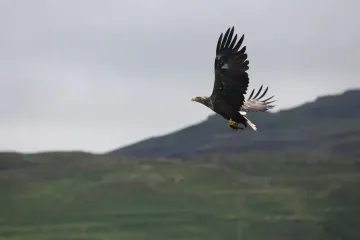
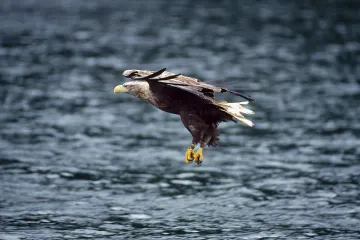
The sheer scale of the White-Tailed Eagle is a testament to its evolutionary success in an apex niche. With wingspans that can reach up to 2.5 meters, it rivals the size of other massive raptors. This size supports its mixed diet, which is characterized by opportunistic feeding, heavily reliant on scavenging dead fish and carrion, though it is also a capable hunter of live prey, including birds, mammals, and fish.
This adaptability in diet is a key evolutionary trait. Unlike some specialized predators, the Sea Eagle’s reliance on scavenging provided a buffer during times of prey scarcity—a crucial adaptation for surviving fluctuating environments. The strong, heavy beak and powerful talons are tools honed by this mixed strategy: capable of tearing into large carcasses or securing a struggling seabird. The pale, wedge-shaped tail, which gives the bird its common name, is retained throughout life, differing from the development seen in related species.
When comparing its life history traits to those of smaller raptors, it's useful to consider the trade-offs inherent in being a giant. Large size demands more food and potentially longer developmental periods for young, which means reproductive success might be inherently slower and more dependent on long-term stable resources. An interesting consequence of this life history strategy is that while they live a long time, they may not reproduce as frequently as smaller birds, meaning population recovery from a bottleneck, like the one seen in Scotland, takes significantly longer—a factor that influences the rate at which natural selection can act on a recovering population.
# Modern Returns
Recent decades have seen concerted efforts to restore populations, offering a unique look at how genetics and geography interact in rapid, human-assisted evolution or recolonization. The reintroduction of White-Tailed Eagles to areas like Scotland provides a living case study. Birds sourced from Norway, which carried a distinct genetic background compared to the extinct native stock, were released. This program essentially jump-started the population, bypassing centuries of natural expansion or slow demographic recovery.
In regions like the Isle of Wight, the breeding program follows closely monitored protocols, tracking the birds' success in adapting to the local ecosystem, including navigating wind farms and establishing territories. This monitored adaptation is essentially selection in action—the birds that successfully integrate into the modern landscape, find mates, and fledge young are the ones whose genes will define the future island population.
The Baltic Sea population demonstrates how wide-ranging birds can be connected, yet still face localized pressures. While the overall population may show recovery trends, specific sub-populations or 'lineages' within the Baltic area might still be vulnerable to local contaminants or specific changes in fish stocks. The long-term viability of the species rests on maintaining enough connectivity, whether natural or assisted, to prevent these genetically distinct units from becoming too isolated and suffering inbreeding depression.
Thinking about the scale involved, if the average lifespan of a White-Tailed Eagle is around 20 years in the wild, the recovery of a genetically sound population from a single introduction event—as seen in the Isle of Wight program—requires several generations for the adaptive behaviors (like local hunting techniques or nest site selection) to become fully established across the new territory. This generational time scale is far slower than the rate at which human impacts like habitat loss or pollution can occur, highlighting the continuous tension between the bird's evolutionary pace and modern environmental change. The successful establishment of a bird that was locally extinct just decades ago proves that the underlying evolutionary potential for survival remains strong, provided the primary threats—persecution and poisoning—are mitigated.
Related Questions
#Citations
White-tailed eagle - Wikipedia
high genetic diversity retained in white-tailed eagles upon recovery ...
White-tailed Eagle | BTO
The Return of Scotland's White-Tailed Eagles - Earth Island Institute
White-Tailed Eagle Facts | Haliaeetus Albicilla - RSPB
White-tailed Eagle Reintroduction on the Isle of Wight
[PDF] Distinctive mitogenomic lineages within populations of White-tailed ...
[PDF] Population Development of Baltic Bird Species: White-tailed Sea ...
White-tailed eagle - ارسباران