White Rhinoceros Evolution
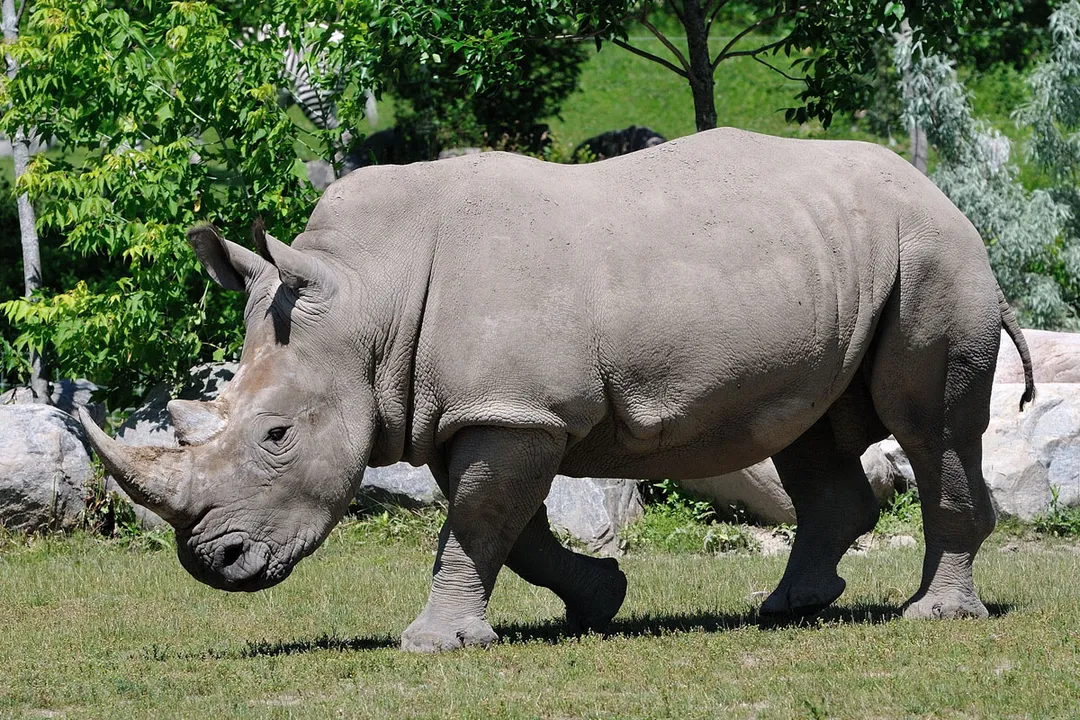
The story of the white rhinoceros is written across millions of years, a testament to mammalian adaptability within the order Perissodactyla, which also includes horses and tapirs. [2] This lineage has persisted on Earth for nearly fifty million years. [5] To understand the modern Ceratotherium simum, one must trace its ancestry back through significant morphological and ecological transformations that set it apart from its ancient relatives and its close contemporary, the Black Rhino. [3]
# Ancient Roots
Rhinoceros evolution spans a vast timeframe, rooted deeply in the Cenozoic Era. [2] Within the scientific classification system, the white rhino resides in the Kingdom Animalia, Phylum Chordata, Class Mammalia, Order Perissodactyla, and Family Rhinocerotidae. [1] Its scientific designation, Ceratotherium simum, tells us much about its structure—Cera relating to horns and therium to beast, while simum refers to its distinctive wide muzzle. [1]
The evolutionary journey of rhinos involved diversification, leading to various forms across different continents. [2] Early rhinos often differed significantly from the bulky, two-horned giants we observe today, sometimes possessing smaller stature or different dental characteristics reflecting their diets. [8] The family Rhinocerotidae itself shows considerable variation, but the path leading specifically to the white rhino involved key adaptations related to feeding strategies and body size. [6]
# Genus Shift
The genus Ceratotherium represents a significant branch in rhino history. [8] Tracing this genus reveals a transition from smaller, likely more generalized ancestors to the large grazers that characterize the modern Southern White Rhino. Evolutionary studies, often examining fossilized skulls and teeth, suggest a key divergence in feeding habits. [6]
When comparing the evolutionary trajectory of Ceratotherium to other horn-bearing mammals, the commitment to grazing appears as a defining moment. If ancestral forms were browsers, feeding on leaves and branches, the development of the broad, square lip characteristic of C. simum signals a specialization for eating low-growing grasses. [3] This ecological commitment—the shift from browsing to grazing—is a profound evolutionary change that allowed the lineage to exploit open grassland environments that expanded over geological time scales. [8] This specialization means that while the Black Rhino (Diceros bicornis) remains adapted for stripping foliage from bushes, the White Rhino is structurally designed as a lawnmower for the savanna. [3]
The size difference between ancient forms and the modern species also marks this evolution. While it is challenging to reconstruct the exact size relationships without detailed fossil data, the lineage appears to have trended toward significant bulk, likely driven by predator avoidance and efficient digestion of lower-quality grass forage. [8] Observing the scale differences between ancestral species and the current two-tonne animals offers a tangible measure of this long-term evolutionary scaling. [8]
# Species Division
The concept of the White Rhino as a single entity is complicated by the division into two recognized subspecies, which have distinct recent histories and conservation statuses. [3] These are the Southern White Rhino (Ceratotherium simum simum) and the Northern White Rhino (Ceratotherium simum cottoni). [3]
The separation between these two groups reflects a fragmentation event in their more recent evolutionary history, driven by geography and habitat change. The Southern subspecies thrives in greater numbers today, primarily in Southern Africa, while the Northern subspecies was historically found further north. [9][3]
| Subspecies | Primary Region | Approximate Wild Population (Early 2020s) | Status Context |
|---|---|---|---|
| Southern White Rhino | Southern Africa | ~16,800 | Near Threatened/Vulnerable (historically recovered) [9] |
| Northern White Rhino | Central/East Africa | 2 (Females in care) | Functionally Extinct [5][9] |
This stark demographic difference underscores how recent evolutionary paths can diverge drastically under differing external pressures. [9] The Southern White Rhino population experienced a near-extinction event as well, dropping to perhaps only fifty individuals in the early 1900s, but has since undergone a significant rebound due to intensive conservation efforts across Southern Africa. [3][7] Conversely, the Northern White Rhino population faced unrelenting pressure, culminating in its functional extinction, with the last male dying in 2018. [5][9]
# Evolutionary Implications
The white rhinoceros's evolutionary success, spanning millions of years, is defined by its specific adaptations: its massive size, its two horns, and its specialized square lip. [1][3] These traits reflect deep time responses to ancient ecological niches.
A fascinating comparison arises when considering the relative scarcity of fossils or molecular data for the exact divergence points between these subspecies compared to the vast fossil record of rhinos generally. [2][4] While the overall family timeline is ancient, pinpointing the exact split between simum and cottoni requires finer-scale genetic analysis or very recent fossil finds, which are often harder to secure than skeletal remains of older relatives. [4] Yet, the differing fates of the two subspecies provide a sobering real-world test of evolutionary viability in the modern era. The species survived vast climatic shifts, but the pressure exerted by human activity over the last century is a novel, rapid environmental stressor unlike anything faced during its long evolutionary tenure. [5] The fact that the Southern population managed to recover from the brink—from near zero to over sixteen thousand—demonstrates the incredible resilience inherent in the species' underlying biology, provided the fundamental environmental conditions (absence of poaching, secure habitat) are met. [9]
The physical distinction between the species, while seemingly minor to a casual observer—the Northern White Rhino historically had a slightly more elongated skull—is the culmination of countless small adaptive steps over millennia, now threatened by changes occurring in mere decades. [8] This contrast between deep, slow evolutionary change and acute, rapid demographic collapse is perhaps the most significant observation one can draw when studying the white rhinoceros's long history alongside its precarious present. [5]
Related Questions
#Citations
Taxonomy & History - White Rhinoceros (Ceratotherium simum) Fact ...
Rhinos Through the Ages
White Rhino - International Rhino Foundation
Ancient and modern genomes unravel the evolutionary history of the ...
After nearly fifty million years on Earth, the northern white rhinoceros ...
Contrasting evolutionary history, anthropogenic declines and ...
White rhinoceros - Animals - Toronto Zoo
Evolution of Ceratotherium, the white rhino, to scale
Rhino populations | Rhino Facts - Save the Rhino International