Which taxonomic Family unites *Lepidophyma flavimaculatum* with other live-bearing lizards?
Answer
Xantusiidae
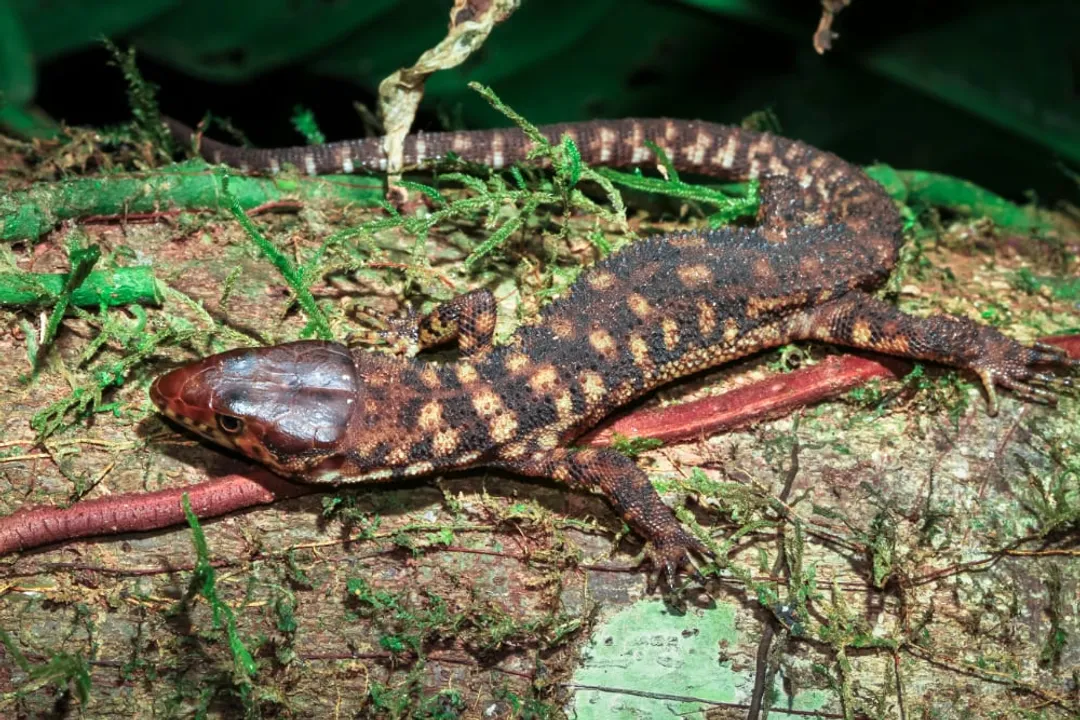
The Family rank for *Lepidophyma flavimaculatum* is **Xantusiidae**, a group commonly referred to as the night lizards. Placement within this specific family is significant because it groups species that share fundamental biological traits, the most notable of which is being viviparous, meaning they give birth to live young rather than laying eggs. While the Order Squamata is massive and includes all snakes and lizards, and Chordata represents a broader phylum, the Family Xantusiidae offers a much tighter grouping based on shared evolutionary history and key characteristics like reproductive strategy and general nocturnal habits. This family is relatively small, comprising only three recognized genera.
Related Questions
What Latin roots form the specific epithet *flavimaculatum* of *Lepidophyma flavimaculatum*?What do the Greek roots composing the genus name *Lepidophyma* translate to, referencing a physical trait?Which taxonomic Family unites *Lepidophyma flavimaculatum* with other live-bearing lizards?What reproductive strategy allows *L. flavimaculatum* populations to produce exclusively female offspring without fertilization?What common name is sometimes used by pet dealers for tropical night lizards like *Lepidophyma flavimaculatum*?According to the IUCN assessment, what is the current conservation status of *Lepidophyma flavimaculatum*?What taxonomic feature distinguishes the genus *Xantusia* from the genus *Lepidophyma* within the Xantusiidae family?Which reproductive trait do *L. flavimaculatum* and other members of the Family Xantusiidae share?What unusual physical data discrepancy highlights the difficulty in gathering standardized field data for *Lepidophyma flavimaculatum*?What mechanism is identified as the primary source of venom in *L. flavimaculatum*, despite fictional portrayals?Which authority established the binomial designation *A.H.A. Duméril, 1851* for the species *Lepidophyma flavimaculatum*?