Yellow Tanager (Black-and-Yellow Tanager) Scientific Classification
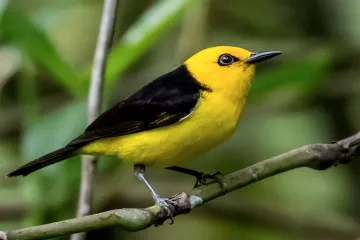
The formal placement of the Yellow Tanager, widely recognized by its more descriptive common name, the Black-and-Yellow Tanager, within the Linnaean hierarchy reveals key insights into its evolutionary relationship with other birds. This species holds the scientific designation Chrysothlypis chrysomelas. The study of this bird's classification, like that of many species, is a narrative of discovery, documentation, and refinement, anchored by the initial formal description.
# Initial Description
The species was first formally described in the year 1869 by the ornithologists P.L. Sclater and O. Salvin. Their original work established the species under a different generic name, which is now known as the protonym. This original assignment was Tachyphonus chrysomelas. The type locality for this description was pinpointed to the Cordillera del Chucu in Veraguas, Panama. Understanding the protonym is important because it provides a fixed reference point against which all subsequent taxonomic arrangements are measured, even when the genus placement changes.
# Hierarchical Placement
The Black-and-Yellow Tanager is firmly situated within the familiar classification structure for birds. It belongs to the Class Aves and the Order Passeriformes, placing it among the perching birds, which is the largest order of birds. Its current placement in the Family Thraupidae confirms its identity as a true tanager, a large and diverse family primarily composed of Neotropical species.
The complete ranking, according to several accepted checklists, is as follows:
| Taxonomic Rank | Classification |
|---|---|
| Kingdom | Animalia |
| Phylum | Chordata |
| Class | Aves |
| Order | Passeriformes |
| Family | Thraupidae |
| Genus | Chrysothlypis |
| Species | C. chrysomelas |
# Genus Evolution
The shift from the former genus Tachyphonus to the current Chrysothlypis represents a significant step in understanding the evolutionary relationships among these colorful birds. The genus Chrysothlypis itself has a descriptive Greek origin, with the name generally translating to signify "gold". This grouping likely reflects shared morphological or, more recently, molecular characteristics that distinguish these species from those retained in Tachyphonus or other related tanager genera. When ornithologists reassign a species to a new genus, it is usually because new evidence suggests a closer common ancestry with the species already placed in that destination genus than with the species remaining in the original one.
It is worth noting that the specific epithet, chrysomelas, is derived from Greek elements meaning "gold" () and "black" (), perfectly summarizing the bird’s striking plumage. In the world of nomenclature, slight variations sometimes appear due to historical interpretation or transcription errors. For this species, the spelling chrysomelas is the one recognized as correct by most modern authorities, despite some past taxonomic lists adopting the emendation chrysomelaena. This subtle difference highlights the need for strict adherence to the original description's spelling when cataloging biodiversity, even across different global standards.
# Subspecies Variation
Classification often extends below the species level into recognized subspecies, which represent populations with distinct, consistent differences across their geographic range. For the Black-and-Yellow Tanager, most authorities recognize at least two subspecies. The nominate subspecies (C. c. chrysomelas) is found in Costa Rica and western Panama. A second recognized form is C. c. ocularis, which is found further east in Panama.
A fascinating point of divergence in taxonomic opinion involves the recognition of a potential third subspecies, C. c. titanota, which some systems apply to the population found in extreme western Panama and Costa Rica, thereby slightly narrowing the range of the nominate form. This discrepancy between different authorities—such as the IOC World Bird List versus regional field guides—shows that classification, even at the subspecific level, is not static. For the dedicated field observer, recognizing these subtle differences, like the black spot on the lores of the male ocularis compared to the nominate, becomes a practical exercise in applying these taxonomic divisions. This varying acceptance of subspecies, even when the species boundary is stable, underscores the ongoing evaluation of avian biogeography and local adaptation.
# Data Consistency Across Authorities
Reviewing taxonomic databases demonstrates the consensus on the core classification while occasionally revealing small variations, particularly concerning spelling or subspecies recognition. For instance, while the primary scientific name remains consistent across major registers, the presence of the species across multiple classification authority lists (such as the AOU, Clements, and IOC, as evidenced by compilation lists) confirms the stability of the family and genus placement. The fact that authoritative bodies consistently place Chrysothlypis chrysomelas within Thraupidae and in the genus Chrysothlypis indicates a strong agreement on its fundamental phylogenetic position within the tanager radiation, suggesting that molecular data, where available, supports this current arrangement over its historical placement in Tachyphonus. This widespread agreement provides confidence for anyone using the current scientific name in research or field identification.
Related Questions
#Citations
Black-and-yellow tanager
Chrysothlypis chrysomelas (Black-and-yellow Tanager)
Yellow Tanager (Black-and-Yellow Tanager) Bird Facts