Which reproductive trait do *L. flavimaculatum* and other members of the Family Xantusiidae share?
Answer
Viviparity, or live-bearing
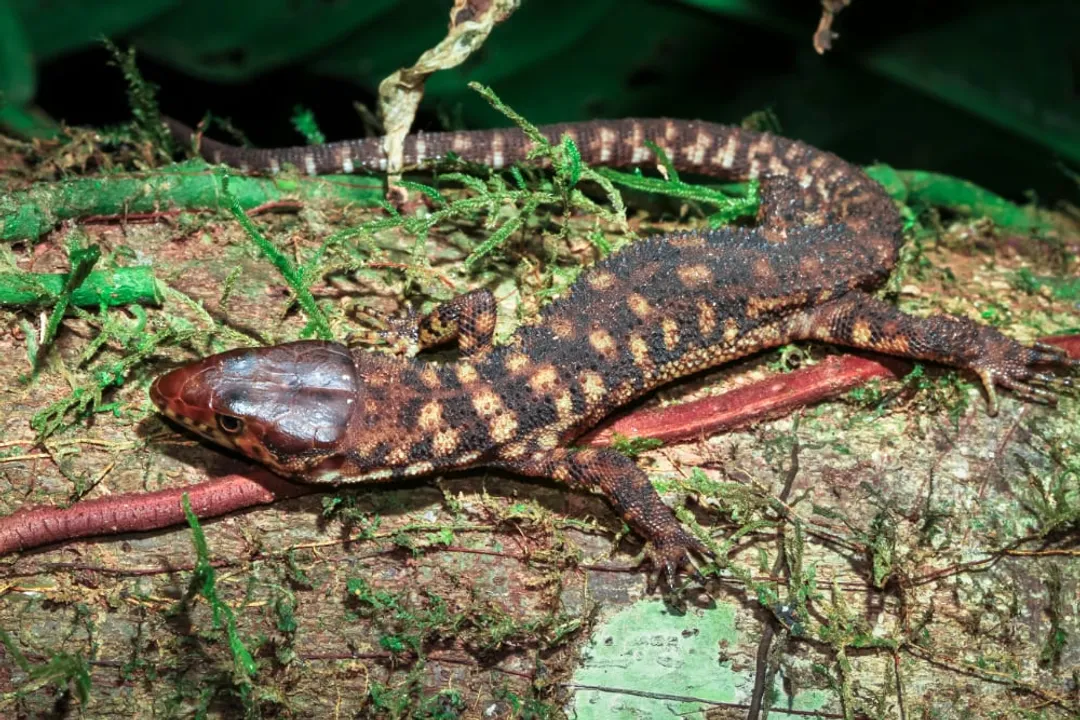
A defining characteristic shared by all members of the Family Xantusiidae, including *Lepidophyma flavimaculatum*, is that they are viviparous. Viviparity means that the female carries the developing embryos internally and gives birth to live, fully developed young, bypassing the egg-laying stage (oviparity). Litter sizes are typically modest, generally ranging from five to eight babies, which are born approximately 3 cm in length. Although *L. flavimaculatum* exhibits the unusual addition of parthenogenesis in some locales, the fundamental shared characteristic within the family structure remains this commitment to live birth.
Related Questions
What Latin roots form the specific epithet *flavimaculatum* of *Lepidophyma flavimaculatum*?What do the Greek roots composing the genus name *Lepidophyma* translate to, referencing a physical trait?Which taxonomic Family unites *Lepidophyma flavimaculatum* with other live-bearing lizards?What reproductive strategy allows *L. flavimaculatum* populations to produce exclusively female offspring without fertilization?What common name is sometimes used by pet dealers for tropical night lizards like *Lepidophyma flavimaculatum*?According to the IUCN assessment, what is the current conservation status of *Lepidophyma flavimaculatum*?What taxonomic feature distinguishes the genus *Xantusia* from the genus *Lepidophyma* within the Xantusiidae family?Which reproductive trait do *L. flavimaculatum* and other members of the Family Xantusiidae share?What unusual physical data discrepancy highlights the difficulty in gathering standardized field data for *Lepidophyma flavimaculatum*?What mechanism is identified as the primary source of venom in *L. flavimaculatum*, despite fictional portrayals?Which authority established the binomial designation *A.H.A. Duméril, 1851* for the species *Lepidophyma flavimaculatum*?