Yellow-faced Bee Scientific Classification
The common name "Yellow-faced Bee" often conjures an image of a single insect, but scientifically speaking, it refers to a vast and globally significant lineage of bees belonging to the genus Hylaeus. This genus is one of the largest and most diverse groups of bees in existence, encompassing over 500 described species worldwide. Understanding the Yellow-faced Bee requires delving into the formal Linnaean structure that organizes this diversity, moving from the broadest categories down to the unique characteristics that define this specific group.
# Animal Kingdom

At the most inclusive level, Yellow-faced Bees are classified within the Kingdom Animalia. This places them among all multicellular, heterotrophic organisms that ingest their food. Within Animalia, they are placed in the Phylum Arthropoda, characterized by segmented bodies, jointed appendages, and an exoskeleton, which certainly describes these small insects.
The next major step down in the classification places them in the Class Insecta. This class is defined by having three distinct body parts—head, thorax, and abdomen—and typically three pairs of legs, all features evident in the Hylaeus bees.
# Order and Family Placement

Moving into more specific groupings, the Yellow-faced Bees belong to the Order Hymenoptera, an order that famously includes ants, sawflies, wasps, and other bees. What separates Hylaeus from many of its Hymenopteran relatives is its position within the bee lineage, specifically the Family Colletidae.
The Colletidae family is sometimes referred to as "plasterer bees". This distinctive, family-level trait is what gives these bees their peculiar nesting behavior: the female secretes a specialized substance from her mouth, often described as cellophane-like, which she uses to line her brood cells and plug the nest entrance. This lining is waterproof and contaminant-proof, a remarkable adaptation for protecting the developing brood. While this family feature is shared, the defining characteristics that isolate the Hylaeus genus occur at the next taxonomic step.
# The Genus Defining Traits

The Yellow-faced Bees are formally grouped into the Genus Hylaeus. The genus was established by Johan Christian Fabricius in 1793. The name itself is derived from the Greek word hyle, meaning "wood, timber, or forest," referencing their association with woody plants that provide nesting materials. This genus is unique among the Colletidae because it is the only colletid genus that is truly globally distributed, found on every continent except for Antarctica.
The Hylaeus genus is defined by several crucial morphological traits that distinguish its members from other bee genera, even within the Colletidae family, leading to their placement in the Subfamily Hylaeinae.
# A Wasp-Like Appearance
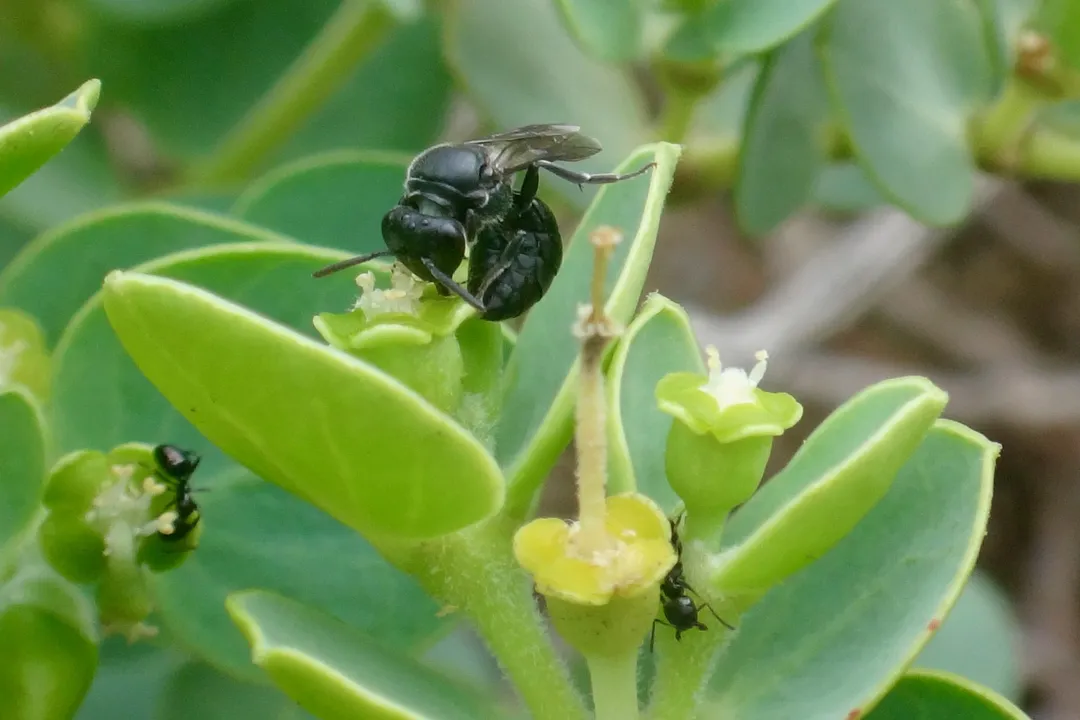
One of the most immediate, yet sometimes misleading, classification cues for Hylaeus is their resemblance to small wasps. This mimicry is enhanced by their slender, or hylaeiform, body shape and, most notably, the absence of a scopa. A scopa is the dense mass of specialized, branched hairs on the hind legs that most female bees use to externally carry pollen—the "pollen basket".
The lack of this external pollen-carrying apparatus is a key characteristic setting Hylaeus apart. Instead, they transport the provisions internally in their crop, often referred to as the "honey stomach". The female mixes the gathered pollen with nectar and regurgitates this liquid mass directly into the brood cell. This internal transport method is considered an ancestral trait among bees.
# Facial Markings
The common names "Yellow-faced Bee" or "Masked Bee" stem from the distinct facial markings. Males typically exhibit extensive yellow or white markings, often filling the lower face region (clypeus) to look like a "mask". Females often show less extensive markings, sometimes described as two distinct yellow triangles near the eyes, occasionally likened to "devil horns". However, it is worth noting that because many species have pale markings that are white or cream-colored rather than distinctly yellow, some enthusiasts prefer the term "masked bee".
# Niche Specialization
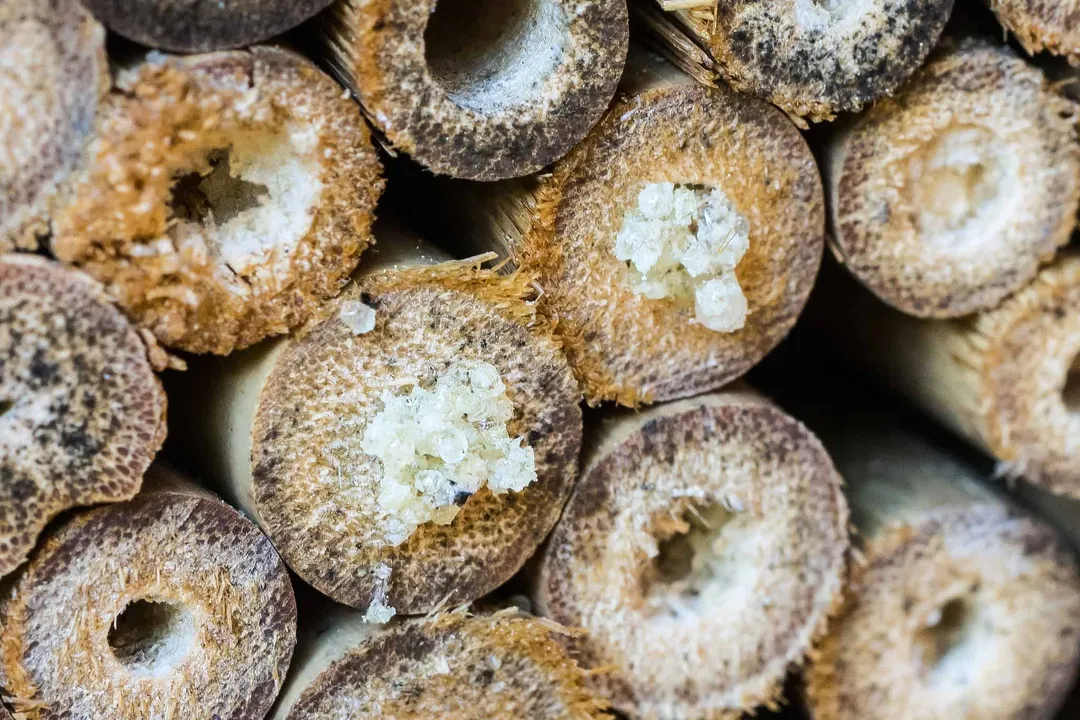
The habitat and nesting behavior further support their classification within this genus. Hylaeus species are generally solitary bees. They typically nest in pre-made cavities, such as the pithy stems of dead plants, crevices under bark, or sometimes in the ground. They lack the adaptations for digging or excavating, relying on tunnels created by other insects or natural conditions.
# Global Distribution and Subgenera
The global reach of Hylaeus is extensive, leading to a complex internal classification structure involving numerous subgenera. Phylogenetic work, such as that done by Ikudome in 1989, categorizes these groups geographically. The distribution highlights significant evolutionary divergences:
- Australasian Region: Contains the highest number of subgenera, with 19 noted groups, including Prosopisteron and Analastoroides. Phylogenetic data strongly suggests the genus originated in Australia approximately 30 million years ago.
- Palearctic, Nearctic, Oriental, Ethiopian, and Neotropical Regions: Each contains fewer subgenera, suggesting later dispersal events from the ancestral Australian lineage. The Nearctic region, for example, holds about 130 species, with roughly 20 recorded in Canada.
When looking at the evolution of the genus, the subsequent colonization of other areas involved significant speciation events. For instance, a single colonization event is believed to have led to the massive diversity found in the Hawaiian Islands.
# Species-Level Classification Case Studies
Classification culminates at the species level, where subtle morphological differences, or in the case of island endemism, distinct geographic isolation, separate one form from another. The diversity of the genus is perhaps best illustrated by contrasting a widespread, introduced species with highly localized endemic ones.
# The Hawaiian Radiation
The Hawaiian Islands are a hotspot for Hylaeus, hosting about 64 known species, all native to the island chain—they are the only native bees there. This radiation is so significant that the diversity of Hylaeus in Hawaii surpasses that of all of mainland North America combined.
Consider the Easy yellow-faced bee, Hylaeus facilis. Historically widespread across Oahu, Molokai, Lanai, and Maui in habitats ranging from coastal strand to wet forest, this species is now critically imperiled, listed as Endangered by the U.S. Fish & Wildlife Service. Its classification into this specific species highlights a lineage adapted to particular Hawaiian ecological niches that are now severely degraded.
Contrast this with Hylaeus assimilans, which is listed as Critically Imperiled on the Xerces Red List. This species is known for being comparatively large among the coastal Hawaiian Hylaeus, a feature that might be linked to its apparent adaptation to handling the large pollen loads of Sida fallax (Ilima). While its females are entirely black, the males are recognizable by their large facial markings; however, identification of females often relies on geographic distribution alone, as they can be indistinguishable from close relatives like H. ombrias based on morphology alone.
# Continental and Introduced Species
On the North American mainland, species like Hylaeus lunicraterius demonstrate classification based on extreme geographic restriction. This bee is known only from the Craters of the Moon National Monument in Idaho, nesting in lava flow crevices—a habitat specialization that places it in a unique ecological category separate from its Hawaiian cousins.
Conversely, the presence of introduced species further complicates the broader classification context. Hylaeus hyalinatus, for example, has been introduced to the United States, with documented occurrences in New York, New Jersey, and Pennsylvania. While geographically classified within the Nearctic region now, its origin is external, demonstrating that the Hylaeus genus continues to spread via human activity.
# The European Example
In Europe, we see classifications based on chemical ecology. The species Hylaeus prosopis is noted for a strong, lemon-like scent attributed to mandibular gland secretions containing neral and geranial, possibly functioning as a defensive or social pheromone. This chemical signature becomes an integral, albeit non-traditional, part of distinguishing that species' profile within the classification system.
This variety in habitat, morphology, and chemistry across the genus underscores a fundamental realization in taxonomy: the broad classification of Hylaeus encompasses evolutionary pathways adapted to drastically different global environments—from the volcanic slopes of Hawaii to the calcareous grasslands of Britain.
The differentiation between the Hawaiian endemic radiation and the continental/introduced populations provides an insightful comparison. The massive diversification in the Hawaiian Hylaeus lineage, stemming from a single colonist perhaps 0.5 to 0.4 million years ago, suggests an incredibly rapid speciation rate, calculated at a minimum of 9.23 species per million years on Hawaiʻi Island alone. This accelerated evolution filled numerous novel ecological niches—coastal strand, dry forest, wet forest, and even cleptoparasitism, a behavior unique among Hawaiian Colletids. In contrast, the subgeneric organization in the ancestral Australian range reflects millions of years of slower diversification across a much larger, older landmass, leading to a greater number of established subgenera rather than a single explosive speciation event.
It is also fascinating to consider the single most defining characteristic of the genus: the internal pollen transport method via the crop. While this places Hylaeus firmly in the Subfamily Hylaeinae, it represents a deep evolutionary split from the vast majority of other bees that use external scopal hairs. A close examination of the Hylaeus female grooming behavior reveals a focused process where pollen is only groomed from the head and forelegs to the crop; pollen caught on the rest of the body is simply lost. This efficient, yet seemingly limited, mechanism of pollen gathering, contrasted with the generalist foraging habits many species display, suggests a highly specialized evolutionary solution for provisioning that prioritizes liquid transfer over bulk transport, making them perhaps less effective at long-distance pollen transfer but highly specialized for certain floral architectures.
This specialization has real-world consequences. For instance, native Hawaiian species are almost entirely reliant on native plants for nutrition; they rarely visit non-native species except for the naturalized tree heliotrope, Heliotropium foertherianum. This extreme reliance on specific native floral resources means that habitat alteration, such as the replacement of native shrubs by invasive grasses, directly threatens the basis of their survival, even if nesting sites remain—a critical factor when assessing the conservation status of species like H. facilis.
The naming conventions themselves reflect the authority of the classification process. While Fabricius established the genus, specific species have been named by later taxonomists to reflect morphology, location, or association, such as Smith, Perkins, Cockerell, and Magnacca & Daly. The process of revising these names, such as when Nesoprosopis was reduced to a subgenus of Hylaeus by Meade-Waldo in 1923, shows that classification is a dynamic, evolving science based on accumulated evidence, not a static list of pronouncements.
In summary, the scientific classification of the Yellow-faced Bee is a hierarchical narrative. It begins with the broad traits of an arthropod insect in the Hymenoptera order, narrows to the "plasterer bee" family Colletidae, and finds its most specific identity in the genus Hylaeus due to its unique, wasp-like morphology, lack of external pollen baskets, and internal crop provisioning system. Below this, the division into dozens of subgenera and hundreds of species reveals fine-grained adaptations to environments spanning the globe, with the Hawaiian Islands serving as a powerful, high-speed laboratory for evolutionary divergence within this single genus.
Related Questions
#Citations
Hylaeus (bee)
Species Profile for Easy yellow-faced bee(Hylaeus facilis)
Yellow-Faced Bee - Hylaeus
Yellow-faced Bee Insect Facts
Nalo Meli Maoli (Yellow-faced Bees)
Hylaeus hyalinatus
Hylaeus verticalis (Masked bee, yellow faced bee)
Yellow faced bee (Hylaeus assimulans)
Chalk Yellow-face Bee - Hylaeus dilatatus
Yellow-Faced Bees