What structural feature forms a reservoir for trapped air in many adult water beetles?
Answer
Elytra
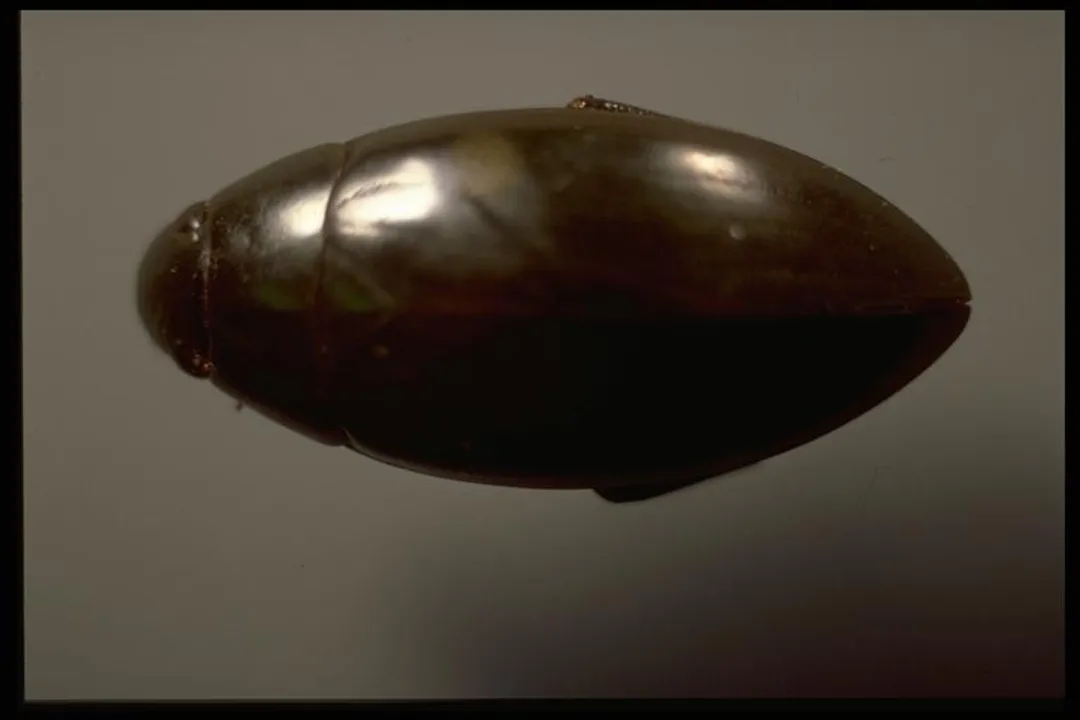
The elytra, which are the wing covers, serve a critical dual function for many aquatic beetles. While in many terrestrial beetles, the elytra meet in a straight line, in numerous water beetles, these structures meet in a tight, smooth seal over the abdomen. This tight formation creates a specialized space where a reservoir of air can be trapped when the beetle surfaces. This trapped layer of air functions analogously to a portable diving bell or a physical gill. Through this thin film, oxygen from the surrounding water can diffuse into the beetle's body tissues, and conversely, carbon dioxide produced by the beetle diffuses outward, enabling extended periods submerged beneath the water surface.
Related Questions
What structural feature forms a reservoir for trapped air in many adult water beetles?What type of antennae do Giant Water Scavenger Beetle adults possess?Which larval structure allows some diving beetles to breathe while remaining mostly submerged?How are the hind legs of powerful swimming predaceous diving beetles specialized?What difference illustrates niche partitioning between predatory diving beetle larvae and their adults?What visual observation signals the trapped air mechanism in the Giant Water Scavenger Beetle?Which fundamental characteristic do water beetles share with their terrestrial Coleoptera relatives?Which species is significantly smaller, measuring only around 3.6 to 4.2 millimeters in length?How is the larva of the Giant Water Scavenger Beetle described in terms of physical appearance?What sensory organs housed in the head capsule must function both above and below the water surface for water beetles?