What physical feature distinctly characterizes the tail of the Black Wildebeest (*C. gnu*)?
Answer
A longer tail that often appears white
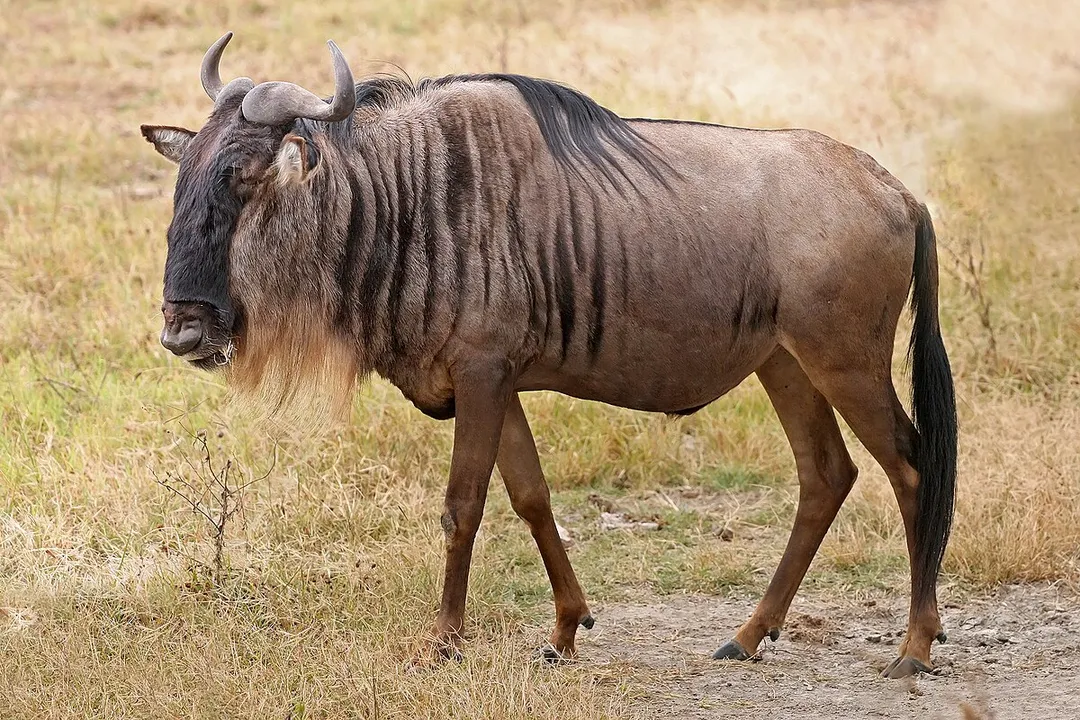
The Black Wildebeest, or white-tailed gnu, possesses several morphological differences that set it apart from its blue counterpart, one of the most noticeable being its tail. While the Blue Wildebeest has a shorter, dark tail, the Black Wildebeest exhibits a tail that is notably longer and frequently features white coloring. This difference is part of a broader set of morphological distinctions suggesting that *C. gnu* may have split earlier or adapted to a different set of ecological pressures, possibly involving patchier, less continuous grass availability that did not necessitate the massive movements associated with the Blue Wildebeest.
Related Questions
To which tribe does the genus Connochaetes, which includes wildebeest, belong?What two key environmental conditions drove the evolution of dramatic migratory behavior in wildebeest?What physical feature distinctly characterizes the tail of the Black Wildebeest (*C. gnu*)?How is the visual coloration of the Blue Wildebeest (*C. taurinus*) described in contrast to its counterpart?What evolutionary specialization defined the lineage leading to the immense migratory herds of *C. taurinus*?Which wildebeest species historically maintained a more geographically restricted range, centered in South Africa?How do the horns of the Black Wildebeest (*C. gnu*) curve differently from those of *C. taurinus*?What collective action involving millions of Blue Wildebeest expresses their evolutionary success?What contemporary human impact turns the Blue Wildebeest's ancient strategy into a vulnerability?What specific conservation measure was crucial for the recovery of the Black Wildebeest from near extinction?