Woodpecker Evolution

The woodpecker family, formally known as Picidae, represents a remarkable testament to evolutionary specialization, a group of birds perfectly sculpted by selection pressures to exploit resources locked deep within wood. [2][6] Understanding how these birds came to possess their unique abilities requires tracing their lineage and examining the almost unbelievable mechanics packed into their anatomy, which allows them to transform a tree trunk into a high-speed percussion instrument.[2]
# Ancient Lineage

Woodpeckers belong to the order Piciformes, a group that also includes toucans and barbets. [6] Within the Picidae family, there are roughly 200 recognized species distributed across subfamilies like the true woodpeckers (Picinae), the wrynecks (Jynginae), and the piculets (Picumninae). [6] The fossil record suggests that woodpeckers diverged from other birds quite a long time ago, establishing distinct traits that set them apart. [6] These birds are primarily arboreal, meaning they live in trees, and are found on every continent except Australia and the polar regions. [6] The fact that their specialized feeding strategy—excavating wood—has allowed them to fill such a specific niche across such a wide global range speaks to the power of the adaptive pathway they followed. [2]
# Specialized Tools

The ability to hammer repeatedly against hard wood without self-injury is not accidental; it is the result of an array of perfectly calibrated anatomical features. [1][2] Central to this design is the structure of the skull itself. [2] Woodpeckers possess extremely thick, spongy bone surrounding the brain, acting as a natural shock absorber. [2] Furthermore, the brain is relatively small in proportion to the skull, allowing more space for these protective tissues. [2] The hyoid apparatus, the bone structure supporting the tongue, is also highly modified. [2] In many species, the hyoid bone loops up over the top of the skull, sometimes even wrapping around the eye socket, providing an anchor point for the long, specialized tongue. [2][5]
The feet are equally specialized; woodpeckers exhibit zygodactyly, meaning they have two toes pointing forward and two pointing backward. [2] This configuration provides an exceptionally strong grip for clinging vertically to bark. [2] Complementing this grip is the tail, which is often comprised of stiff, pointed feathers that press against the trunk, acting as a crucial third point of contact or a prop to maintain balance during drilling. [2][6]

# Foraging Mechanics

When a woodpecker drums, it strikes wood at speeds sometimes exceeding 20 feet per second and experiences impact forces equivalent to several thousand times the force of gravity (G-force). [1] The question of how this rapid, repetitive impact does not cause catastrophic brain injury has long been a subject of intense scrutiny, sometimes serving as an argument that such a complex structure could not have arisen through gradual evolutionary steps. [8][10] Evolutionary biology, however, explains this through the gradual refinement of these integrated systems. [1] The combination of the shock-absorbing skull bone, the constrained space for the brain, and the muscular system that controls the blow ensures that the head decelerates extremely quickly after impact. [1][2]
The tongue itself is a predatory instrument. It is often extremely long, sometimes twice the length of the skull, and may be barbed or tipped with sticky saliva to extract insect larvae from galleries within the wood. [2] The mechanism is one of precise tool application: the bird drills a perfectly sized hole, probes the exact location of the prey, and then uses the tongue to spear or scoop it out. [2] Consider the Northern Flicker, for example; while many woodpeckers primarily drill for insects inside the wood, Flickers also spend significant time foraging on the ground for ants, demonstrating a slightly broader use of their evolutionary toolkit. [6]
If we map out the sequence of specialized features, we can see a reinforcing loop. A slight advantage in gripping bark (better feet/tail) allows the bird to hold position longer, enabling more effective pecking. This opens up a specialized food source (grubs), which then provides the energy necessary to support the development of ever-more robust skull/tongue apparatuses to exploit that source better. It suggests that the evolutionary refinement wasn't a single leap but a tightly coupled, reinforcing cycle of anatomical and behavioral feedback loops acting over deep time. [1][7]
# Convergent Forms
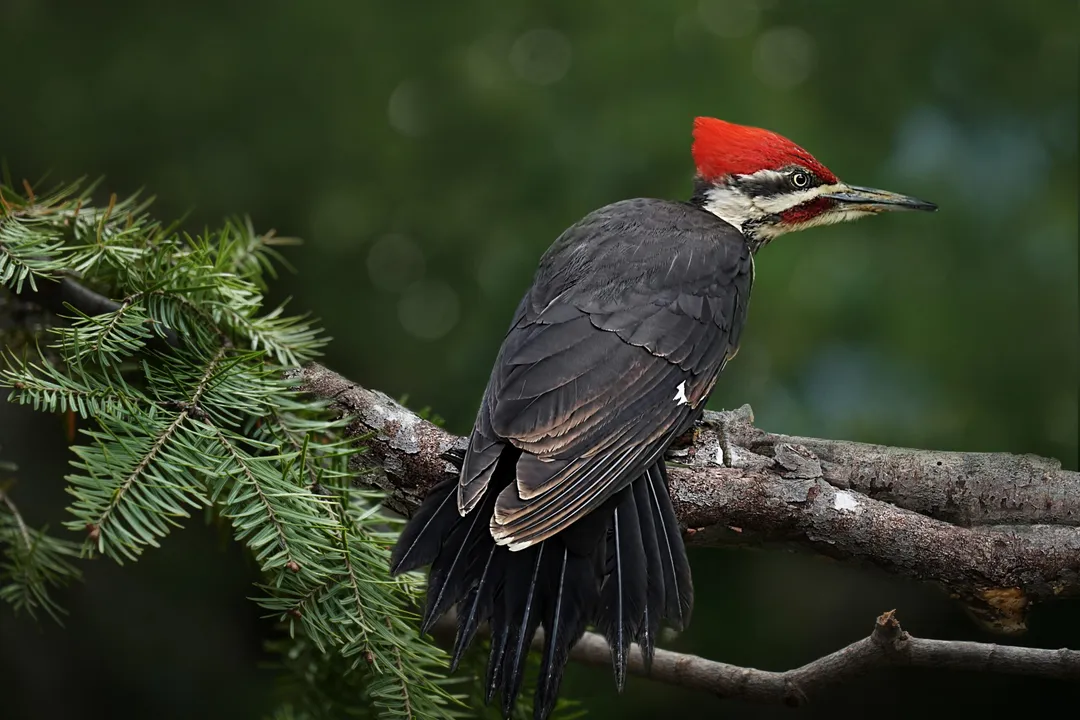
One of the most intriguing aspects of woodpecker evolution is not just the shared features across the entire family, but how similar forms have developed independently in unrelated groups when facing similar ecological challenges—a phenomenon called convergent evolution. [7] A study looking at woodpeckers across the globe demonstrated that visual similarity often correlates more strongly with shared environment and foraging behavior than with genetic closeness. [4][7] For instance, species that live in regions with very hard wood and share similar insect prey might evolve similar plumage patterns or body shapes to be maximally effective in that specific ecological niche, even if their last common ancestor lived millions of years ago and looked quite different. [7]
This pattern shows that evolution does not always follow a single predetermined path but often arrives at similar "solutions" when the physical constraints of the environment are nearly identical. [4] Looking at a Black Woodpecker next to a Flicker, one might assume a very close relationship based purely on morphology and size, yet their genetic divergence can be substantial. [4] This implies that for specialized traits like drumming proficiency, the environmental filter is so strong that it molds disparate lineages toward a common physical outcome that maximizes energy intake per striking effort. [7]
When observing woodpeckers in a local area, it is worthwhile to consider not just what they look like, but how they forage, as this is often a stronger indicator of the specific evolutionary pathway they took in response to local resources. For example, a region dominated by soft, decaying wood might favor woodpeckers with less robust skull structures compared to those inhabiting forests with dense hardwoods, even if they appear superficially similar. [2]

# Evolutionary Synthesis
The success of the Picidae family lies in this exquisite integration of structure and function. It is not just the hard skull; it is the quick muscle contraction, the specific angle of impact, the shock-absorbing spongy bone, the anchor provided by the hyoid bone wrapped around the cranium, and the specialized feet and tail working in concert. [2][5]
If you spend time observing a local woodpecker colony—say, a cluster of Downy Woodpeckers in a suburban park—you notice that not every tap is a full-force strike; much of their time is spent in light tapping or probing. [2] This suggests that the high-G-force drumming is reserved for specific tasks, likely breaking through thick outer bark or signaling territory, while regular foraging involves less dramatic, more subtle movements that still rely on the specialized tongue and precise eye-foot coordination. [2] The evolutionary payoff comes from maximizing the harvest of energy (insects) while minimizing the risk of mechanical failure (injury) to the drilling apparatus. [1]
Birdwatchers, particularly those interested in avian ecology, can use this knowledge to better appreciate their local fauna. Next time you hear a woodpecker hammering on a utility pole or a chimney flashing during the spring months, pause to consider that sound is likely more about communication—securing a mate or defending a high-value nesting site—than it is about securing an immediate meal. [2] This communicative drumming represents an evolutionary feature whose utility has been successfully transferred from natural substrate (wood) to human-made structures, demonstrating the plasticity inherent in these highly specialized traits. [2] The evolution of the woodpecker, therefore, is a classic textbook example of how a unique biological challenge—accessing food within wood—drives the development of an entire suite of interlocking, optimized physical attributes across a global lineage. [7]
#Videos
Woodpecker Defies Evolution - YouTube
Related Questions
#Citations
How does evolution explain / account for super niche specializations ...
Woodpeckers - The Science of Birds
Bock: Functional and evolutionary morphology of woodpeckers
Are Woodpeckers Evolving to Look Like Each Other? A New Study ...
Woodpecker Defies Evolution - YouTube
Woodpecker - Wikipedia
Ecological and geographical overlap drive plumage evolution and ...
The Woodpecker Shouldn't Exist! - Alpha Omega Institute
Brooklyn Bird Watch: The evolution of the woodpecker species
Who Designed Woodpeckers? - Creationism