How do the horns of the Black Wildebeest (*C. gnu*) curve differently from those of *C. taurinus*?
Answer
They have a sharper curve, sweeping back then up
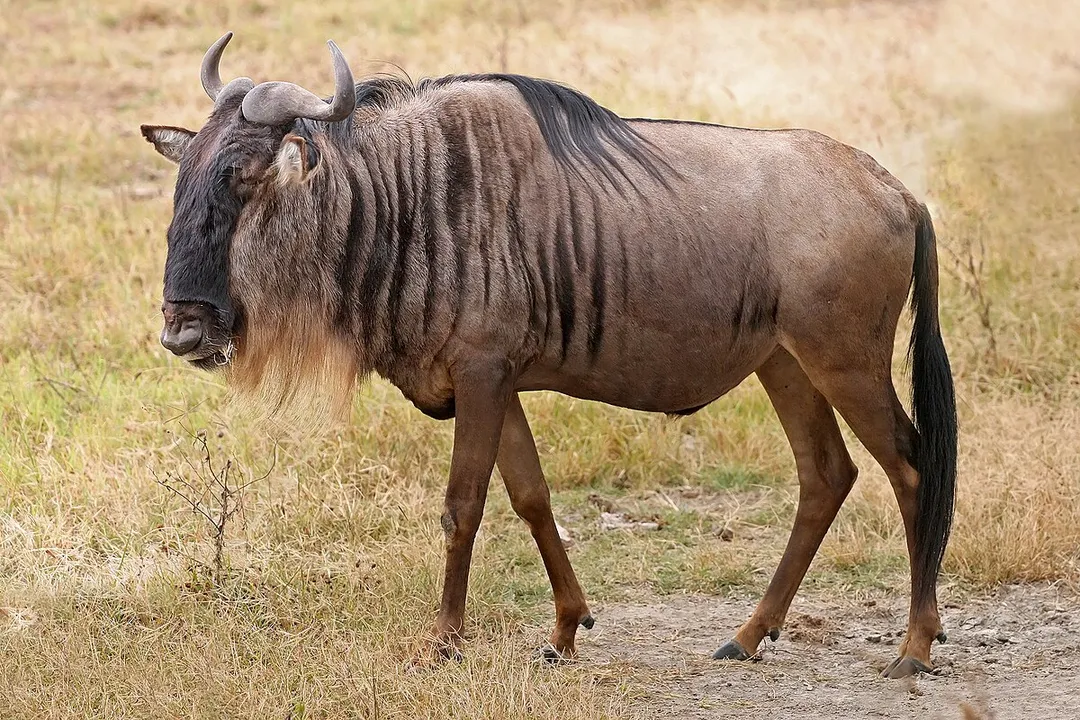
The morphology of the horns differs subtly but significantly between the two species. The Blue Wildebeest horns are characterized by having a broad base from which they sweep outward before curving upward. Conversely, the Black Wildebeest horns exhibit a sharper curve overall, defined by sweeping initially backward before curving upward. These morphological differences, alongside variations in tail length and coloration, provide evidence supporting the view that the two species followed separate evolutionary trajectories after diverging from a common ancestor, adapting to slightly different environmental niches.
Related Questions
To which tribe does the genus Connochaetes, which includes wildebeest, belong?What two key environmental conditions drove the evolution of dramatic migratory behavior in wildebeest?What physical feature distinctly characterizes the tail of the Black Wildebeest (*C. gnu*)?How is the visual coloration of the Blue Wildebeest (*C. taurinus*) described in contrast to its counterpart?What evolutionary specialization defined the lineage leading to the immense migratory herds of *C. taurinus*?Which wildebeest species historically maintained a more geographically restricted range, centered in South Africa?How do the horns of the Black Wildebeest (*C. gnu*) curve differently from those of *C. taurinus*?What collective action involving millions of Blue Wildebeest expresses their evolutionary success?What contemporary human impact turns the Blue Wildebeest's ancient strategy into a vulnerability?What specific conservation measure was crucial for the recovery of the Black Wildebeest from near extinction?