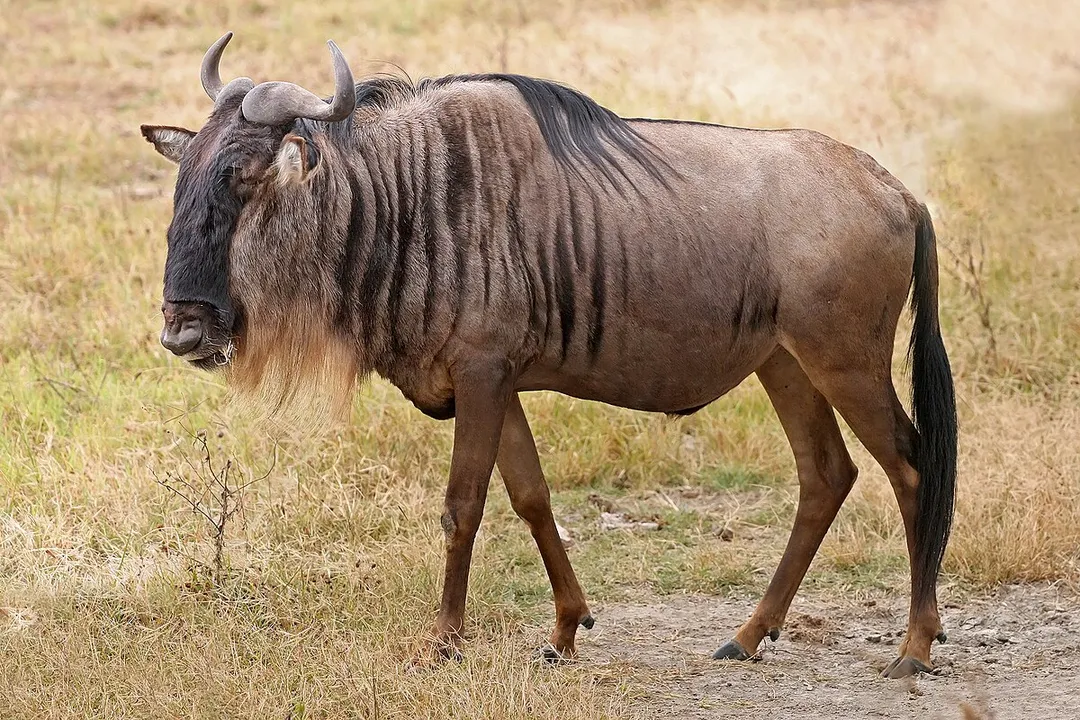
How is the visual coloration of the Blue Wildebeest (*C. taurinus*) described in contrast to its counterpart?
Answer
A silvery-blue or grey sheen with distinct black vertical stripes
The Blue Wildebeest exhibits a striking coloration that distinguishes it from the darker Black Wildebeest. Its body typically displays a grey-blue or silvery sheen, and it is further characterized by pronounced black vertical stripes located prominently on its neck and shoulders. This pattern gives rise to its common regional name, the 'brindled gnu.' This striping may have offered camouflage advantages within the complex light and shadow patterns found in the mixed savanna habitats it often occupies, particularly in contrast to the more uniformly dark Black Wildebeest.
Related Questions
To which tribe does the genus Connochaetes, which includes wildebeest, belong?What two key environmental conditions drove the evolution of dramatic migratory behavior in wildebeest?What physical feature distinctly characterizes the tail of the Black Wildebeest (*C. gnu*)?How is the visual coloration of the Blue Wildebeest (*C. taurinus*) described in contrast to its counterpart?What evolutionary specialization defined the lineage leading to the immense migratory herds of *C. taurinus*?Which wildebeest species historically maintained a more geographically restricted range, centered in South Africa?How do the horns of the Black Wildebeest (*C. gnu*) curve differently from those of *C. taurinus*?What collective action involving millions of Blue Wildebeest expresses their evolutionary success?What contemporary human impact turns the Blue Wildebeest's ancient strategy into a vulnerability?What specific conservation measure was crucial for the recovery of the Black Wildebeest from near extinction?