What is the locomotion style characteristic of the white-tailed deer (O. virginianus)?
Answer
Fast bounds in a relatively straight path
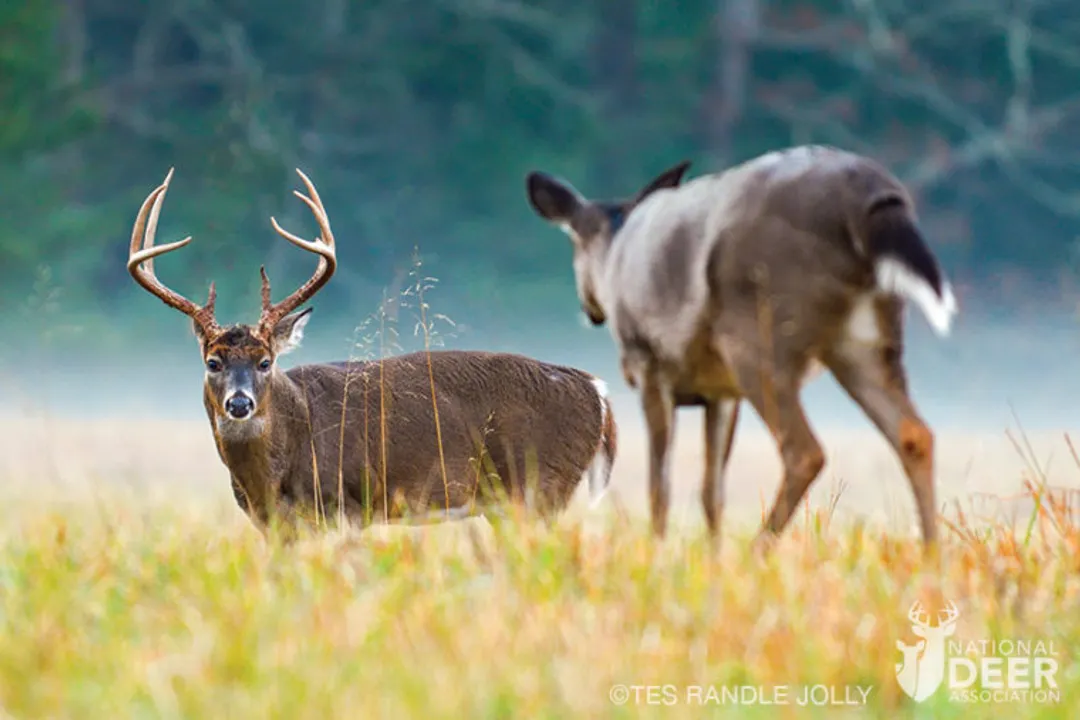
The anatomical differences between white-tailed deer and mule deer reflect adaptations to their respective primary habitats. The white-tailed deer possesses a bounding gait, which involves relatively fast movements generally following a straight path. This method of locomotion is highly effective for rapid evasion through dense cover, such as thickets and woods, where immediate, swift escape is prioritized over the need for complex aerial maneuvers. This contrasts with the mule deer's stotting or jumping motion, which is better suited for maneuvering in open terrain.
#Videos
The History Of Whitetail Deer - YouTube
Related Questions
Which species represents a distant evolutionary starting point for all cervids around 25 million years ago?What major geological event likely coincided with the divergence of whitetails and mule deer?What dietary strategy allows O. virginianus to persist through environmental shifts?What is the locomotion style characteristic of the white-tailed deer (O. virginianus)?What survival strategy proved most resilient for the whitetail during Pleistocene extinctions?What led to the near-obliteration of O. virginianus by the late 1800s?What evolutionary scenario is suggested by the rapid increase in O. virginianus density since the mid-20th century?What ecological implication is suggested by the mule deer's large, mule-like ears?What did a peculiar buck specimen discovered in the 1980s suggest about O. virginianus ancestors?How do human management practices like favoring large racks affect O. virginianus evolution?