What characteristic coloration defines the tail of mature Black-tailed Rattlesnakes?
Answer
Solid black or very dark gray
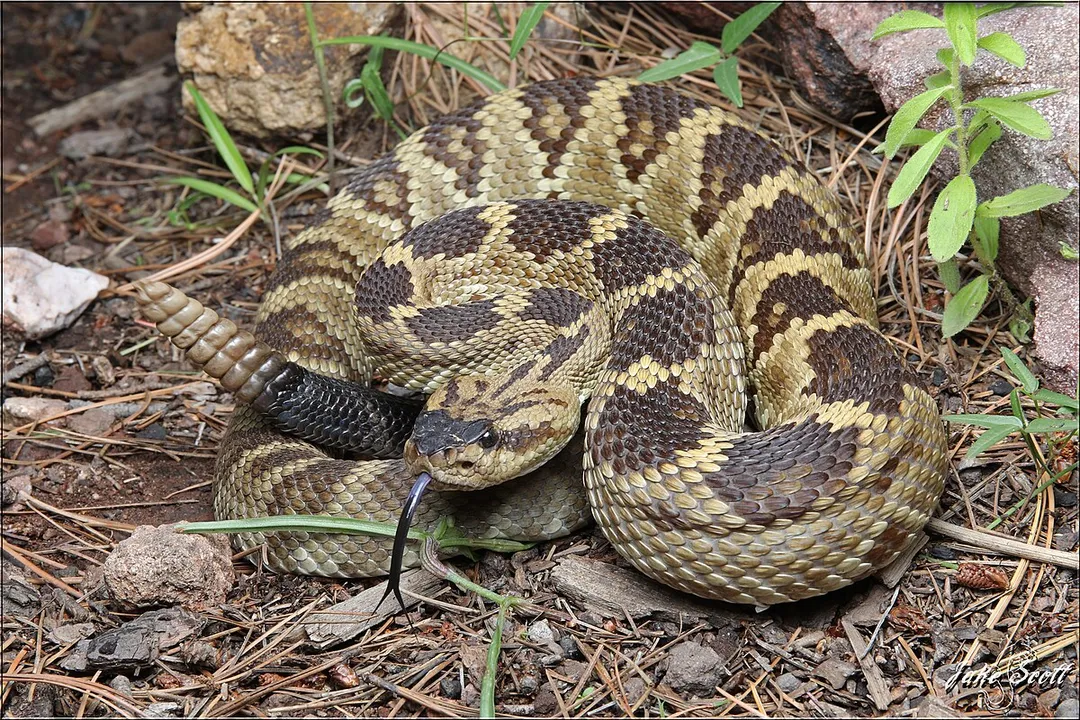
The defining physical characteristic that grants the Black-tailed Rattlesnake its common name is the appearance of its tail in adult specimens. Mature individuals typically exhibit a tail that is uniformly colored, appearing either solid black or a very dark gray hue. This contrasts with the body coloration, which can be highly variable, ranging through shades of gray, brown, and blackish tones due to chromatic plasticity. Furthermore, juveniles display a key difference: while their tail tips are black, the segment directly preceding the rattle often retains banding, unlike the solid black appearance characteristic of older adults.
Related Questions
What characteristic coloration defines the tail of mature Black-tailed Rattlesnakes?What distinct feature is often present on juvenile *Crotalus molossus* but fades in adults?What primary category describes the venom composition of *Crotalus molossus*?Which environmental feature do Black-tailed Rattlesnakes often prefer for cover and thermal regulation?What reproductive strategy is characteristic of *Crotalus molossus*?The body coloration of *C. molossus* demonstrates considerable what?Which states are specifically mentioned as home to populations of *Crotalus molossus*?What constitutes the main component of the Black-tailed Rattlesnake's diet?What defensive action precedes striking if a Black-tailed Rattlesnake feels cornered?What anatomical feature distinguishes pit vipers like *C. molossus* from non-venomous constrictors?