How does the nesting strategy of the female *A. manicatum* contrast with honeybees?
Answer
It is solitary, excavating and provisioning individual nests.
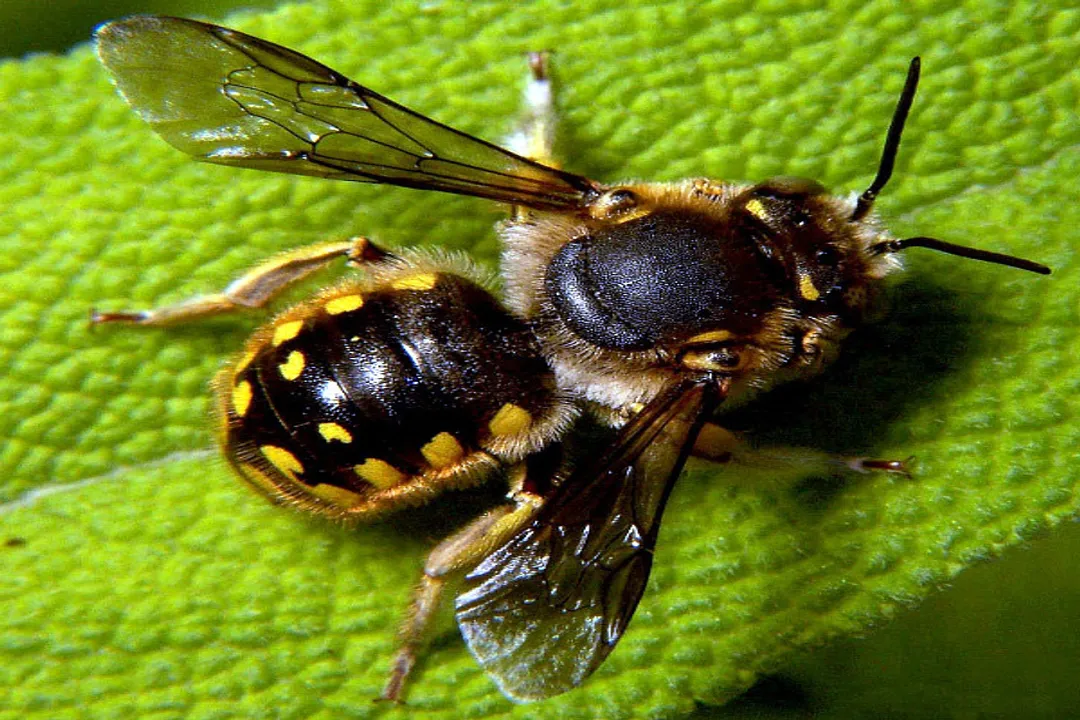
The reproductive strategy of the Wool Carder Bee diverges significantly from highly social insects like honeybees. *Anthidium manicatum* exhibits a solitary life cycle, meaning that the female bee is entirely responsible for her own reproduction. Each female excavates and provisions her own individual nest cells without the assistance of a permanent colony structure or sterile workers. Furthermore, these solitary females do not create new tunnels from scratch; rather, they seek out and repurpose pre-existing cavities, such as abandoned tunnels made by beetles in dead wood or hollow plant stems, adding a layer of complexity to habitat requirements beyond just floral resources.
Related Questions
When was *Anthidium manicatum* first officially detected in the USA?What distinctive marking identifies the male European Wool Carder Bee?How does the nesting strategy of the female *A. manicatum* contrast with honeybees?What specific fibrous material gives the Wool Carder Bee its common name?Which plant species is often a favored source for nesting fuzz in invasive ranges?Besides fibrous material, what physical substrate must *A. manicatum* females seek for nesting cavities?What role do territorial males play in locating nesting activity?What geographical areas constitute the native home range of *Anthidium manicatum*?Where is the Wool Carder Bee particularly prevalent within the United Kingdom?How does tracking an *A. manicatum* sighting in North America contrast with one in its native range?