Wool Carder Bee Locations
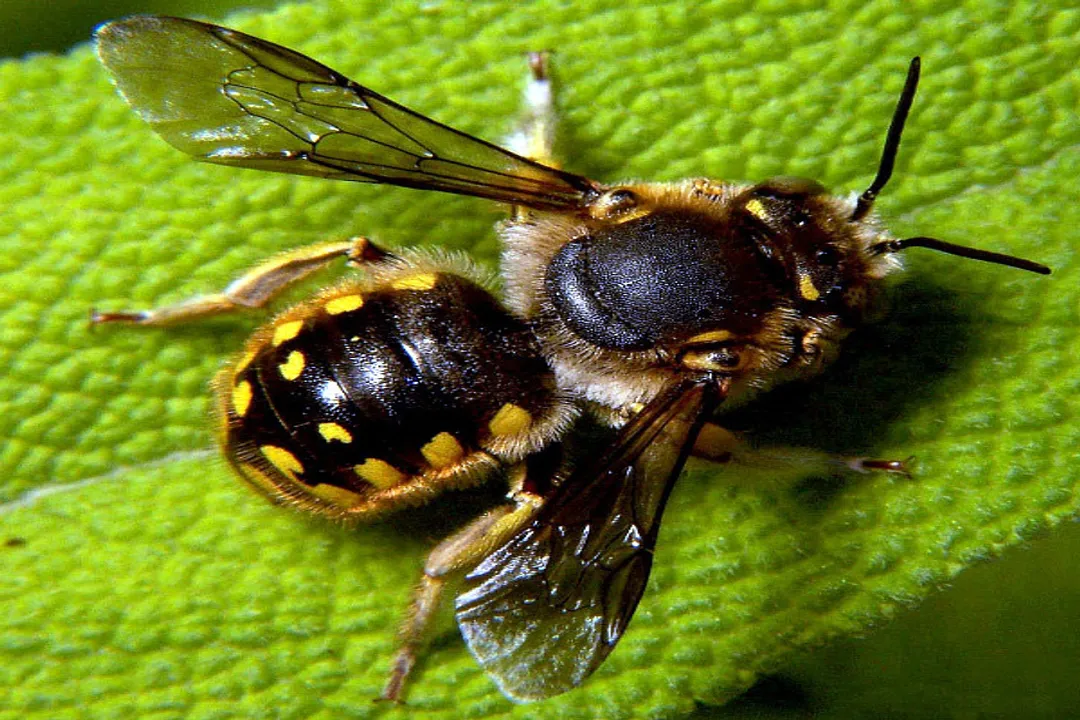
The European Wool Carder Bee, scientifically named Anthidium manicatum, presents a fascinating, albeit sometimes complicated, picture when tracing its geography. This species, easily recognized by the fuzzy abdominal patches on the female and the distinctive yellow markings on the face of the male, is not confined to a single continent but rather exists across a native home range and a rapidly expanding introduced territory. [1][8] For gardeners and entomologists alike, knowing where this bee is found is essential, particularly because its status shifts dramatically depending on the latitude—native in one place, and a documented invasive species in another. [1]
# Native Region
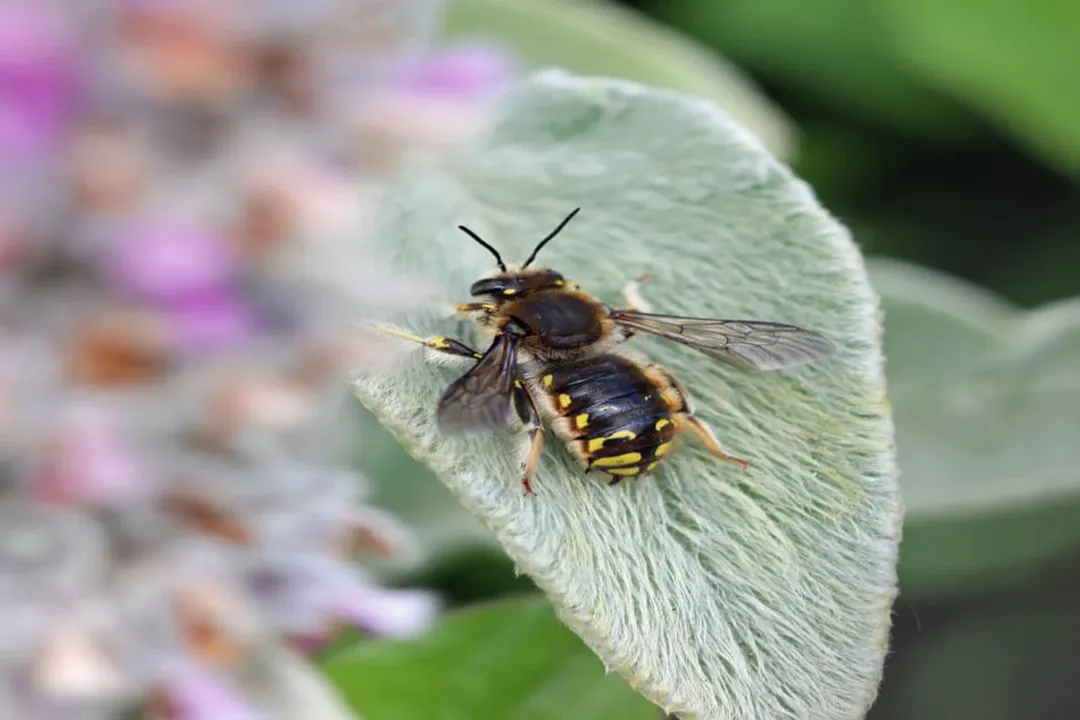
The origins of the Wool Carder Bee lie in Europe, North Africa, and temperate Asia. [1] This vast area represents its long-established home ground where its population dynamics are part of the natural, indigenous pollinator community. Within this native zone, the bee has adapted over millennia to local flora and climate.
Across Europe, the species is widespread. For instance, in the United Kingdom, it is established, with records showing it is particularly prevalent across much of England, concentrating heavily in the southern half of the country. [7] However, documentation also shows records extending further north within Britain, indicating adaptability to cooler conditions than might be initially assumed for a Southern European native. [7] The key understanding here is that within its native distribution, the bee is a natural component of the ecosystem, playing its established ecological role. [6]
# Arrival USA

The geographic story takes a sharp turn when considering its presence in North America. Here, Anthidium manicatum is classified as an introduced and often invasive species. [1] Its establishment in the United States is a relatively recent event, with scientific records pinpointing its first official detection in New York State in 1994. [4] This date serves as a clear marker for when ecological monitoring needed to begin focusing on its spread across the continent.
Since that initial detection, the bee has successfully established populations across the US landscape. It is not limited to a single region of introduction but has managed to disperse widely. Reports confirm its establishment along the East Coast, into the Midwest, and even reaching the West Coast, showing a broad tolerance for varied American climates. [1][4]
# Continental Spread
Mapping the current distribution reveals a significant contrast between its Old World and New World presence. In North America, specific states have reported sightings, confirming its establishment beyond just the initial eastern points of entry. For example, reports document its presence in Michigan, where it is frequently noted in flower gardens, [2] and in California, suggesting it has crossed the continent. [3]
The way we track and report its presence highlights a difference in research focus. In its native range, a sighting in a southern English garden, for instance, is simply a confirmation of an existing resident population, perhaps noted by local nature recording schemes. [7] Conversely, in North America, every new county or state record contributes to the understanding of an invasive front—tracking the rate and direction of an exotic species’ expansion. [4] A subtle but important analytical observation arises when comparing monitoring efforts: while we know where the bee is in North America due to targeted tracking efforts following its invasive status, the absence of records in certain central states might simply reflect fewer dedicated surveys rather than an absolute barrier to its dispersal. In contrast, its presence across much of Europe is generally assumed unless specific detailed surveys show a retreat. [1][7]
When considering its presence across these two continents, one can organize the known locations by environment type, as the bee strongly associates with areas where human activity supports its needs:
| Region Type | Primary Range Context | Notable State/Country Examples | Citation Context |
|---|---|---|---|
| Native | Widespread across the continent | Southern England, Temperate Asia | Established endemic resident [1][7] |
| Introduced | Areas with recent detection | New York (first detection 1994), Michigan | Invasive species tracking [2][4] |
| Introduced | Western US establishment | California | Confirmed West Coast presence [3] |
# Local Habitat
Regardless of whether it is native or introduced, the Wool Carder Bee requires a specific set of local resources to thrive, which dictates its micro-locations within broader geographical areas. They are commonly observed in areas rich with flowering plants, such as gardens and waste ground. [5][6] The presence of preferred nectar sources is a basic requirement for any foraging bee.
However, the definitive clue to its local presence lies in its unique nesting habits. The female A. manicatum needs specific plant material to construct the cells in her nest. This material is the soft, hairy (or "woolly") fiber scraped from plants, a behavior that gives the bee its common name. [4] In many regions, particularly where it is invasive, the plant species Stachys, commonly known as lamb's ears, is a favored source for this nesting fuzz. [4]
This reliance on a particular type of plant material, combined with its nesting strategy, is crucial for predicting local density. If a garden is overflowing with lamb's ears, it provides a strong attractant for female carder bees looking to nest nearby. [4]
# Nesting Needs
Understanding the nesting requirements adds another layer to predicting where these bees will settle. Unlike honeybees or bumblebees that create large, perennial colonies, the Wool Carder Bee is solitary. [3] Females excavate and provision their own individual nests.
Crucially, they do not excavate new tunnels but rather repurpose existing cavities. [3] This means they seek out pre-existing holes, such as abandoned beetle burrows in dead wood or hollow plant stems. [3] This dual requirement—a source of woolly fiber nearby and an existing cavity—means that a seemingly perfect meadow might be overlooked if the available nesting substrate is absent or unsuitable (e.g., heavily managed, freshly cut wood).
Considering this combination of needs leads to a practical observation for land managers or dedicated gardeners: simply removing the preferred plant source, like lamb's ears, might not be enough to discourage the bee if the environment offers ample alternative nesting sites like untreated fence posts, old brickwork with voids, or thickets of dead, hollow reeds. The bee's persistence in an area becomes a measure of both floral availability and structural habitat availability, not just the presence of its woolly food source. [3][4]
The males, too, play a role in location fidelity. They are highly territorial, often perching conspicuously on a prominent object—a flower head, a blade of grass, or even a post—to guard resources and mate with approaching females. [3] If you see a male hovering aggressively near a patch of desirable flowers, you can be relatively certain that nesting activity is occurring very close by, as they are defending the immediate vicinity of their female counterparts. [3]
In summary, the location of the Wool Carder Bee spans from its established European and Asian home to its actively spreading North American range, detected from the Atlantic to the Pacific. [1][7] Wherever you find it, its presence is tied not just to climate, but to the availability of soft, fibrous plant material and the existence of small, pre-formed tunnels for solitary reproduction. [3][4] Being aware of this specific, dual habitat requirement allows for more informed observation, whether you are documenting a native species in one part of the world or managing an introduced one in another. [2][8]
Related Questions
#Citations
Anthidium manicatum - Wikipedia
Michigan insects in the garden – Season 2 Week 6: Wool carder bees
[PDF] Wool Carder Bee
[PDF] Wool Carder Bee - Western Colorado Insects
Woolcarder Bees - NATIVE BEES
Anthidium manicatum | BWARS
European Wool-carder Bee - Anthidium manicatum - NatureSpot
Wool Carder Bee - Beevive