Are wool carder bees rare?

The European wool carder bee, Anthidium manicatum, is a subject of frequent inquiry, and the answer to whether it is rare depends entirely on the location of the observer. In many parts of its established range in North America, particularly in the southern and western regions, it is quite noticeable and far from uncommon. However, these bees are not native to the United States or many other regions where they now thrive; they are an introduced species, which naturally puts them under a different kind of scrutiny than truly native or endangered insects. Their presence is often tied to the availability of specific host plants, meaning if you have the right fuzzy foliage in your yard, you are likely to encounter this large, distinctively marked pollinator.
# Established Distribution
The wool carder bee arrived in North America accidentally, believed to have entered the country from Europe in the early 1960s, with the earliest confirmed sighting recorded in New York State. Since that initial detection, A. manicatum has successfully colonized much of the continent, rapidly spreading outward. Reports confirmed its presence on the West Coast, with collections noted in California by 2007, and it has since been documented in areas like Oregon and Colorado. Similarly, it was found in Michigan around 2001 and is now widespread across much of the Lower Peninsula. Its successful colonization across such a wide geographical area, including Europe, North Africa, Asia, South America, the Canary Islands, and New Zealand, suggests that where conditions permit, this species establishes itself effectively.
The question of its rarity is best answered by contrasting it with its native relatives. While there are native species of Anthidium found in North America, none possess the same large stature as the introduced male wool carder bee. Furthermore, the introduced species often favor the non-native ornamental plants commonly found in human-cultivated landscapes, such as Lamb’s Ears, which makes them more visible to gardeners compared to native species that prefer indigenous flora. Therefore, if you are in an area where it has naturalized, it is not rare; rather, it is a common, albeit exotic, garden visitor.
# Distinct Appearance
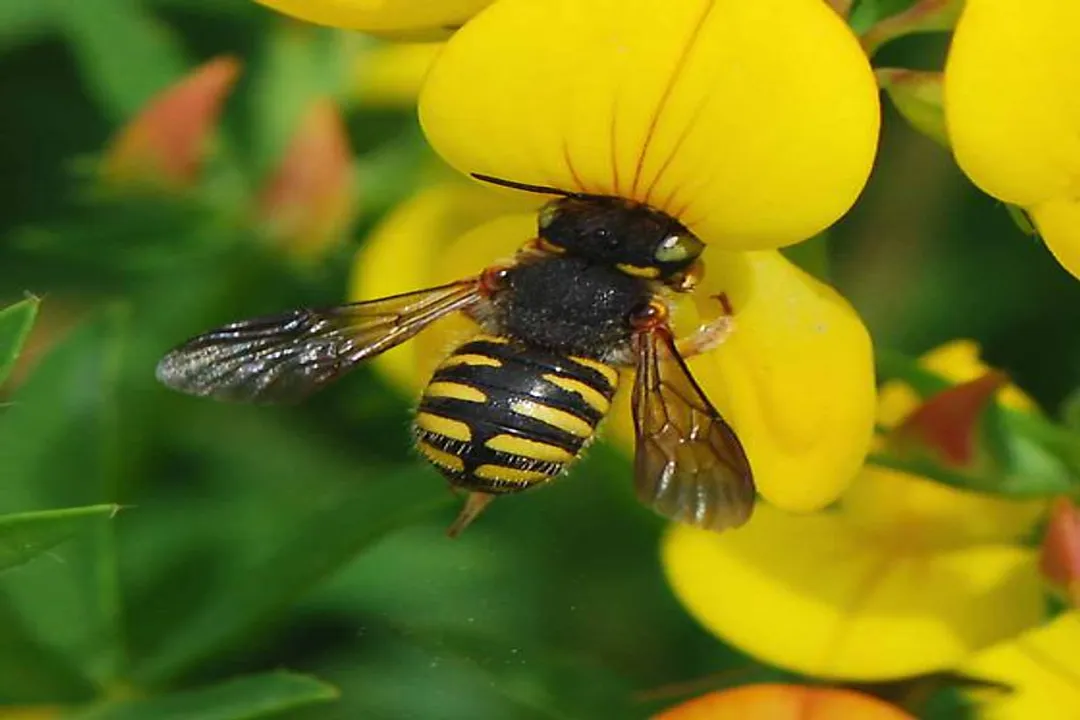
Distinguishing the European wool carder bee from other common insects is relatively easy once you know what to look for, contributing to the reports of its prevalence. They are robust, solitary bees belonging to the Megachilidae family, which also includes leaf-cutter bees. While many bees are quite hairy, the wool carder bee appears comparatively shiny and slick. A key identifier is the pattern across its abdomen: bright yellow spots set against a black background.
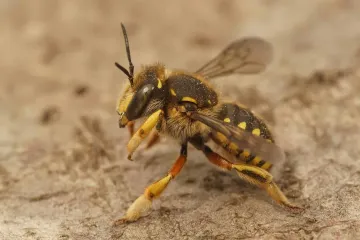
The sexes display a noticeable size difference, which is critical for identification. Males are generally larger than the females. Male wool carder bees are also known for having striking, bright yellow markings on their faces and possessing several spiny projections near the rear of their abdomen, which are used in territorial defense. Females are smaller, possess a hairier face, and lack the prominent abdominal spines of the male, though they do have stingers—unlike the males.
# Carding Fuzz
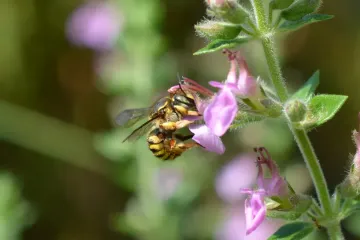
The name "wool carder bee" comes directly from the unique nesting behavior of the female. While they collect nectar and pollen from flowers, they have a very specific requirement for nest construction. The female seeks out plants with soft, fuzzy leaves to collect the fine hairs, or "wool," which she scrapes off using her jaws—a process called "carding". This collected fiber is then used to line and partition the individual cells within the nest.
The preferred plants for this material are those with downy foliage, with Lamb’s Ears (Stachys byzantina or Stachys lantana) being the most commonly cited source, though they will also utilize plants like mullein or even wool socks if available. Females build their nests in existing cavities, such as cracks in wood, walls, or old tunnels, and produce only one generation per season. They provision each cell with a pollen and nectar ball before laying a single egg. Observing this behavior is part of the enjoyment for many naturalists, as the female can sometimes be heard scratching the leaf surface.
# Territorial Displays
The most famous aspect of the wool carder bee is the aggressive, almost theatrical, behavior of the male. Once mature, the male establishes a territory centered around flower patches that he anticipates females will visit, either for nectar or for collecting nest fibers. These territorial males become highly active, often hovering rapidly in their chosen patch, resembling a dragonfly or hoverfly in their flight patterns.
The male’s primary activity is driving off any other insect that enters his zone, including other males, flies, butterflies, and even much larger bees like bumble bees or honey bees. This is not necessarily about defending food for himself, but about securing mating rights. This system is sometimes referred to as "convenience polyandry," where the female trades mating with the patrolling male for access to the valuable foraging resource he is defending. Male wool carder bees do not possess stingers; instead, they use the sharp spurs on their abdomen to bump or injure intruders. While they have been observed injuring or killing honey bees, experts generally conclude that this behavior is unlikely to have a significant, widespread impact on large populations of honey bees, as the honey bee is also an introduced species in North America. This aggressive guarding is a spectacle that many observers find both alarming and entertaining.
# Gardener’s Perspective
The reaction to the European wool carder bee is split, often depending on the local context of other pollinator populations. In areas where native bee diversity is high and the carder bee is new, some observers report significant negative impacts, suggesting they outcompete native bees or viewing the aggressive males as killers. Conversely, in many US gardens, the impact is characterized as minimal, with the male being labeled a "bully" who simply protects a flower patch where females can feed. They seem to show a preference for non-native flowering plants such as Teucrium, certain Sedum varieties, and catmint, often leaving native plants unbothered. This plant preference provides a potential management avenue for native bee enthusiasts. For instance, if a specific patch of Lamb’s Ears is constantly patrolled by a male, removing that plant may cause the male to relocate his territory to a less utilized spot, effectively opening up other flowers for native visitors.
It is worth noting that the introduction of this species has happened alongside the proliferation of ornamental gardening that favors non-native plants. In areas like southeast Michigan, more urbanized gardens with a mix of exotic ornamentals often host a higher percentage of non-native bees. This suggests that the presence of the wool carder bee in your garden is not a sign of some rare sighting, but rather an indicator that your planting choices align well with this successful European colonist. Furthermore, monitoring for related exotic species is also wise; in Michigan, for example, a second non-native species, Anthidium oblongatum, has been found, distinguishable by an orange spot where the wing meets the body (the tegula).
# Activity Patterns
Understanding the daily rhythm of the wool carder bee can help both in observation and management. These bees rely on warmth to become active. They are notoriously sluggish on chilly mornings and often require sunshine to warm up before they begin foraging or patrolling. For anyone hoping to get clear photographs or observe their unique behaviors without the males being at their most belligerent, late morning, once the sun has fully warmed the area, or perhaps early evening before they settle down to collect nesting wool, are good times to watch. The males’ hyper-aggressive territorial defense tends to ramp up as the day warms, while females are more focused on collecting fibers in the early evening. If you see a large, black-and-yellow bee hovering with quick, darting movements near fuzzy leaves, you are almost certainly looking at a male A. manicatum, regardless of whether you consider him rare or common in your locale.
In sum, the European wool carder bee is not rare in the sense of being scarce or endangered; it is an established, widespread exotic species across much of the temperate world, including North America. Its conspicuous size, loud presence, and distinctive, aggressive male behavior ensure it is often seen where it has successfully established a foothold alongside its preferred fuzzy-leaved host plants.
Related Questions
#Citations
Wool Carder Bee - USDA Forest Service
[PDF] Wool Carder Bee
European Wool Carder Bees: Likable Bullies
Wool-Carder Bees | Good Natured - Hickory Knolls Discovery Center
Michigan insects in the garden – Season 2 Week 6: Wool carder bees
[PDF] Wool Carder Bee - Western Colorado Insects
The Wool Carder Bee - Habitat Aid
European Wool Carder Bee - Bees with eeb
European wool carder bee | College of Agricultural Sciences